12 February 2007

I remember the first time I saw the movie Amélie. It was New Year’s eve before any of us had our driver’s licenses, and my friend Rachel’s dad drove us to the Grand Cinema to see a movie.


I’m not sure why we picked Amélie, but aside from a few moments of discomfort – the kind that stems naturally from being 16 and hearing the word “orgasm” while sitting next to a friend’s father who also happens to be a pastor, we loved it.

I’m not sure I know anyone who has seen the movie and didn’t enjoy it, actually. We loved it because we were 15 and it painted such a magical picture of Paris. Freshman year living in the dorms at UW we had an “Amélie Night” in the third floor lounge to share the movie with those hapless Honors students who had somehow escaped falling in love with Amélie thus far.

It’ll always be one of my favorite movies, but these days the name Amélie Poulain carries a bit more weight for me. Tacomans and Seattlites watched it for Paris and its mystery and romanticism. Parisians watched it because it was their movie. Audrey Tatou is their sweetheart, and being set in the heart of Montmartre – filmed in cafés and markets that really exist, Amélie was born in the heart of Paris.

Café les deux moulins:
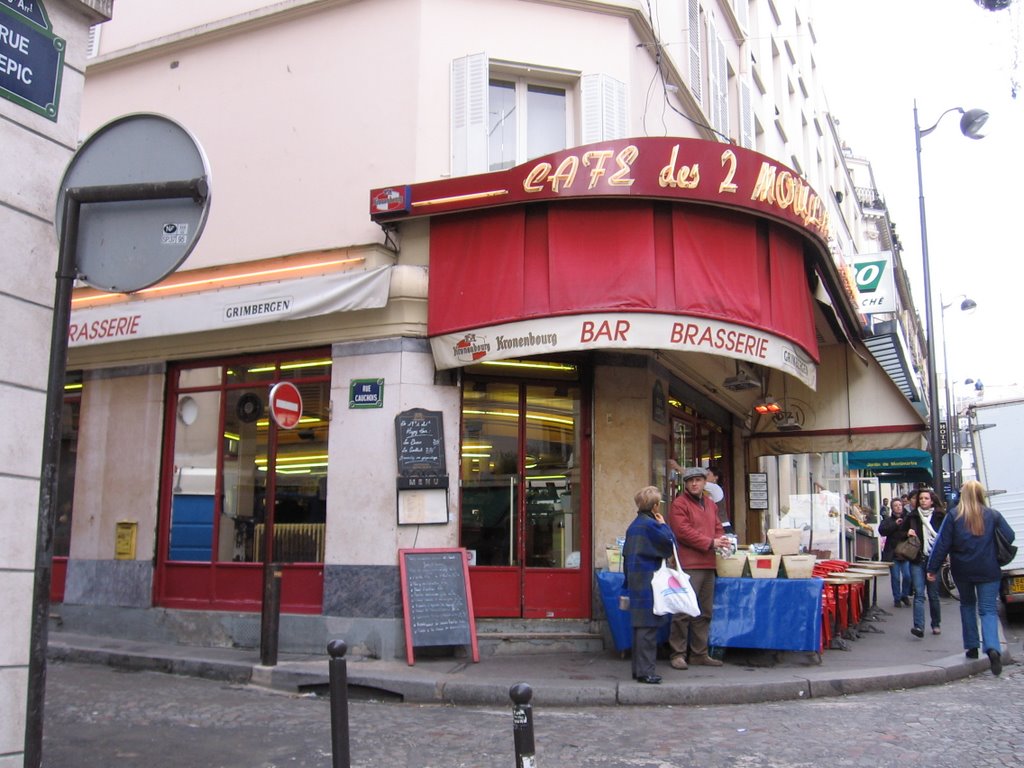

In the six years since the world became privy to the Fabuleux destin d’Amélie Poulain, Audrey Tatou’s Amélie has become something of a Parisian symbol. C’est la Paris d’Amélie, it’s Amélie’s Paris, has become something of a catch phrase, inducted into life by students, professors, journalists and all other denizens of Paris. The funny thing about this categorization, is its connotation – which depends completely on the context and the person saying it.

Montmartre is rather idyllic:


If you hear someone refer to Amélie’s Paris, it’s just about as likely to be pejorative as it is affectionate. If you’ve seen the movie Amélie, it’s going to be easy to conjure up an imaginative mental picture of Paris – a bright and lively world, where the streets are clean, Parisians know the names of their grocers and waitresses. It's a place where you’re not going to catch a crippling disease sleeping in a metro station, where a goldfish “liberated” into a river is going to survive the pollutants for longer than a few days, where love is waiting to sweep you off on the back of his scooter.

Amélie's Paris:
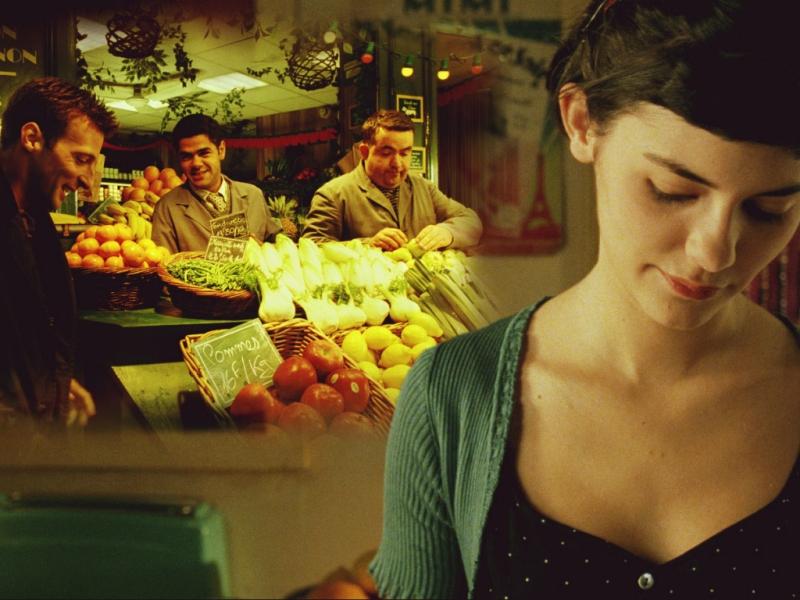

It’s a nice place to imagine – it really is, and in some ways it does exist. In a way, Amélie’s Paris is the heart of this city – a chic, colorful, comfortable, fascinating, magical endroit. A place where there’s possibility in every day – and, as trite as this expression has become, you never know where the day will lead you. In that sense, the Paris of Amélie Poulain is quintessential Paris, a fabulous girl that holds a special place in the heart of the most cynical of Parisians.

What can’t be forgotten is that while Amélie’s Paris really is that endearing magical place for some people (i.e. bobo (yuppies who don't want to believe they are yuppies) to affluent exchange students here on a ticket from an elite institution of political science), it is the absolute contrary for so many who live here. An article we read about immigration and discrimination in France for one of my classes during the stage d’integration defined Amélie’s Paris as a Paris with ni noir, ni arabe (basically a white Paris without blacks and Arabs). The sole Arab in the film, Lucien is a handicapped employee of the grocer, played by a Moroccan beur actor (a beur is a second-generation North African – the term used to be derogatory, but it’s lost its original meaning in becoming part of mainstream speech) who was born in Paris.

Lucien was an intentional placement by the director as a symbol of the Arab in France, but his solitary presence still adds weight to the implications of Amélie’s Paris. For those who have a lesser affection for the Paris of Amélie Poulain, it is more a symbol of everything that is wrong with the country than everything that is essential to Paris.

Real Paris:


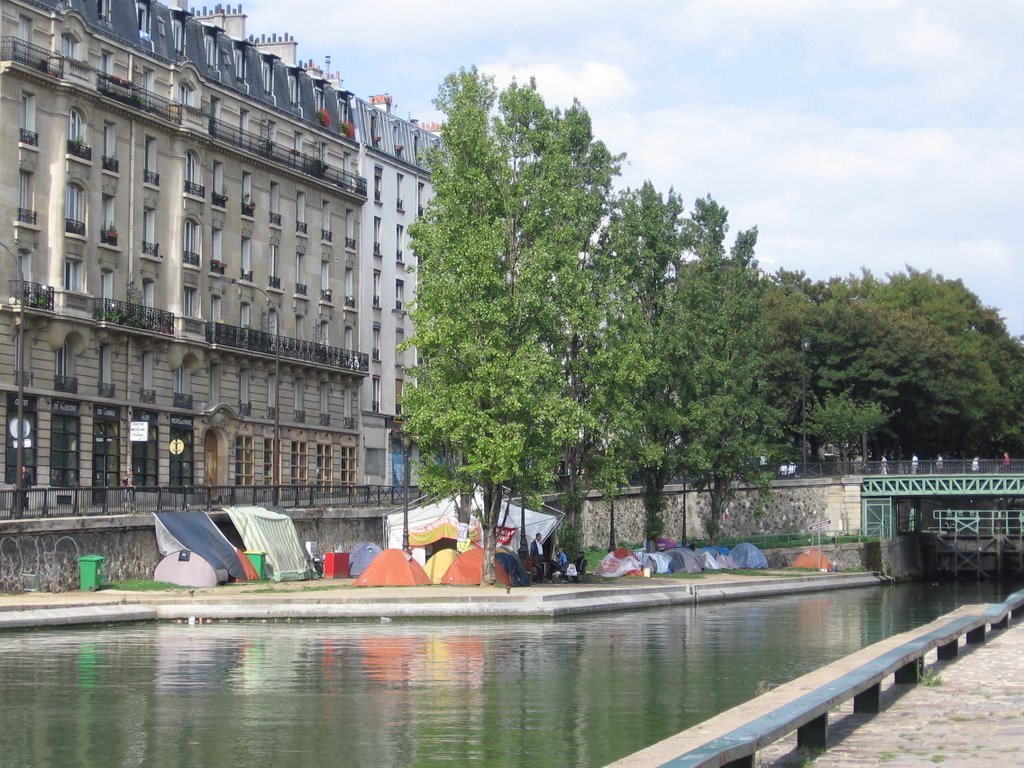
The film shows nothing of the banlieues, the tent cities that line the Canal Saint-Denis, the street protests and the problems facing the countries immigrants and minorities. There are many who feel that the country is run by a stuffy elite, all formed from the same mold who often fall into the trap of thinking that Paris is a true representation of France. There’s a pretty widespread sentiment that that very quintessential Paris inhabited by Amélie represents this stale situation and everything that desperately needs to be changed. To this end, to live in Amélie’s Paris is to be idealistic and naïve, to sweep the country’s problems under the rug – no matter how attractive and whimsical that rug may be.

For me, an outsider just listening and observing, I love living in the marvelous Paris of Amélie Poulain. I love walking through Montmartre in a skirt, buying baguettes at my local boulangerie, going to the open-air Saturday market, making eyes at cute boys on Vespas – all to the soundtrack of old-school Parisian street-corner accordian music that plays in my head.

This is fun and lovely while it lasts, this strolling and thinking how much I love living in this most magical of cities. But then I take a turn up Quai de Valmy, and spend 20 minutes walking by tent after tent after tarp after tent, spray-painted with messages like, Je vis sans toi (I live without any help from you) and a sloppily-scrawled survivant (survivor) across a small red tent close to collapsing under the wind. This is all it takes to jerk me back to that other Parisian reality – the one that exists in a combination of Amélie’s magic and all of the problems that are unceasingly present.

Real Paris:
07 February 2007

I’ve been terrified of my European Union final since the first lecture of the semester. After sitting through one Cours Magistral, I realized that it was completely pointless for me to be in the lecture – not only was the class held for two hours at 8 in the morning, I could not, for the life of me, understand the French of Professor DeWost. Going to my conférence only confirmed my assessment – none of the other international students got anything out of the lectures either. The man just mumbles, and there’s nothing to be done about it, aside from filling out less than favorable course evaluations.


Fortunately, the teacher of my conférence was very knowledgeable and a clear speaker, so I figured I’d get more out of paying good attention during her section classes on Monday afternoons. All was well until we found out that at Sciences Po, completely unlike the system at UW, you receive two separate grades for each course – one full, five-credit note for the conférence and one full, five-credit note for the lecture.

This is when I began to get even more apprehensive – I’d been going on the assumption that even if I blew the final, I’d have my exposés, débats, fiches and participation credits to balance out my lack of familiarity with the French system of oral examination. Apparently not. Instead, the final that I took for L’union européenne et droit communautaire would yield a full grade – and since that grade was based on a mere 20 minutes of assessment, I could very easily fail a five-credit course.

Fears grew even sharper among the international students when we learned the full format of the exam. Apparently we were each to receive an appointment time for an individual exam. Upon arriving at the site, we’d be called into a room to receive our topic and 20 minutes of tense preparation. After that, we’d go into another room to present a 10 minute exposé – yes those oral presentations that I’ve been preparing and giving all semester (but with days and days of prep time).

Everyone in my conférence emailed each other their notes for the entire semester, but still I had no idea what to study. The only advice I’d received was the not very reassuring (and kind of insulting), “Make sure to tell them your American (or from the programme international) so they know to expect less from you.” I read through the European Union’s website to remind myself of the functioning of the Parliament, the Council and the Commission; the ratification dates and objectives of each treaty and the demographics of the EU. I read the BBC’s European news coverage from the past week, but other than that, I didn’t know what to do. So instead of studying efficiently, I sat around and worked on giving myself a hernia.

To add to everyone’s stress about this test, the fact that individual exams had to be scheduled for each of the 300-some students in the lecture meant that for weeks after Sciences Po had posted the final exam schedule online, we were still waiting to find out when our appointments would be. We finally received an email from the sécretariat, with an attachment that would supposedly give us our assigned times. Instead it was an Excel chart with the names and email addresses of all the international students in the course. After many frantic mass emails were sent out, someone from the class finally emailed the sécretariat back, and on Monday we finally received our appointments. Mine was today, February 7th at 14h40.
When I arrived at the ENA building, I found out from the line of classmates waiting in chairs outside of the preparation room that exams were running late. Like everyone else, I pulled out my class notes, but instead of reading them I stared blankly at the opposite wall, feeling my legs and hands twitch rhythmically.

I was finally called into the salle de préparation at about 15h10. I presented my student card to the woman overseeing the preparation time, signed my name on a contract stating that it was really me taking my exam, and she offered me two manila envelopes. From each envelope I was to select a strip of paper with an exposé topic on it, choose the one that interested me and return the other. My two options were l’élargissement et approfondissement de l’union européenne (the enlargement and deepening of the European Union) and le processus juridique entre l’union européenne et les états-membres (the legal processes between the European Union and its members).

I grabbed the slip about l’élargissement and ran to a desk as I was already down three minutes of prep time. Since this was supposed to be a formal presentation, not an interactive examination, I needed some kind of coherent structure, not to mention a problématique and a thesis, so I sketched out a sloppy outline and begin writing down everything I could remember from the week we’d discussed the EU’s enlargement and any other useful information I could come up with.


After twenty minutes of frantic scribbling, I was escorted into the actual examination chamber. I shook hands with the examiner, signed another contract and began to argue my thesis, that enlargement, rather than being a detriment and complication to the EU was a necessary project to not only unify Europe, but inspire a greater confidence in the power of the EU by not only its citizens, but outside countries as well.

While I’m not sure my actual presentation made any sort of sense organizationally, I had a thesis that, if not always being completely logically supported, was strong and I finished with a solid conclusion. I also pulled out some of my old International Studies written exam techniques and threw as many hard facts into the presentation as I possibly could – so that even if my on-the-spot French and exposé were at times shaky, the examiner would at least know that I’d attended class and knew what I was talking about. I hit a rough spot when I stumbled before remembering that the newest additions were Romania and Bulgaria, but hopefully made up for it by discussing the Bolkestein Directive and quoting Jacques Delors and Winston Churchill (when he called for a “United States of Europe”). I even found a way to work in the article I’d read just before my final, about the busting of a child pornography ring in Austria.

My examiner followed up with a few questions about the relationships between the Commission, Council and Parliament, and whether the judicial system of the EU could be compared to that of the U.S., which I answered adequately, if not brilliantly. My final question was something along the lines of “what do I want to be when I grow up,” so we spoke for a few minutes about journalism and whether or not there would be any demand for an American foreign correspondent whose specialty was French politics. We came to the conclusion that, as horrid and convoluted as it is for us non-Europeans to learn, my best bet is to stick with my studies of the European Union.

As I left the exam, my legs were shaking so badly I could barely walk up the stairs, but I managed to tell a German friend from my class that he’d be fine. When my muscles finally began to relax, I treated myself to a pastry from my boulangerie (whichever neighborhood boulangerie you shop at the most automatically becomes “yours” when you’re describing it to anyone else) and couldn’t think anything but “I survived!” Now all I have to do is make it through one more marathon night of studying for my three-hour essay test on contemporary French politics tomorrow morning.

04 February 2007

Something I’ve noticed a lot, living in Europe, is the fact that as a people, we Americans are really quite conservative. After five months in France, I’d like to think that I’m mostly used to the freedom of sexual expression that is so different from the taboos and behavioral expectations back in the United States – but every once in a while I’m still caught off guard.

The first thing you notice in France is the pub, or advertising that is often blatantly sexual and is pretty much everywhere. From naked women on billboards, to a TV spot for instant coffee that borders on soft core pornography to the infamous egg billboard, sex is everywhere you look, with a hand in nearly everything you buy. You can turn on the TV at 16h and see naked people (which you definitely can not in the U.S.), sex in movies is more frequent and less of a deal, and posters advertising porn websites or hotlines fill the windows of most tabacs and presses.


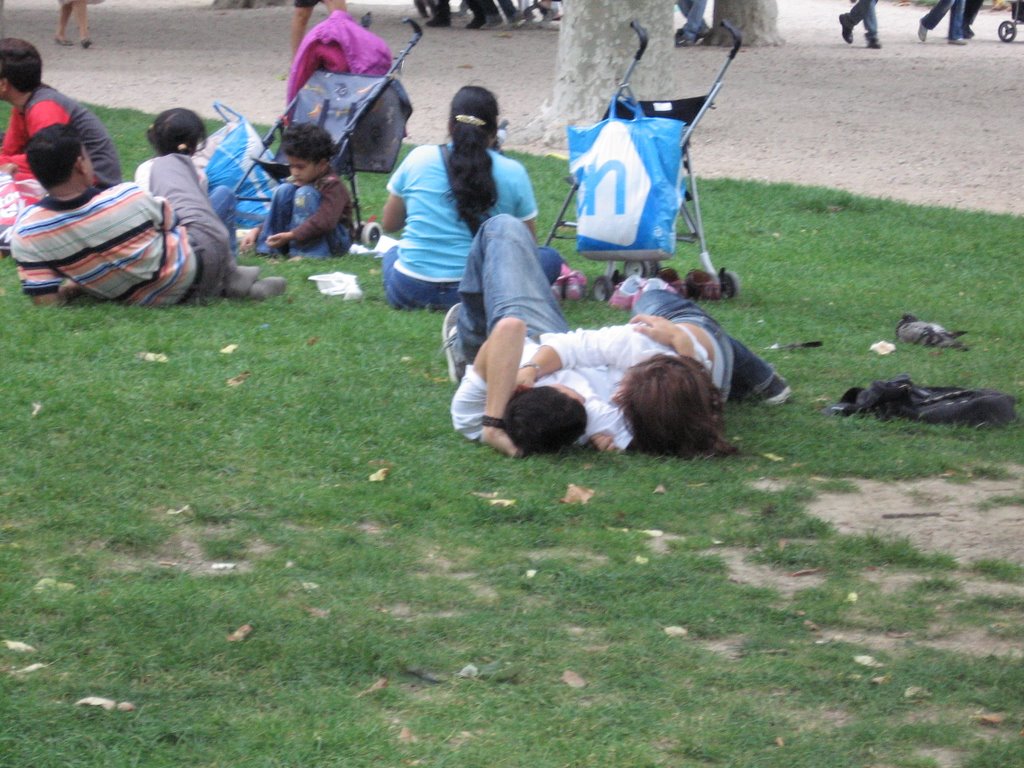
Sex in France isn’t limited to the media – stroll across any bridge crossing the Seine, or wander through any park in the city and you’ll probably see enough action that you can save your money on those adult websites. It isn’t uncommon to see a couple making out horizontally in the grass, or feeling each other up as they lean against the wall of the Pont Neuf or Pont des Arts.

(Like this couple, who seemed close to undressing each other, surrounded by families having picnics in the Champs de mars below the Eiffel Tower).


It’s surprising for me, a girl from a pretty liberal area of the United States, to witness all these public displays of affection, sexy billboards and intense TV ads, but for the French who see them day in and day out, the presence of sex in mainstream society is old hat. Sexuality is so integrated into everyday life here that Printemps, a major department store like Galaries Lafayette, Nordstrom, Sak’s or Macy’s features a plaisir section.

Even for someone who may not be versed in the French vocabulary for lovemaking, plaisir is pretty easy to figure out. Last Wednesday I was wandering through the sous-sol (basement) level of Printemps, checking out the soldes, when my attention was caught by a long counter with a sign reading simply Plaisir. I couldn’t see any of the items on the counter, as it was surrounded by a low wall to keep anything from falling off, so I walked over to check it out.

Apparently, the pleasure section is exactly what you’d imagine. There, sandwiched between the Christian Dior and Christian Lacroix lingerie departments was the sex toy section of Printemps. In addition to dildos, lubes, vibrators and furry handcuffs, the display also contained a book section. The Kama Sutra (in French) a “position playbook” (in English) and a French book about achieving female orgasms were among those featured.

Being an American and completely surprised to find such a section in the middle of a department store in the 9ème arondissement of Paris, my cheeks were burning as I examined the contents of the table. The French women hitting the sales however, were completely unsurprised, and either walked by without a second look, or walked over to the table to unashamedly handle the toys. While I feel like I’ve gotten quite used to the sexed-up culture over here, I was really not expecting to find plaisir during my casual browsing, and couldn’t help but imagine the reaction if Macy’s or JC Penney’s was ever to begin stocking vibrators alongside their make-up, shoes and towels.


The progressive attitude here isn’t limited to the explicitly sexual. For every erotic TV ad, there’ll be another billboard that features nude people but is completely un-erotic. For the French, it’s okay to be a sexual person – but it’s also okay to appreciate the human body for what it is, without a display of nudity having to be overtly sexual. Kids learn about their bodies at an early age, and there is no shame associated with nudity or sexuality – which seems to be the complete opposite of trends in the United States.

Check out this book on the human body for young children, for example. The nanny family owns two copies, one in French and one in English (so the kids learn the appropriate vocabulary in both languages). Notice anything bizarre? In the French version, you actually see the entire body, and learn the real word for each body part – including la sexe. In the version published for U.S. consumers, however, every single child wears a pair of white underpants – even the babies are covered up, and while there are arrows pointing to the stomach, the belly button, and the waist, there’s a big gap in the middle of the body before jumping down to the legs and the knees. Disturbing the difference, isn’t it?


The result of the openness here is that everybody is incredibly comfortable with themselves and sex in general. While everybody may have an inkling about Jacques Chirac’s sexual indiscretions, nobody cares – it’s his decision and his business and his sexuality has nothing to do with his ability (or perhaps lack thereof, based on more recent public opinion) to govern the country. If the U.S. adopted an attitude that was anything similar to that of France, Bill Clinton and Monica Lewinsky would have been the last thing on anyone’s mind – and nobody would even know who Kenneth Starr was. The infamous Janet Jackson boob slip at the Superbowl would have been so insignificant that it would have been forgotten the next day. Looking back at the States with my new French goggles, we seem pretty ridiculous. Who protests a breast? It seems like a joke, but I guess we are the joke.

It’s rather invigorating to be living in a country that is so open about its sexuality. The whole atmosphere just seems so healthy – nobody’s growing up with shame or confusion about their bodies or feelings. It’s so much easier for people (particularly teenagers) to make decisions about their bodies and their sexuality when they have a plethora of information that nobody’s trying to stifle. Twenty years of growing up in a country with institutions like the FCC has apparently rendered me a bit more conservative than I’d like to admit. While I really admire the freedom of sexuality here, I still tend to blush when I find things that surprise me, which embarrasses me to no end. I don’t want to be the American who blushes at sexy commercials! Maybe after a full year of expatriotism, I’ll have trained a slightly cooler response – or at least have figured out how to keep the blushing to a minimum.


•••• This has nothing to do with sex, sexuality, nudity or conservatism, but the idea of a Che Guevara bellybutton ring really cracked me up. What better way to honor a symbol of revolution than to put him on a charm and stick him through your bellybutton?

29 January 2007

As I often lament, for all my obsessive printing out of entire fashion week schedules, “casual” walk-bys of the Ritz, the Georges V hotel, and strolls up and down the rue Saint Honoré (a celebrity-sighting hotspot for all the high-end shopping), I am really not very good at celebrity stalking.

Every fashion week, I study and print out the fashion week schedules, and wander around the outside of the École des beaux arts near Sciences Po or the Grand Hôtel near place de la Madeleine, hoping to spot, if not celebrities, than some really tall chic models. R and I compulsively check Pink is the New Blog to find out which celebrities might currently be wandering around Paris, and lurk around the nicest hotels and most expensive designer boutiques.

Last weekend it was Beyoncé, Jennifer Hudson and Eddie Murphy, here for the French premiere of the movie Dreamgirls. Last week it was Victoria Beckham, Katie Holmes and Anna Wintour, here for the haute couture shows.

For an International Studies major and admitted nerd, I am hyper-aware of Fashion Week. Errr, make that fashion. I refuse to buy Diet Coke in Paris because it’s too expensive (1 euro 30 for a bottle!), but I’ll gladly shell out eight euro for an imported last month’s American Vogue – and then buy the British and French issues as well.

My favorite thing to do on a Sunday evening is walk along the rue Saint Honoré, from the avenue de l’Opéra to the beginning of the embassies, not exactly window shopping (when am I ever going to be able to afford a John Galliano slip dress?), but window gazing. I hit up Chanel, Miu Miu, John Galliano, Dior and everything in between to soak up the window displays. During Fashion Week, I make the same rounds, but instead of checking out the mannequins, I’m peering beyond them to see if there’s anyone famous in the store.

During Fashion Week, instead of walking straight down avenue de l’Opéra and through the courtyard of the Louvre, I walk down rue de la Paix and through place Vendôme, home of the Ritz hotel – to absolutely fruitless results. So far, my celebrity log includes one moderately well-known French tv actress I’d never heard of, a random footballer from FC Barcelona, who I’d never heard of, and a mad paparazzi rush to stalk some American actress (I couldn’t see who) in Le Voltaire, a restaurant across the Seine from the Louvre.

Yesterday I finally began to understand where I was going wrong. Apparently my stalking efforts were entirely misplaced, because the first thing Zoé said when she got home last night was “I saw that guy with the big nose again.”

I was doing the kids’ dinner dishes and kind of laughed and asked what she was talking about, thinking something along the lines of “Haha, 12-year olds…”

“You know, that actor with the big nose – he’s French, he’s in a lot of movies?” This is where I finally paused in my dishes to look at her. “You mean Gérard Depardieu?”

Yes, she meant Gérard Depardieu – one of the few French actors who has mostly made the crossover to mainstream American pop culture. His one disadvantage is not being a gorgeous woman – if he happened to resemble Audrey Tatou or Juliette Binoche, he might be even more familiar.

Apparently, Gérard owns the restaurant right around the corner from my building, Le Petit Gaillon. Apparently he’s always wandering around right in my neighborhood, checking on his restaurant – the restaurant that is directly across from the boulangerie where I buy my bread every few days. Apparently, I am a terribly inobservant person. How many times might I have passed by him already, too focused on the taste of my still-warm baguette to look around me?

This is kind of ridiculously embarrassing. I really am the world’s most inefficient stalker, wasting my time patrolling rue Saint Honoré, place Vendôme and rue Georges V. Not to mention the fact that a Gérard Depardieu sighting would be a much grander coup than a sighting of Posh Spice or the like.


••• Pictures of Le Petit Gaillon to come, check back!

27 January 2007

Getting dressed this morning, I chose my outfit carefully. I don’t have huge plans for the day – just babysitting, doing a little apartment cleaning and then meeting some people at a bar in the 11ème for drinks and couscous. While the bar is chill and nobody really dresses up to go there (well any more than French people usually dress up just to live their lives), it is still a Parisian bar – which means you’re likely to be sitting in a cloud of stale smoke for upwards of an hour or two, which in turn means choosing your clothing wisely.

Even when the temperatures are measuring below freezing, I won’t put on a sweater – sweaters are a pain to wash and the wool sucks up the smoke like a vacuum. Some places aren’t so bad – clubs, for example, are still smoky but most have fairly high ceilings so it’s not a big problem. Chez Georges is one of the worst places for smoke – you won’t stop reeking until you’ve showered at least twice and you probably won’t stop coughing for at least 24 hours. It’s also one of the most happening bars for students, so sometimes you just have to suck it up, make sure your inhaler’s in your purse and be prepared to wash all your clothing the next day.

Tonight though, we’re going to Tais. Tais isn’t so bad – I’ll need to hang up everything I’m wearing and let it air out for about a day, but it’s pretty inoffensive as far as smoky bars go.

That’s just Paris though. Everywhere you go you expect to be surrounded in a cloud of smoke – or at least you did five years ago. As difficult as it is for a girl from the clean air of Seattle and its notorious but appreciated smoking ban, even I have to admit that the second-hand smoke problem is far better than it was either of the two previous times I’d been to France.

Smoking kills. Also a common warning label is the Smokers die prematurely.


Just in the past few years a small number of non-smoking restaurants have begun to crop up around the city – this is a huge deal for Paris. Some restaurants have been offering non-smoking sections for longer, but a French non-smoking section is usually just a few tables without ashtrays.

I still inhale quite a number of exhaled carcinogens, but the Paris of today is a far cry from the old thought that “all French people smoke.” When I was staying near Bordeaux in 2002, 16-year old friends of my host sister would stroll into Isabelle’s house, roll up a quick cigarette from their bags of tobacco, grab one of the parents’ ashtrays and start puffing away.

A few weeks ago though, I went out with a boy to celebrate the fact that after being a smoker since he was 16 (he’s 20), he hadn’t had a cigarette in a month, and was really excited about quitting.

Some of the other tenants in my building are pretty obnoxious smokers – sitting on the steps in the courtyard so everyone else is forced to walk through their clouds of smoke to get in and out of the building, or even smoking in the elevator. Given the size of the average elevator in Paris, this is just disgusting, but it’s a long ways from walking down the street and feeling like I need to keep my inhaler out and at the ready.

One particularly interesting development in the smoking culture of the French came in the form of a weekly Sciences Po e-newsletter. Beginning February 1st, all buildings and courtyards of the campus will become completely smoke-free. This is kind of a huge deal – most of the lycées (high schools) have student smoking areas, and of Sciences Po’s two cafeterias on the main campus, one is the “smoking cafeteria.” On any given day, even the sub-zero temperature ones the courtyard between the two main buildings is filled with students grabbing a smoke.

At the beginning of the year, there were actually a few times I thought it might be easier to meet people if I started smoking – it’s very social at Sciences Po. The thoughts only lasted for a few moments – then my asthma brought me back to reality.

I feel like the climate of France is in the process of changing – one of the oldest and truest stereotypes about the French is that “everybody smokes.” But not for long – the times are changing. Maybe in a few years I could even wear a sweater to go out for drinks…errrr, or a few years after that.

20 January 2007

Today I watched a girl climb out of the metro at Étienne Marcel to the soundtrack of the Clash (album: London Calling). She was in my subway car, and I noticed her first for her extremely chic and Parisian coat before I ended up following her out through the turnstile and out of the station.

I was listening to music on my headphones, and thinking only of what I’d make for dinner later as I exited the metro, not paying a great deal of attention to my surroundings. But as this girl reached the top of the staircase, she broke into a huge grin as she spied what she’d been looking for and flew into the arms of her waiting boyfriend.

Surprisingly (to me, anyway), their reunion did not erupt into that infamous spontaneous Parisian make-out session. Instead my girl from the metro recieved an enormous hug that engulfed her, lifted her chic French feet right off the ground and said “I am so glad to see you. The sweetness of the scene put me into quite a good mood. It was kind of like the beginning of the movie Love Actually, with the arrivals gate at Heathrow airport – though this analogy apparently makes me Hugh Grant, which I’m not completely sure I’m comfortable with.

In the city of love and the extreme public display of affection I find it rather funny that instead of the joyful embrace on rue de Turbigo near les Halles, I get the awkward encounters with the boys I really don’t want to be encountering as I make my way through the 7ème arondissement.

I mean honestly. I really feel that Paris is a large enough city, and I am still enough of a foreigner that I really shouldn’t be running into anyone I know, much less three boys I’d either dated or had some sort of history with in the five short months I've been living here. I’ve only been back from the U.S. for two weeks, and while the first was pretty uneventful, I’ve managed to encounter all three of these rather awkward boys in various parts of the city since last Sunday.

First there was the run-in at the Centre Pompidou. Sunday afternoon Rachael and I, thinking we’d accomplish more in a library than in either of our apartments, packed our school bags and waited in a two hour line just to enter the library. (Yes, I know this is ridiculous – but not only is the Pompidou’s library catalogue the most comprehensive in the city, it is also really the only place to do work on a Sunday.) Approximately 10 minutes after finally making into the library, I felt a hand on my shoulder and turned to behold the boy I’d been off and on dating since October – and still hadn’t had the French version of the “I can’t date you anymore” talk with (partly due to my laziness, but mostly because I've been too busy with school to see him, and can't bring myself to do the deed through a French text message).

The second boy I’d only been on one date with before deciding I’d rather just not return his phone calls. Luckily, I spotted him coming from down the street and was able to behave like an immature fool and run in the opposite direction down a little side street. A little disturbing to me, being that I'm 21 and living on my own in France – shouldn't I be beyond the eighth-grade reactions by now?

The third, though, was Thomas. Yes, the one who upon hearing the “I don’t want to date you anymore” speech lectured me for being a “heartbreaker” and told me that he doesn’t just kiss any random girl. This was the first time I’d even seen him since the most awkward evening of my 21-year life, and it was just as uncomfortable as the last time I’d seen him. Luckily I was standing with a group of French friends in the St-Germain Monoprix, so I just blushed and grimaced at him (I promise I tried to smile – it just didn’t work out).

It’s true that everyone has the awkward encounter with an ex stories, but I really feel that three of them in less than a week (in Paris, of all places), is quite excessive. The Thomas encounter unfortunately happened right after the reunion at Étienne Marcel, so as determinedly as I tried to think of the smiles of the metro girl and her boyfriend while climbing the stairs of my building, it was impossible. Instead, I just blushed and cringed, enjoyed the smell of burned out candles from my neighbors’ dinner party, and felt that three awkward moments were surely a fair trade for at least another month of French boy drama-free days.

19 January 2007

Yes, it's been rather windy in Paris the past few days. Though I just thought I was hearing particularly loud gusts because I live at the very top of my building.

16 January 2007

So it’s two weeks before finals start at Sciences Po – and nobody has any idea what’s going on. For the past several weeks we’ve been asking our conférence teachers to explain our finals to us, but after half an hour of explanation today by one of them, none of us (in the programme international) is any closer to understanding.

This is what we’ve got: each Sciences Po class is apparently worth 10 credits rather than the five any U.S. university would assign to a course that consisted of a lecture and a conférence (similar to a quiz section). The scary part is that rather than have a grade that’s an average of the work each student has done over the semester and their grade on the final exam, each grade sheet will reflect two separate grades – one for the conférence, where notes are cushioned by exposés, dissertations and class participation done throughout the past five months. One grade, however is based entirely on the final exam. That’s right, five entire credits are dolled out or withheld based on each student’s performance on a 10-minute exposé during finals week.

That’s the other scary part – the actual format of the finals. A group of us from the programme international were talking in class today (the conférence for La vie politique française d’aujourd’hui) about how in the U.S., you know on day one of the semester when your final will be, what it will cover (be it comprehensive or midterm to final) and what the format will be. At Sciences Po the information is just beginning to trickle down to us, the foreigners.

This has nothing to do with finals, but I rather liked this truck (found in the 19ème arondissement):


Though we’d speculated before on the degree of difficulty of finals at France’s elite school of political science, we hadn’t given a lot of thought to the format – how different could a final on the continent be from what we’re all used to? The answer is quite. We do have a “finals week” at Sciences Po, but at the moment the only finals scheduled are for the masters students. The rest of us are waiting to find out when and where our exams will take place. How will we find out? We have no idea. All we got out of our maître de conférence was that we would, at some point before we’re supposed to show up for it, be assigned an individual exam time for each of our classes.

When we receive our exam assignment, there’s nothing to do but prepare as much as we can – which for my European Union class means that we will all be doing everything we possible can to finally understand this freak political entity, but will most likely not succeed at this. I think the main thing I’ve gleaned from this course is the fact that the EU really is an objet politique non-identifiée, a play on the acronym OVNI, the French version of UFO. Think “Unidentified Political Object.”

When exam day arrives, each of us will arrive at our appointed examination room at our appointed hour, and receive two questions or theses. We then have an hour to prepare a 10-minute exposé on one of those topics, using no resources but the knowledge we’ve acquired over the semester. When the hour is up, we must argue our thesis for 10 coherent minutes in front of anywhere from one to several examiners. After 10 more minutes of exposé-related questions from the examiners, the final is over – and we are left to chew our fingernails to their quicks until grades come out and we find out just how terrible a grade for five credits of lecture can possibly be.

At the moment though, everything is still completely up in the air. We don’t know when our finals are, we don’t know what they’ll cover, we don’t know how to prepare and we have no idea what kind of grades to expect (er well, aside from the fact that we’re expecting low ones). All I have to go on is the fact that my maître de conférence of my EU class doesn’t think that any of us are likely to completely fail the five credits. That assurance really does nothing for my mental state right now.

10 January 2007

On my way to the 11ème this morning, I had the wild idea in my head that I might just walk away from my visite médicale with my carte de séjour in hand. Had I not spent the past two weeks in the United States, I might have remembered that France isn’t exactly a country in which it’s easy to get things done. Assertiveness, sharp negotiation skills and even outright pushiness will get you nowhere here. Efficiency is not a trait I would attribute to any institution in France – be it Sciences Po, the government or the RATP (the organization of the metro, buses and trains within Île de France).

The carte de séjour is a residency permit you are obligated to apply for if you will be living in France for longer than three months. You can be eligible for residency for a number of reasons – marrying a citizen, being recruited for work by a French country, going to work as an au pair for a pre-arranged family, or studying at a school in France. You can’t just up and move to France to find a job or whatnot – you have to have a plan and designated entry and exit dates.

The difficulty in getting a carte de séjour is that you have to apply for it once you’re actually in France. You can apply for a long-term visa (three months, maximum) from the U.S., but it’s supposedly only good for one entry into the country (although I never had a problem returning from trips), and you have to apply for your carte de séjour immediately upon arrival.

The problem with France is that to get anything important done, you usually need to deal with about three different people in three different locations – and they don’t usually have any idea what their counterparts are doing or saying. For example, the Préfecture de police provided Sciences Po with a list of required documents for the carte de séjour, which they then mailed out to us. An officially translated birth certificate, for example, which was not only expensive, but also turned out to be quite an adventure to obtain.

When R and I went to the Préfecture de Police, they informed us that the site had moved and sent us to an address in the 15ème arondissement. When we arrived there, however, we found that we could not apply until we had permanent addresses and bill receipts – our letters and receipts from our hotel were not valid (although we had been told that they would be). When we returned a second time, we found out that Sciences Po has a special office for processing the cartes de séjour, and we were supposed to turn everything in there.

The woman at Sciences Po was incredibly helpful and got everything sent off for us – at which point there was nothing to deal with until we received our dates for our visites médicales.

January 10th at 10h30 was both Rachael and my appointed time, so we arrived early at the Délégation with shot records, medical histories, our birth certificates and stamps (yes, like postage stamps) that served as proof that we’d paid our 55 euro residency taxes.

After checking in, we were ushered to a full waiting room, where we were called one at a time to go wait in another waiting room. From there, we were called one by one into a third room, where we were weighed, measured and had to read eye charts. We were then asked if we were pregnant, and if not, formed a line into a hallway with four doors. One led back out to the waiting room and the remaining three were dressing rooms. We entered the dressing rooms individually, stripped to the waist and were called into an x-ray room that connected to the other end of the changing rooms.

We were then x-rayed (chests only) by a male and female doctor and sent back out to the waiting room. There we waited again, this time to be called on by individual doctors. Mine was more interested in my iPod and practicing his English on me than in doing any kind of actual exam – he ended up just taking my blood pressure, asking about any medications I’m on, giving me my lung x-ray (“It’s a present, for Christmas!”) and sending me on my way.

R and I were then sent to an office of the Préfecture de Police housed in the same building, where we found out that we should be able to get our cartes, but surprise surprise, the machine is broken. We have to return on February 16th to finally obtain our residency permits (just six months after arriving in France), which is a good thing because my visa expired in mid-November – I guess I’m an illegal resident.

I’m not going to get my hopes up though – if you expect to be able to accomplish things, you’ll only be disappointed.
It’s the second Tuesday of 2007, and I’m back in my little apartment in Paris from a two week vacation. Christmas is officially over.


Rather than vacationing in the South with the nanny family, which was alluded to several times, and blatantly lied about several other times, I flew home to Tacoma for a surprise visit. Well, it wasn’t a complete surprise – my family obviously knew that I was coming home – it was my parents who paid for the round-trip ticket (to Paris in August, back to SeaTac in December) after all.

I managed to pack quite a few friends into the short two weeks I got to spend at home, but there were still quite a few people I’d intended to call and just didn’t have a chance to. I only had 15 days – I had to budget my time very carefully, to eat the maximum amount of pho and Mexican food, bake as many chocolate chip cookies as I could fit into the family supply of Tupperware, drive a car for the first time in four months, and hang out with the family as much as possible.

Though I’d expected to feel weird about being back in Tacoma for such a short time, it felt completely natural – especially since the vacation was packed full of the things I always do in Seattle. I went to PNB’s The Nutcracker with my grandparents, cheered at a Stadium swim meet, helped out in the Seabury School library, got dinner on the Ave and hung out with both Tacoma and Seattle friends.

Like I said, it was totally natural to be home. The weird thing is being back in Paris. I think part of the strangeness is the fact that this Christmas was particularly eventful. Wilbur (the family dog) was hit by a car and killed two days before Christmas, which definitely shook things up. Ben is waiting to hear back from a few schools he’s already applied to and is in the midst of the rest of his college applications. My dad is trying to write and publish a book. We threw a party (we’re not generally a party-throwing family). I decided to forsake all of my overly-amorous French boys and try a (really really) long-distance thing for the rest of the year (though I still need to have a talk with one of the boys I’d been kind of casually dating since October – I’m getting really good at giving the “I don’t want to date you” speech in French by now). It was a busy vacation.


Sunday though, I packed up my bags again (this time laden with peanut butter, contact solution and American candy for the nanny kids), and after two planes, a six-hour layover in Amsterdam, two pieces of lost luggage, a train and metro ride, I was back home. This is the really weird part – I feel like I just stopped in to visit Seattle life for a while, but now that I’m back in Paris, I’m back in my real life – everything else that happened in the past few weeks seems like it belongs to someone else’s memory.

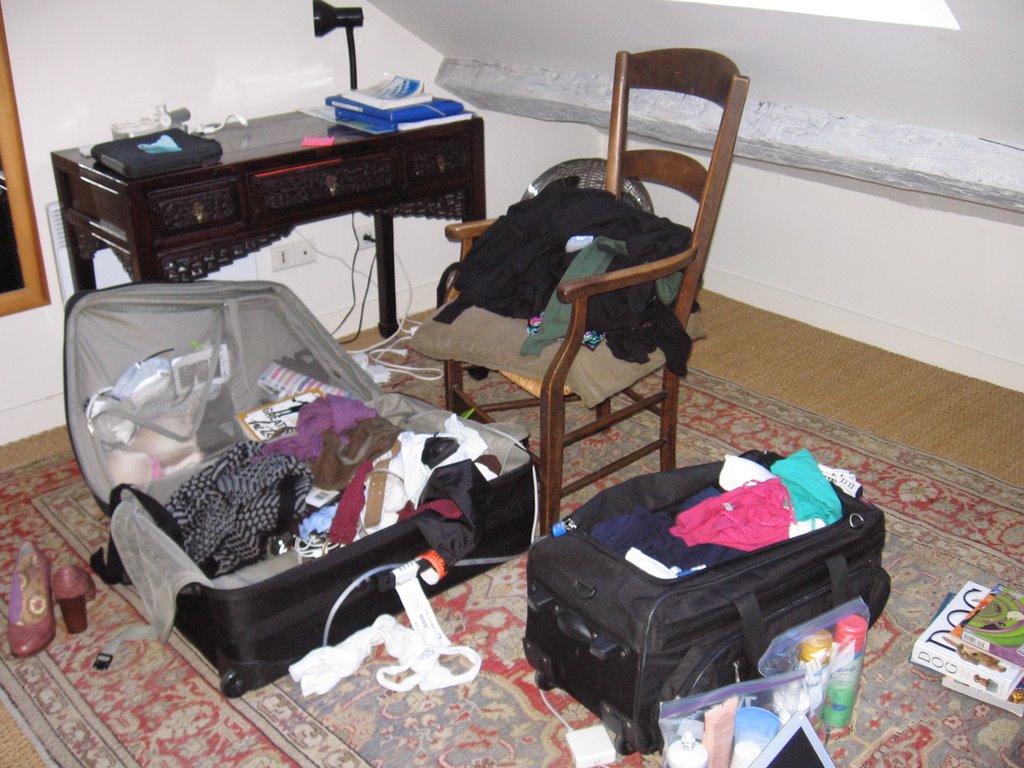
Unpacking, yet again:


The truth is that I don’t live in Tacoma or in Seattle – I live in the 2ème arondissement of Paris, France, and I feel completely at home here. I’m back in my apartment, on my street (although I was disturbed to see that a new restaurant has appeared across the street from me – Paris wasn’t supposed to have changed in only two weeks!), and after sleeping for 14 straight hours in my bed, I went shopping at my local Franprix, to restock my kitchen.

I’m back to the life where I walk through the courtyard of the Louvre everyday to get to school, where I have a year-long membership to the Pompidou Center, where we go out for a drink at 23h on a Tuesday night. I’m back to the life where I buy my bread, produce and groceries in three separate locations, and have to dress up before I leave my apartment to go shopping for them.

I feel like I don’t know where I live anymore – do I live in Tacoma, Paris or Seattle? It feels so weird to “visit” my house in Tacoma – but at the same time it’s so normal that it’s weird to feel as settled as I do, living alone in Europe at the age of 21. I don’t know if that’s something I’ll ever figure out though. I guess the plan is just to enjoy where I am while I’m there and not worry so much about everywhere else. It’s 2007, after all – and I’m in Paris!

19 December 2006

Today Paul asked me what color the number seven is to me. I guess I surprised myself a little, but he was completely unfazed when I answered immediately with “yellow.” But why would he have been? He was expecting me to answer with a color, and I came through.

I love hanging out with that kid – he’s so incredibly smart and genuinely loves learning new things. We have the most fun and random conversations, and he’s completely riveted when I regale him with tales of the Donner Party, or Black Widow Spiders.

He has a continuous stream of questions popping into his head, and, being seven, has absolutely no hesitation in posing each one to me. From what color I think Thursday is (purple), to how many electronics I have in my house in Tacoma (um, a lot, I guess?), to a description of my favorite day ever (the day in kindergarten when I got to go home early because I had tied my shoelaces together during story time, only to find out that my lost American Girl Doll had been found, and that I’d won a Beauty and the Beast coloring contest all in the same day. It’s a warm memory for me).

Check out this pony from the window of BHV – the disturbing part is that it's a real stuffed pony:


These rabbits are no less authentic:


Sometimes the more pressing questions on his mind are what kind of food Wilbur likes best (peanut butter and cheese), or if I know any words in Korean (Kamsahamnida, thanks Dad), to my favorite taste in the world (cilantro), to how I feel about Sundays (I love them), or whether I am in love with anybody right now. No matter what I answer, as long as it’s not an “I don’t know,” he’s satisfied and moves on to other more pressing queries.

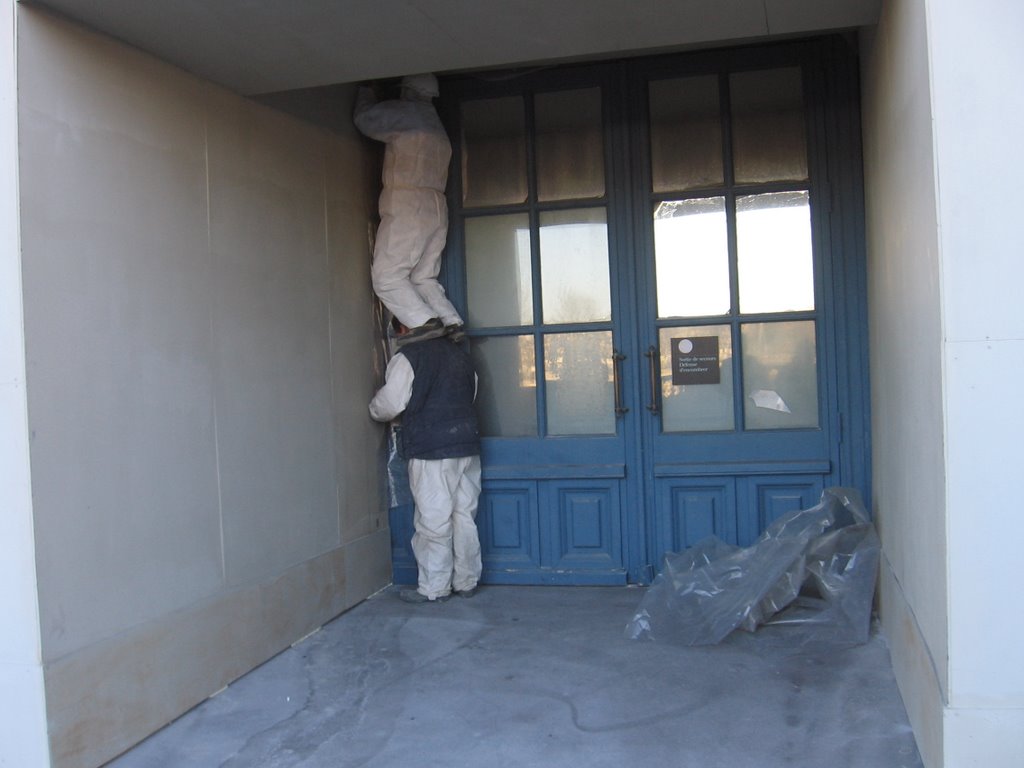
I thought these guys were awesome. No ladder? No matter.


I think out of everyone, P is the most like an actual little brother of mine – at least banter-wise. He tells me that my sunglasses are ugly, and I tell him that I’m trying to trick people into thinking I’m a movie star. He wants to know if it’s true. I say of course, and maybe they’ll think he’s famous too, since we’re together. I tell him he’s stinky, and he tries to gross me out by eating boogers.

We are constantly trying to outsmart each other – him trying to escape into the upper reaches of his bunk bed without me confiscating his Gameboy, and me of course, trying to confiscate the Gameboy. We take turns reading Lemony Snickett’s A Series of Unfortunate Events and Tom-Tom et Nana, and compare our thoughts after each chapter. He tries to catch me with unfamiliar French vocabulary, and I outsmart him by knowing the words (he’s seven years old – we have similar vocabulary skills).

Sometimes P tells me about the girls he “loves” at school, and in turn wants to hear about every boy I’ve ever dated. He asks me each day for gossip about my brothers, and always wants follow-ups on the stories I tell him – he’s anxiously waiting to hear whether Ben has bought new earrings yet, and when Noah plans to take his driving test.

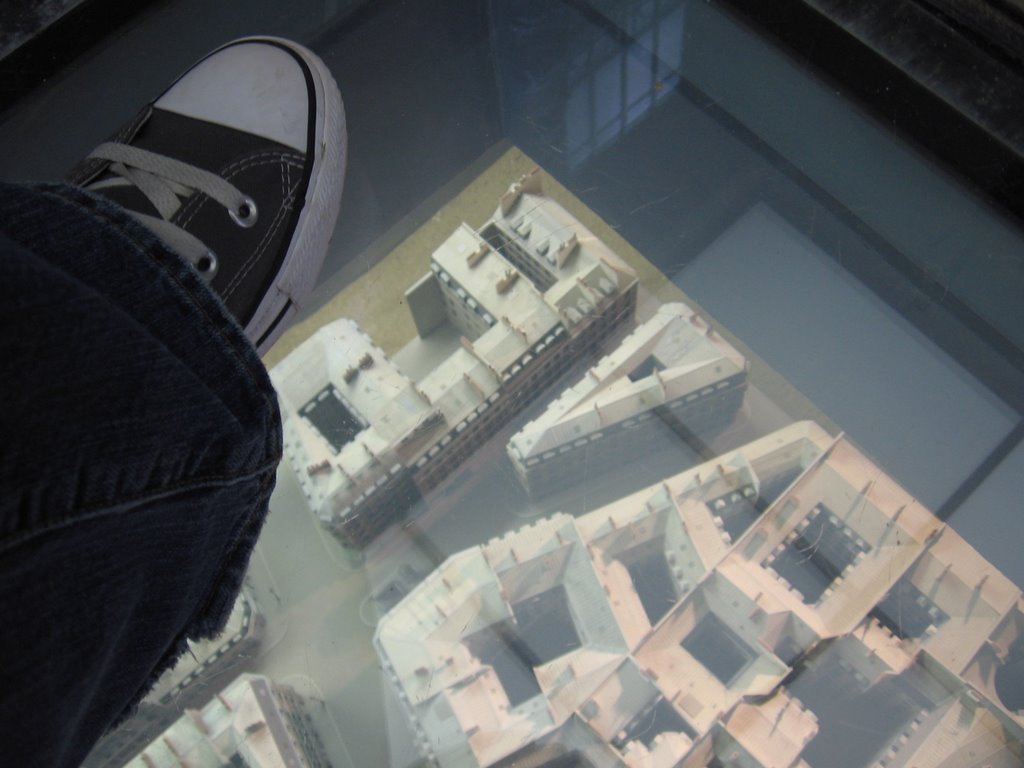
I found my neighborhood on the little model Paris in the floor of the Musée D'Orsay:


And my building!


We’re also constantly teaching each other. I taught P how to play Mancala and about the joys of Legoland, and in return, I learned the names and biographies of each character in Spongebob Squarepants. I know how to say “You suck!” (T’es naze!) and that French ados say tu peux me re-phone for “call me back,” and P is finally beginning to understand what I mean by constantly referring to things as “sweet.”

We really just have a lot of fun together – whether we’re singing “Jingle Bells” to Georges to get him to fall asleep or playing one of his practice songs as a duet on the piano. For a seven year old, he has a great sense of humor. He mailed E a brilliant fake letter from their feared and detested Grandmère that he came up with completely on his own.

Chère Ella, je t’écris cette lettre avec amour. Je veux te dire que ma radio ne marche plus, et je ne suis pas du tout contente. ~ Grandmère

Dear Ella, I send you this letter with love. I want to tell you that my radio no longer works, and I am not at all happy. ~ Grandmère

The greatest part of the prank was E’s reaction: “Grandmère has completely lost her head!” She bought the entire thing, and the fact that it was conceived by her seven year old brother tickles me to no end. P is pretty twisted for such a young age.

Is it weird that my favorite person in Paris is still in CE1 (like second grade)?

16 December 2006

Chanukah began yesterday at sundown. I was curious about the holiday in Paris after hearing stories about French Jews unable to broadcast their religion, and the huge amounts of security around all the temples on Yom Kippur.

Chanukah is not actually that big of a holiday, though. I think I was more into doing something celebratory than even Rachael was – we were originally going to make latkes with a few friends, but we postponed until Monday evening in favor of checking out a new bar.

Christina and I met Rachael, Thomas (French) and Ricardo (Spanish) near Saint Germain, where we left to walk to the smallest, most crowded, smokiest basement bar I’ve experienced in Europe.

This place, Chez Georges is wildly popular. We made our way past the bar and down a tiny set of spiral stairs into a brick cellar no larger (and possibly smaller) than my apartment, to find five seats at a wooden table. As we sat down, we congratulated ourselves on finding seats, which, according to Thomas, is a near-impossible feat.

Within five minutes of sitting down and ordering a bottle of wine, in walked three people I know from classes at Sciences Po. Over the course of the evening I probably ran into ten to fifteen people I know, which is a pretty rare event in a city as populated as Paris.

For a while we all sat around the table, just drinking our wine, talking and slowly asphyxiating from the clouds of cigarette smoke. Think about it – a teeny tiny brick basement room with only one exit and no windows – there’s nowhere for the smoke to go but into our lungs.

At about 23h, the place started to pick up. Soon the room was completely packed, with ten people crammed at each little table, and the minimal amount of standing room packed with couples and groups holding their bottles of wine and glasses. Meanwhile, the smoke cloud became denser and denser with each breath we attempted to draw.

After a few hours and many bottles of wine, the crowd was ready to dance – a difficult endeavor in such a small endroit. No matter, dance we did. There were people on tables, benches and chairs, packed in the center of the room and lining the twisting staircase to the rez de chaussée (rdc, or ground floor).

Normally, I wouldn’t expect such a dank and polluted little cellar to have such a powerful draw, but this is Paris – the people (patrons and bartenders) are friendly, the wine is decent and the music is eclectic, which is a sure recipe for success.

The playlist slid from an Elvis medley, to swing music, to thirties slow-dance music, to half an hour of Beatles songs, to Klezmer Music, to Judy Garland and around and back again. There’s something slightly unreal about standing in a packed mob with your arms around Parisian strangers while everyone sways together, belting “Let it be” at the top of their lungs.

It’s even odder when the same group grabs hands and begins to dance in a frantic circle, singing Hava Nagila in a smoky basement on the first night of Chanukah with approximately five people of authentic Jewish faith are present in the circle. It’s so surreal that the only solution is to join in with the singing, embracing complete strangers and pausing between songs to make toasts (being sure to always look into eyes of the person you're cheering – lest be cursed for seven years with a variety of complaints).

Despite the cough I had upon waking up this morning, the red wine drips on my shirt from last night and the horrible bar smell radiating from my coat and scarf, it was definitely a good night. Hava nagila! And happy Chanukah, of course.

14 December 2006

Sitting here in my apartment, with a cup of tea, the heat blasting, some really warm socks, and no homework to work on, I’m finally starting to relax a little. The past two weeks have been ridiculous, work-wise, but now (with only 4 more days of school before break) I can breathe again.

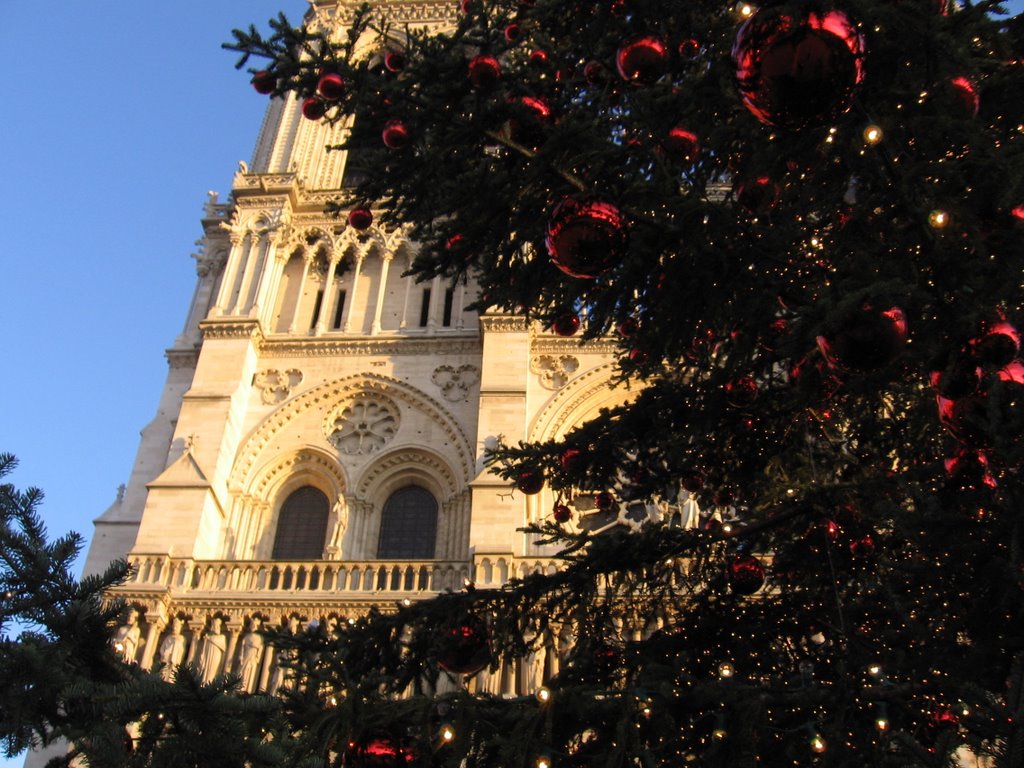
Yes, that's Notre Dame peeking through the tree.


Beginning December 3rd, most of the work of my semester began to pile up – over the past 10 days, I had a presentation and analysis of current events and projects of the European Union, an exposé (basically a speech) on Jacques-Louis David’s painting The Death of Bara, a fiche technique (basically a report), a debate, an essay for my French class and an exposé for my French politics class.

It was a stressful beginning to the month. Today though, I have only five classes (and one final essay) standing between me and Christmas vacation. Of all the work that piled up, my French politics exposé was by far the worst. All of the projects required considerable work, but once I put the work in, I was quite satisfied with the result.

It's Christmas time in the city


This exposé though, Combien de gauches dans la vie politique française aujourd’hui? (Or, how many leftists in French politics today?) really terrorized me. It wasn’t so much the subject (which was pretty awful, I do admit), but the fact that for this particular class, my entire grade for the semester is weighted on this one exposé. That’s a lot of pressure riding on my analysis of the shock of 2002, Lionel Jospin’s political failings and the ultragauche (extreme left) in France. This was the exposé that I devoted my 21st birthday to, that I stayed up until 5am three nights in a row working on, that I’d practiced so many times I had it timed to the minute (exposés may NOT exceed 10 minutes).

Despite my knocking knees, quavery voice and flub of one of the post-exposé questions posed to me, my professor thanked me with a smile and a “Vous avez bienfait.” (You did a good job). Unfortunately, that wasn’t the end of my work, as I had to return home after class to complete an essay for my French class Wednesday.

Today is Thursday though, and I am feeling pretty good. Somewhere in the middle of all my researching and note-taking and typing in French of the past couple weeks, I began to notice a few bizarre things about myself. Or, the amount in which I unwittingly conformed to France over the past three and a half months.

In France, we do not double-space our fiches and essais. Everything is force justified rather than aligned-left. Titles of books, movies, institutions, and anything else with a multi-word designation have only the first letter of the first word capitalized – everything that follows is lower-case. Example, Droit constitutionnel et politique by Olivier Duhamel (who happens to be one of my professors). Oh yeah, and everything’s italicized.

Last names are always capitalized to avoid confusion and usually come first, GRIFFIN Halley, but not always Halley GRIFFIN. Sevens and Z’s are always crossed, and ones are never just vertical lines. We underline important points with rulers (although that might just be us nerds at Sciences Po) and we never omit zeros from dates. January 5th, 2006 is always 05/01/06, never 5/1/06.

None of these things are that odd individually, of course – the strange part is how easily and unconsciously I’ve adapted them. They’re all just simple differences in style – and being that I’m across an ocean from the schools where I learned to write papers it makes perfect sense that the styles should be different. It’s just interesting how naturally they’ve integrated themselves into my American style – which isn’t so American anymore, apparently.


I keep imagining next year and wondering how long it’ll take me to shake all the French out of my schoolwork. Christina will have the chance to reintegrate before I do, since she’s flying home for good next Thursday, so I guess I’ll have to hear about it second-hand.

C is staying with me for a few days and we spent the afternoon at a marché de Noël outside the Pompidou center. We were wandering around, casually drinking paper cups filled with cinnamon-y and delicious vin chaude, and we stopped to look at some artwork by a typical, if unusually scruffy-looking street artist. He looked at our cups and asked, “C’est du café?’ (Is that coffee?) When we informed him that it was in fact hot wine, he winked, said, “Yesss, al-co-hol-ic? Moi, je préfère la bière.” He then opened up the pocket of his dirty coat to show us an open bottle of beer for him to surreptitiously swig in between ripping off tourists with overpriced mediocre paintings. That’s Paris.

It hasn't snowed here yet – well, except for the dusting of sparkly plastic that's coating the Champs Elysées.

08 December 2006

Paris was a mess this morning. I woke up at about 7h this morning to the sounds of my building collapsing under the pressure of the wind.

Once I’d actually been awake for a few minutes, I came to the conclusion that my building was not actually being blown over – but it definitely being assaulted from every direction.

My apartment sits under the Northern eave of the building, and my windows are all positioned at a 45 degree angle. When I looked outward, I felt like I was in a carwash – buckets of water being thrown at the glass. I attempted to open one just a crack and one arm was immediately drenched.

I spent most of the morning dreading the moment when I would actually have to bundle up and venture outside to go to class. Most of the time I love the fact that I can get to Sciences Po faster on foot than in the metro, but today I wasn’t feeling particularly thankful.

When it starts raining in Paris, the souvenir stands suddenly all stock these very large blue Paris ponchos.


Unfortunately, I had an exposé to present in my art history class today, so no freak wind and rainstorm was going to be a legitimate excuse for skipping class. I waterproofed (read: Seattled myself) as best as I could, with my North Face, my REI raincoat a waterproof Timbuktu bag and my trusty if already falling apart cheapo umbrella from H&M.


Then I was ready to venture out into the storm. I thought maybe the wind would be a little less intense once I made it down to street level, rather than the top floor of my building. I was wrong.

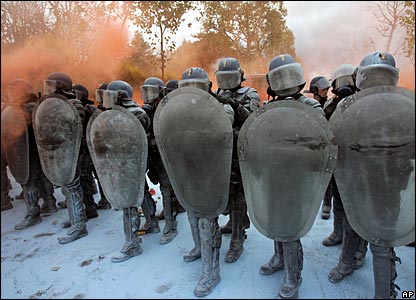
I felt like a member of the riot police as I joined the ranks of soggy Parisians battling their way down avenue de l’Opéra. We’d position ourselves carefully, looking directly into the wind and pouring rain, force our umbrellas open and begin stalking down the street, umbrellas held out directly in front of us.

This picture (from the pompier protest a few weeks ago) comes from BBC’s week in pictures. Yeah, that was me trying to walk to school today.


After a few blocks, we began to realize that today was not a day for umbrellas.


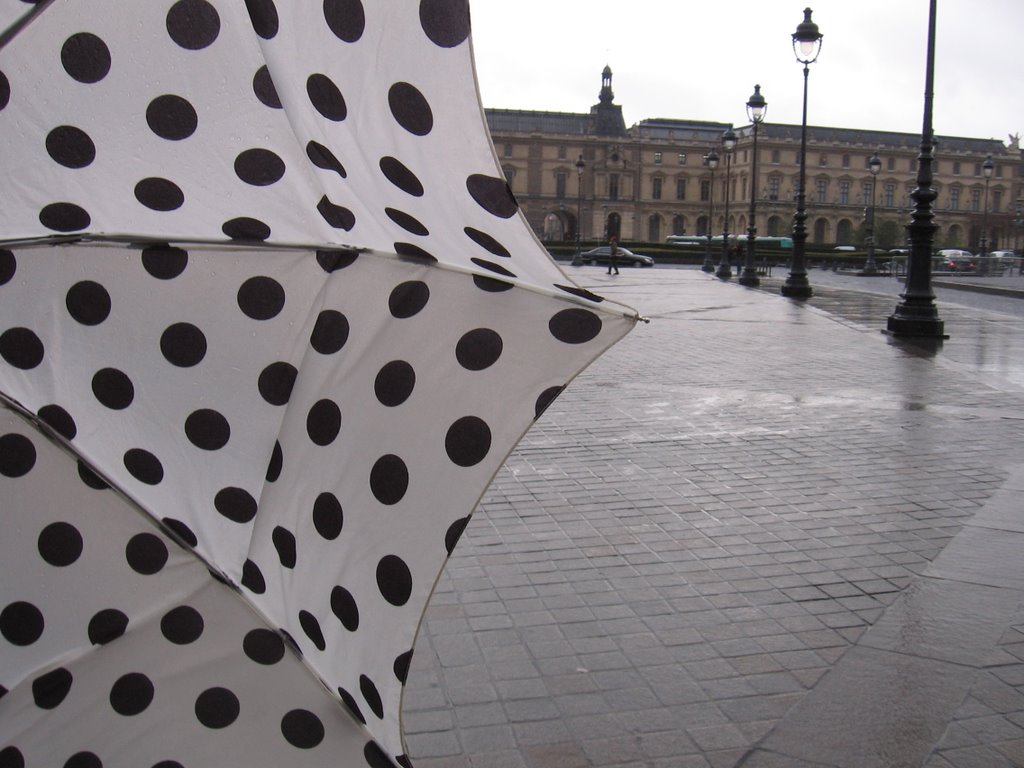
The face full of December rain proved to be less of a hassle than battling an umbrella through Paris. In the courtyard of the Louvre, I put my umbrella back up – the wind was extra strong in open spaces. It sheltered me for about….half a second, before flipping inside-out.


That’s when I officially gave up on the umbrella and instead walked backward through the courtyard. A few older ladies saw me doing this and chuckled at first, but once they got a face full of the wet wet wind, they were ready to adopt my technique.

My backwards walking technique made much more sense than chasing this around:


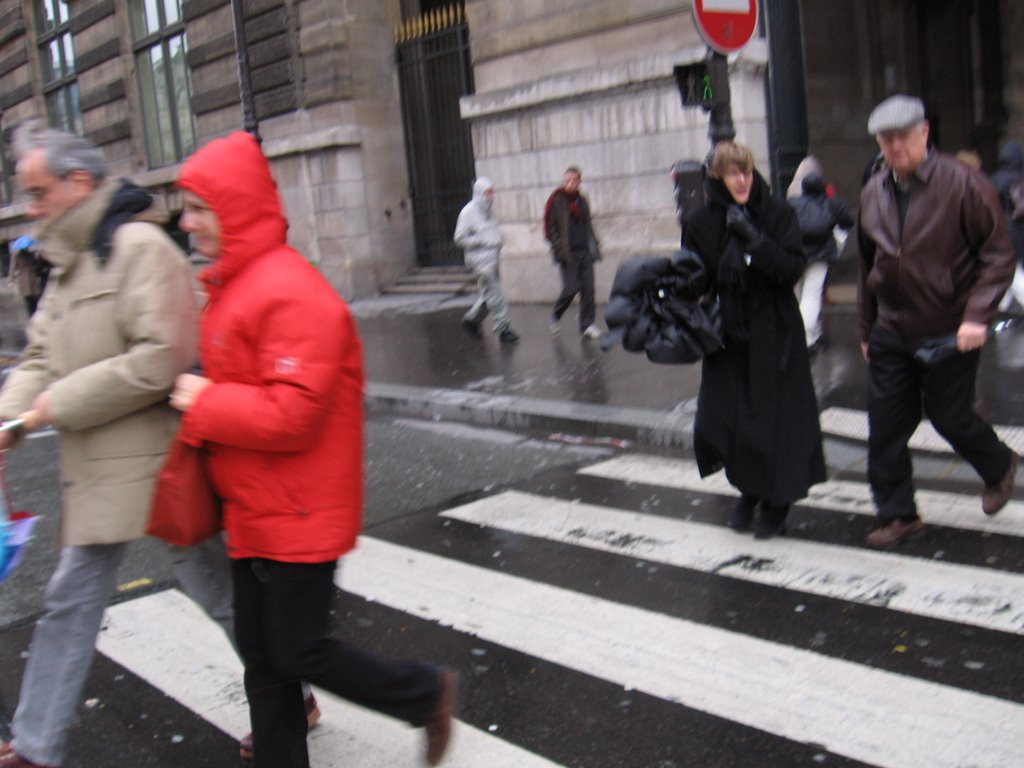
Throughout the rest of my walk to school I grinned at fellow soaked Parisians. Each one of us was soaking wet and disheveled with an umbrella tucked under one arm, even as the rain continued to drench us. Everyone wore the same hapless look that said, "I just had to give up on the umbrella."

We all eventually gave up.


For the rest of the morning, the trash cans of Paris continued to fill up with battered and broken umbrellas. Then, around 14h30, the sun broke, and it became a beautiful French day.

The evidence remains, though.


••• In other news, Rachael and I RSVP'd for a talk by Vice Premier of Israel, Shimon Peres at Sciences Po. It's scheduled for Monday morning and should be pretty interesting.

06 December 2006

Sciences Po has been a bit of a hub of chaos lately. Not only has there been an unexpected crackdown on security (we can now only enter the two buildings through one door on rue Saint Guillaume, and not before showing our i.d. cards), but this week is the 75ème birthday of the Association Sportive.

At Sciences Po, there’s the BDE (Bureau des Elèves) which is kind of the technical French equivalent of ASB or ASUW. Aside from orientation though, they really don’t do much. During the regular school year, parties, events and performances are planned instead by the sports association, who are generally pretty good at what they do – at least the party planning aspect.

It’s thanks to our friends at the AS that we’ve had the opportunity to attend at least one party a week (always on Wednesdays). Now that we’re nearing the holidays, they’ve upped the tally to include weekly cocktail parties along with the big blowouts – i.e. tonight’s AS birthday celebration.

Halloween, for example, was an AS party:


As far as planning anything else goes…I’m not so sure that I’m impressed. This week, the 75ème celebration was supposed to be full of events showing off, what else, the sports association. We’ve been getting emails for the past two weeks detailing the events – photo exhibits, parties, sports classes and dance demonstrations. The dance performances were supposed to be salsa, modern, capoeira and l’hip-hop, organized by the teams and their teachers (yes, technically we’re a hip-hop team).

My teacher (Florence “Flo”) decided to do it like an open class – have everyone (who didn’t have a conflicting class) from the two groups come in to Sciences Po this afternoon and take a class with some pieces we’d already prepared. I thought it sounded fun, so I rearranged my nanny schedule a little bit so I could participate. We’d been getting reminder emails all week from the AsSp, and I think everyone (the coordinators, Flo and myself) assumed that at least a few hip-hoppers would show.

We were wrong. I arrived in the Penîche (the room just past the entry hall of Sciences Po, through which everyone who enters the building has to pass) at 14h20 to find Flo setting up speakers with two girls from the AS. I was the first and only student there. We waited and waited, but no one else from either hip-hop group showed up. The sports association girls were in a bit of a panic because there were huge posters everywhere advertising this hip-hop demonstration, and spectators were beginning to hear the hip-hop music and meander through.

At about 14h40 (ten minutes after we were supposed to start), we figured out that no one else was coming. Flo and the AsSp girls were having a harried French conversation about what they should do about the people waiting to see some hip-hop, the fact that I was all alone and they didn’t want to put me on the spot and whether they could quickly recruit some random students to take part. This last bit was clearly desperation speaking – once you know a few Sciences Po students, you know that they’re not going to be jumping over each other to throw off their pea coats and book bags and break it down.

Finally Flo walked up to me with a look on her face that said, “I know you’re going to say no, but…” and asked if I thought we should go ahead and start. What they obviously didn’t know is that I am the kind of person who enjoys being put on the spot. I love performing in front of a crowd, whether or not I was planning on busting out a hip-hop solo show that day. Of course I said yes.

Since the idea of a demonstration class was clearly not going to work, we instead put together a combination to perform over and over. It was so fun. We usually move a lot slower in class because most of the other students don’t have any previous hip-hop experience, but today we were under pressure. The combination was fast-paced and so fun to dance, and we got to throw in some of the break dancing moves we’ve been working on in class.

With just Flo and I working the dance floor – er, great hall of Sciences Po, we didn’t manage to recruit any students to dance with us – but we did draw quite a crowd. There were two boys (one French, one from Michigan) who’d been homeworking in the Penîche and a little old lady from the Secretariat’s office who were our most appreciative audience members. The three of them watched us for the entire hour we performed, even though we were doing the same combination over and over again as people milled through. We shook it up from time to time by entering the room in creative ways, or adding some freestyle break dancing to the end, but it was really repetitive. Even so, those three stayed until the end – when we got a big cheer upon finishing our final poses in our final run-through.

I stuck around to talk to Flo for a while afterwards, and she thanked me for being willing to perform half-solo in front of all of Sciences Po at a moment’s notice. I assured her that I loved every minute of it (I really am just a big fat show-off), and she told me she actually wasn’t surprised that no French students had turned up to take part in the demonstration. The French are so reserved, she told me, they don’t put themselves into situations they’re not in control of – unless it’s a meticulously choreographed spectacle taking place in an actual theatre. The funny thing is, Cassie said the same thing when I told her about the afternoon.

On my way back from the impromptu spectacle d’hip-hop, I found my passage blocked by yet another protest march.

When I first arrived in Paris, I was fascinated by manifestations in the streets. Actually the word manifestation doesn’t really make much sense here in English, but in French, it can describe a protest, march, rally or other demonstration.

My first protest:


I witnessed my first Parisian protest march in August, just a few days after arriving in the city. It was a demonstration against France’s (and Sarkozy’s) immigration policies, and I was pretty enthralled, taking photograph after photograph to document it. I saw my second march barely a week afterwards, and my third a few days after that.

I’ve probably been privy to some kind of protest every 10 days since landing at Charles de Gaulle. If it’s not immigrants and sans-papiers, it’s architecture students, université students, or pompiers (firemen/EMTs). Today it was a performing arts union.

I used to stop and watch each protest for a few minutes – at least long enough to find out what the demonstrators were trying to accomplish. Now I roll my eyes thinking, “yep, I’m in France,” and hurry to the other side of the street before my route home is completely blocked. Strange the things that I accept as day-to-day life here.


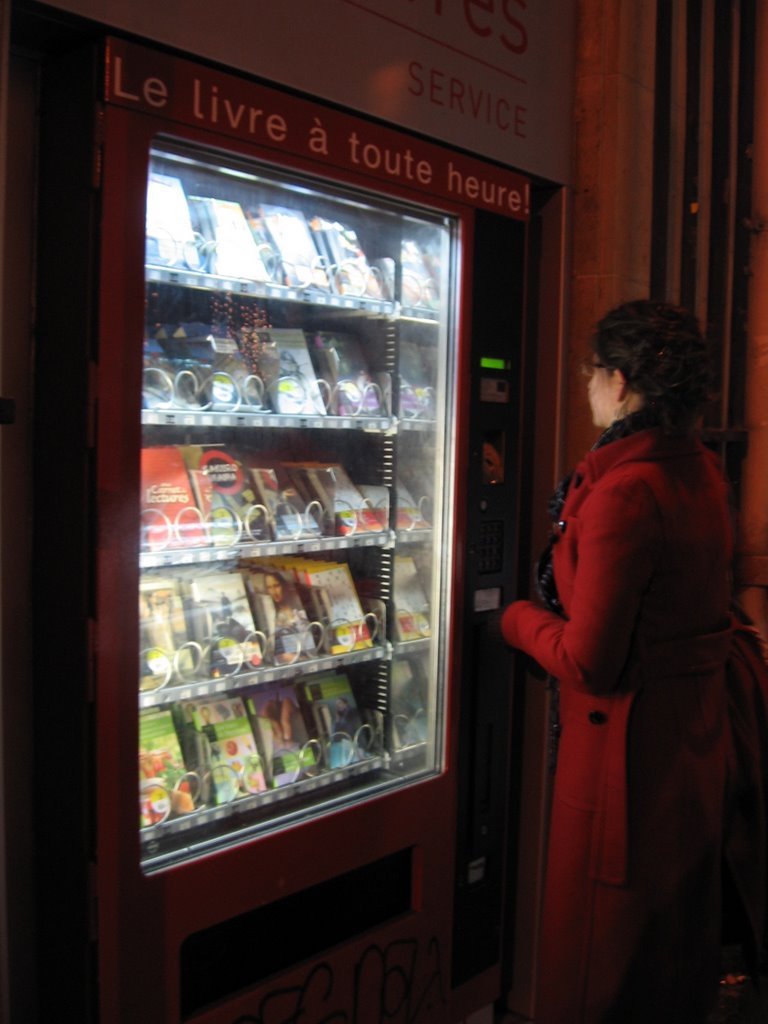
••• Paris has book vending machines. Only 3 euro for La Metamorphose or Petits Grains du Bible...

04 December 2006

About halfway through the ballet I leaned over to Amelia to ask, “the swans aren’t usually men, are they?”

No, the swans in the ballet Swan Lake are generally female – that’s the whole point of the story. Prince Siegfried falls in love with Odette, a woman under a sorcerer’s curse – swan by day, woman by night. At least that’s how it went down in the original Bolshoi Ballet version in 1877.

The Swan Lake A and I saw today was no traditional Russian ballet. Tchaikovsky was still the composer, and there were indeed swans, but other than that, it was a completely modern ballet.

Matthew Bourne’s Swan Lake debuted in 1995 in London and immediately generated rave reviews. In addition to its three Tony Awards, it apparently became the longest-running ballet on London’s Broadway. (And yes, it is the same version of Swan Lake featured at the end of Billy Elliot – furry pants and white-painted bodies included).

Théâtre Mogador


Amelia and I had both really been looking forward to seeing the show, so I made sure to complete enough homework yesterday that we could just have a fun Sunday. The ballet wasn’t until 15h, so we took a walk around the jardin des Tuileries and stopped for a glass of vin chaud in one of the little cafés in the park. On this rainy and windy Sunday, it was a lovely break to drink warm wine with cinnamon with a good friend from home and watch cold and wet people through the windows of the café. From there we headed up rue de la Paix through place Vendôme to the Théâtre Mogador (located behind l’Opéra Garnier).

Rue de la Paix is decked out in white plastic decorations for the holidays:
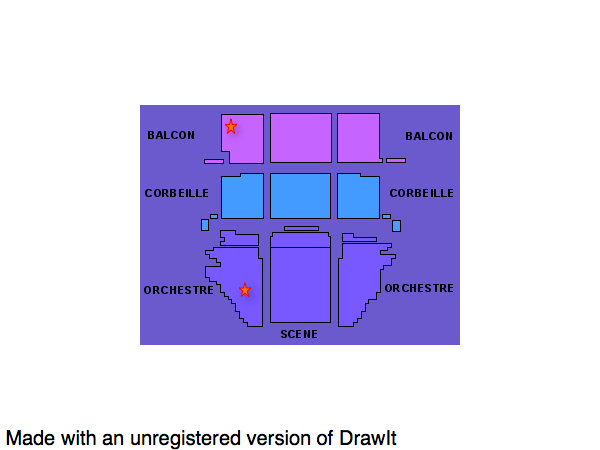

Being that we are cheap and students, we were only able to bring ourselves to spring for the cheapest of tickets. Our forty euro a piece secured us seats in row XX in the very back corner of the theatre’s balcony. As I completely forgot yesterday to ask Cassie for a pair of opera glasses to borrow, A and I arrived at the theatre hoping to be able some.

When we handed our tickets to the usher, however, we were informed that “le balcon est fermé aujourd’hui.” (The balcony is closed today). We were directed instead to the orchestre, where we found ourselves with seats upgraded by about 65 euro. We were close enough to see the sweat dripping down the backs of the swans (yeah, not sure that was such a bonus). The opera glasses proved to be entirely unnecessary.

The star in the balcony is where our tickets instructed us to sit. The star in the orchestre section is where we actually got to sit.


Despite some initial confusion about the lack of female swans, and the fact that the ballet was set in Britain today (supposed by some to be a kind of satirical commentary on Charles, Prince of Wales and the rest of the current monarchy), A and I were both riveted. Oh, it was so good.

And we had a very good view (except for that one guy's head):


After the show A and I went to diner at my favorite Arrmenian restaurant on rue Mouffetard, then walked back to my apartment via all of the best Christmas lights we could find. It was a good day.

Lights on rue Mouffetard.

02 December 2006

Two days into December, and this city is ready for the holidays. The air is crisp, the Christmas markets have sprung up in streets all over Paris. The vin chaude is hot and delicious in the jardin des Tuileries, and since the first of the month, Christmas lights have been lit up all over the city.

The department store windows are full of stuffed bears and toy trains and Christmas stockings and presents, and the patinoire (ice skating rink) is busily freezing in front of Hôtel de Ville (open for business beginning on Tuesday).

Windows of boulangeries are filled with bûches de Noël, and the entirety of rue de la Paix is lined with fake white Christmas trees on pedestals.

Oh yes, Paris is ready for Christmas. So am I.

Last night R and I went to a really fun bar in the 11ème arondissement, before meeting a group of friends at a jazz club near her apartment. We were tipped off by her brother, who spent the year before last living in Paris, that there exists a bar near metro Ménilmontant where the purchase of a drink guarantees you a table and a free dinner.

Feeling a little skeptical, we decided to check it out. The bar (Tais) is a laid-back and funky café, filled with twenty-somethings eating and drinking to a soundtrack of Toots and the Maytals. We found ourselves a piece of bar to lean on and drink our bières blanches while we waited for a table to open up. After maybe ten minutes of sipping, we were directed to our table where we continued to sip our beers and wonder if R’s brother had been pulling our legs.

To our delight and surprise though, after maybe twenty minutes of chilling at our table, we were given plates, knives and napkins, without having seen a menu or ordering anything. The guy who brought our plates disappeared into the back and returned with a steaming platter of couscous, a meat dish to eat with it and a bowl of stew to pour over the entire meal. Not only was the food delicious, but our bill was only 6 euro – the cost of the two girl beers.

We left Tais feeling satisfied and thrilled with our new favorite bar, but somewhat confused. What kind of business can survive giving everyone free dinner every night? I guess some parts of Paris will always be kind of mysterious and magical. Don’t question it – just enjoy the couscous.

These are going to be an odd few weeks in Europe as my apartment becomes home base for everyone whose program is ending. Anyone who’s not staying the entire year is getting ready to go home sometime in the next two weeks. The UW’s Comparative Literature Paris program ended yesterday and Amelia’s host mother couldn’t keep her for the few extra days until she flies home, so she’ll be bunking with me for a few days, with the possible addition of her cousin for one or two of them.

Next week I’ll host Christina for a night before she heads off to Switzerland, and I’m keeping her luggage for the week until she returns to Paris to fly home out of Charles de Gaulle. People I know in London are packing and getting ready for regular life again, and even my friends back in Seattle are hustling to finish their work before the quarter ends.

I feel like I’m some kind of rock in the middle of all the chaos. Things are changing and ending all around me, and I’m just here. I’m turning 21 in a week, but it’s not of any consequence in Europe – besides, I’ll have such a ridiculous amount of work that I probably won’t even bother celebrating. Two of my best friends are heading back to their normal lives this month, with me as their jumping off point, but nothing’s changing for me. Work as usual – my semester isn’t even over until Valentine’s Day. And it’s about to be 2007, for Pete’s sake. Funny how my home base for all of this has shifted to somewhere in the deuxième arondissement of Paris.

So much chaos, and none of it is mine. I think I’ll just keep living on, listening to my Christmas music, enjoying the lights that decorate the city and eating my free couscous.

Happy December!


•• Amelia and I are going to Swan Lake at the Mogador tomorrow afternoon! I can't wait – my mission for the day is find someone to borrow binoculars from...our seats are in row "XX," no joke.

29 November 2006

Paris, sometimes you scare me a little.

There isn't a lot to update – since I've been sick, I wake up, go to class, do my homework and go to sleep. Today though, I happened to walk home a different way and found something a little disturbing.

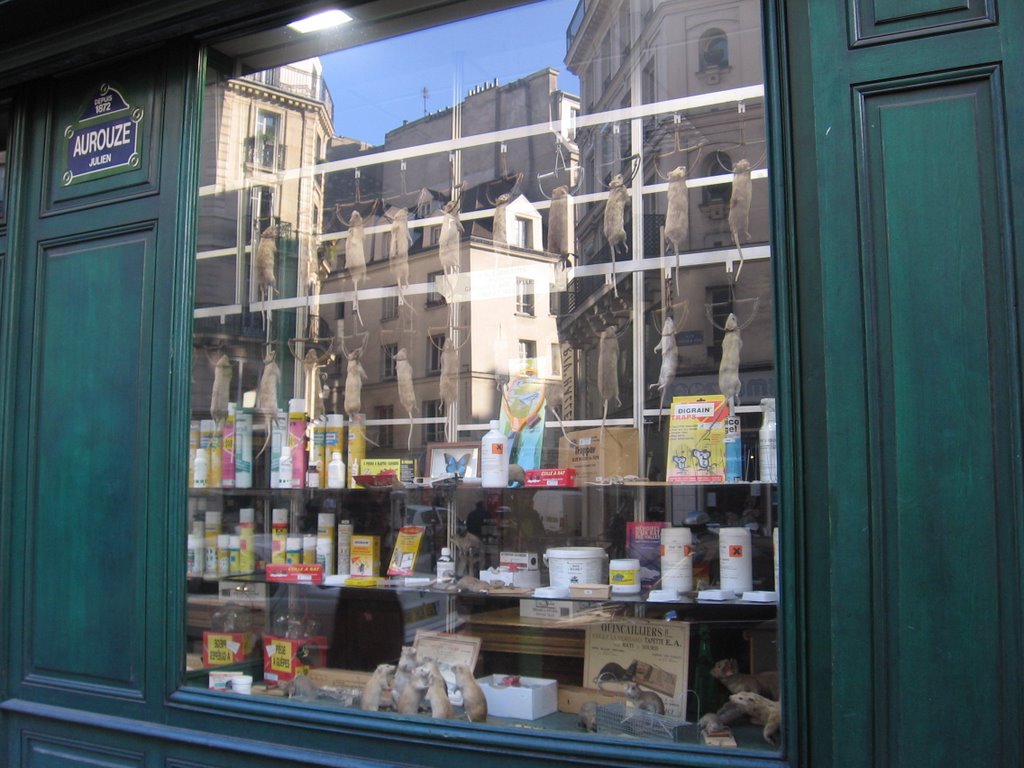
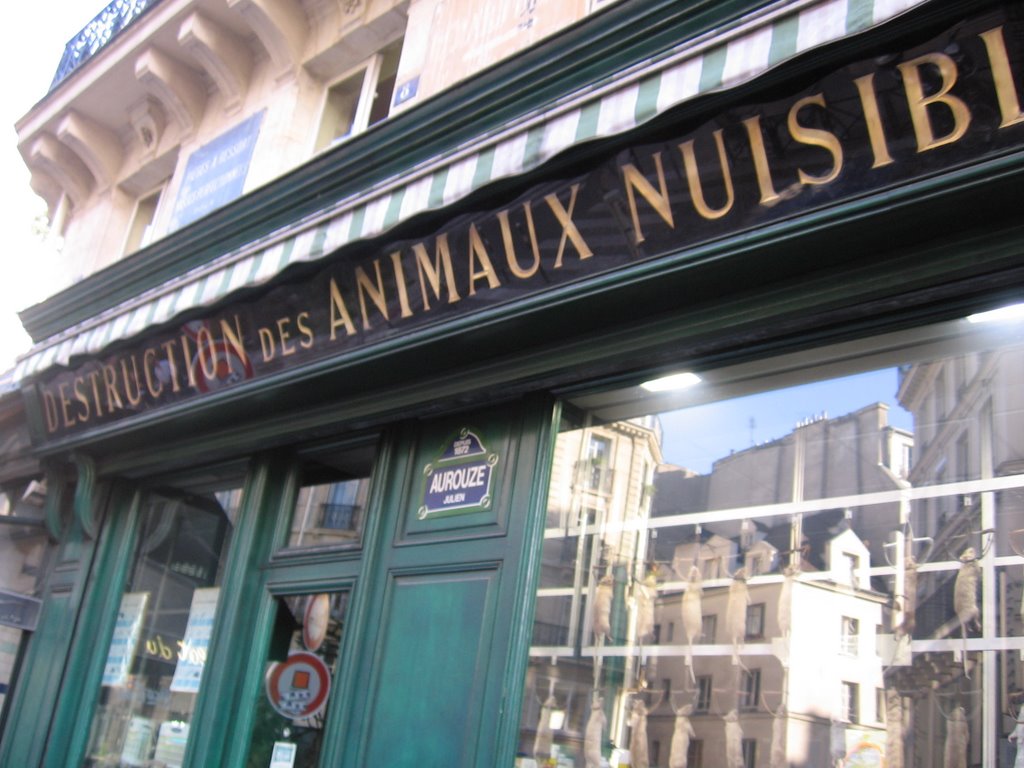
Yes, those are actual stuffed rats. Hanging from traps. In the window of a business on rue des Halles. Right next to a popular boulangerie.


The rats kind of make sense, because it's the office of an exterminator/pest control business...but still. The sign translates to: Destruction of Harmful Animals


Here's a closer view of the dead rats. The sign in the middle explains that these were all sewer rats that were actually trapped and killed by this business around the Forum des Halles in and around the year 1929. Apparently they had them stuffed...and kept them.

27 November 2006

Of the three months and three days that I’ve been living in Paris, I’ve been without my camera for more than half of it. Today, seven and a half weeks after I dropped it off, I finally got to pick up my fixed camera from the Vilma Canon specialists in the 20ème arondissement.

No matter that the projected time in which it would be repaired was only three weeks. The fact that I actually expected it to be ready by the estimated date is a testament to the fact that I really haven’t been living here that long – I should have known better.

This is France, after all. I suppose I’ve only lived in five cities in my life, but out of the five, Paris is by far the most filled with red tape. My experience trying to have a simple repair done on my little camera is an apt example of how ridiculously difficult it is to get anything done in this country.

Even if it's annoying...Paris is pretty for Christmas:


The saga began in October – on the fourth of the month, I dropped my Canon. I’ve dropped it before, but I either dropped it from higher than ever before or it had simply had enough abuse. As soon as I picked it up from the floor, I knew something was wrong.

When I pressed the power button, the lens sputtered, zoomed halfway out, then a quarter of the way back in and the error message “E18” flashed in white on the black screen of the camera. At this point I’d only been living in my new apartment for a few days, and I didn’t have Internet access yet.

To try and figure out what was wrong with my camera, I wandered around my neighborhood with my laptop open, trying to pick up an unsecured wireless network. I finally found one in a small park a few blocks away from my building, and settled down on a bench to peruse the Canon website.

From their site I learned that the E18 message meant that something was blocking the zoom lens (and from Wikipedia, I learned that maybe I got off easy with my free repair). And that there happened to be one authorized Canon repair shop in the entire Île de France region.

I wasted no time in bringing my camera to Vilma, which I remained quite optimistic about, even throughout the 40 minute, three metro transfer trip it took me to get out to their office in the 20ème.

I had a really interesting time trying to communicate to the woman checking the repairs in what exactly was wrong with my camera – the vocabulary to describe the functions of a zoom lens wasn’t covered in any of my French books in school. Finally I gave up and resorted to gesturing at the camera saying “E18, E18.”

The Vilma employee understood immediately, and checked the camera in – I didn’t have my warranty with me, but she assured me that they’d begin work on my camera and I just needed to drop off my garantie as soon as I could locate it. I explained to her that it would half to be mailed to me from the States, but that was fine, she said. The work on the camera would take three to four weeks to complete.

I was a little surprised at how long she thought it would take, but figured they’d overestimate the time a little and I could expect my camera back before the end of October. No such luck.

My mom dug the warranty out of my bedroom at home and mailed it to me the very next day. When I brought it to Vilma about a week after I’d dropped off my camera, a different employee was working the desk. This one spoke English and he explained to me that they had not been able to commence work on the camera without the garantie. They’d need three to four more weeks to work on my Canon, and would email me when it was ready. At this point I was really frustrated – especially since Christina and I had been planning our trip to Barcelona and I was no longer sure I’d have my camera back in my possession by then (as it turned out, I didn’t).

A few days after dropping off the warranty, I received an electronic bill, estimating the work on the camera at around 200 euro and asking if I was in accord with paying it. Knowing my camera was under international warranty, I ignored the email, figuring it was a mistake.

Maybe a month later (a week or so into November) I received the same electronic bill, this time with a note demanding a “oui” or “non” if I was going to comply with the work agreement. This time I responded to the email, saying that my camera was under warranty and was not supposed to cost me money.

The email I got back told me not to worry about it, they had my warranty and I wouldn’t be charged anything. Reassured, but still agitated without my camera, I continued on with my day-to-day business.

This brings us up to last week. At the beginning of the week, I received the bill yet again. I responded this time saying that I agreed to the work, but not to paying, since my camera was under warranty. This time I received my reply via telephone.

The woman who called informed me that I still needed to drop off my garantie at Vilma. This time I was really confused. I explained to her that I’d already given them a copy of my warranty, that the guy I’d given it to had assured me that the repair would cost nothing and that I’d been waiting for my camera for well over a month. The employee told me she’d speak with her coworker and hung up abruptly.

About ten minutes later I received another email that said nothing but “votre appareil sera reparer” (your camera will be repairing – yeah, it’s not even sensical French). This was really driving me nuts, so I sent them an email back saying something along the lines of “Okay, it will be repaired, but when? I’ve been waiting for more than a month.” No response.

Friday night I spent a good portion of R and my Beaujolais walk griping about the incredibly frustrating game I was playing with the employees of Vilma. We came to the mutual conclusion that the most productive thing I could do would be to show up there on Monday (today) in person and ask them what on earth was going on.

This was my plan until I checked my mail Saturday, and found a letter telling me that my camera was finally ready. I was thrilled, but still annoyed. For one thing, the letter was postmarked November 22nd – a day before I’d received the phone call and emails from Vilma. For another, they’d told me I’d receive notification by email – if they had emailed me when it was ready, I’d have had my camera four days ago.

These are my feelings on the whole annoying ordeal:


I was so sick of dealing with this place and so excited to have my camera back that I skipped my vie politique lecture this afternoon to pick it up. I feel like I’m put back together again – it felt like a piece of my arm was missing, to not be able to document everything funny, interesting, bizarre that I saw throughout my days. I feel like I lost two months – two months in which I saw a lot of people wearing red pants and white shirts.

It doesn’t matter anymore though – I have my Canon back in my own hands, and I have another life lesson about the joys of dealing with anything in France under my belt. Vive la bureaucratie!

* Those jerks also changed my camera language into French. Good thing I can already speak it.