27 September 2006

Class was really really hard to be in yesterday. Class itself wasn't hard – it never is, but the 4 hours seemed to stretch for at least 19. By 13h I was so antsy I ended up wandering the city for about 2 hours "on my way home" instead of taking the Metro back to the 10ème.

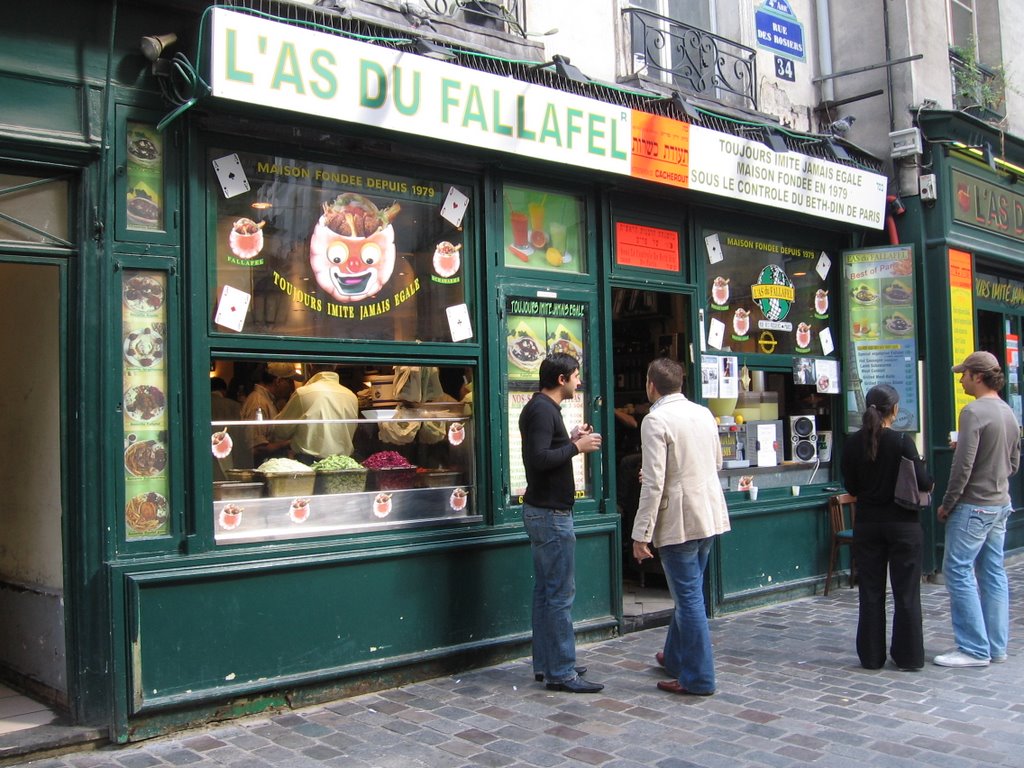
This is where you buy the best falafel in the world. Apparently Lenny Kravitz agrees, because there are pictures of him with the owners on various visits all over the walls. I couldn't walk by without getting one to walk with myself. The man who made my sandwich told me I was a "nice little girl."

Rue des Rosiers has been a center of the Jewish quarter since the 1800s. Those are the same cobblestones.

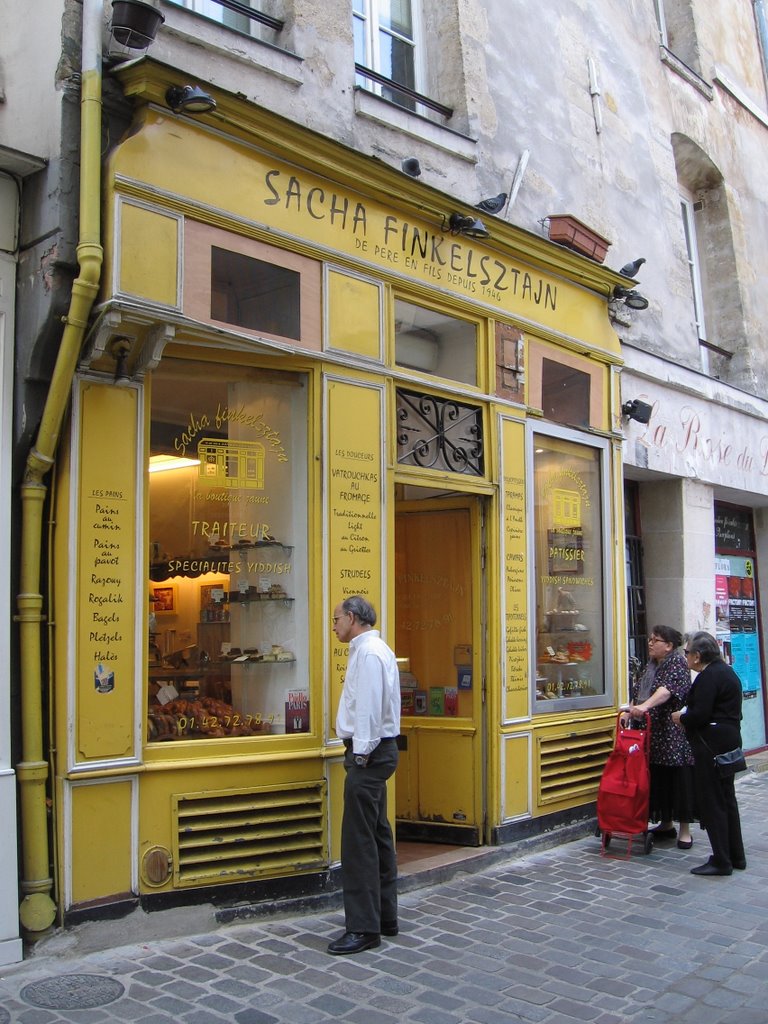
This is where I found the closest thing to bagels in Paris. Even though they're more just like round bread with poppyseeds, they're still pretty good. Thank you Sacha.

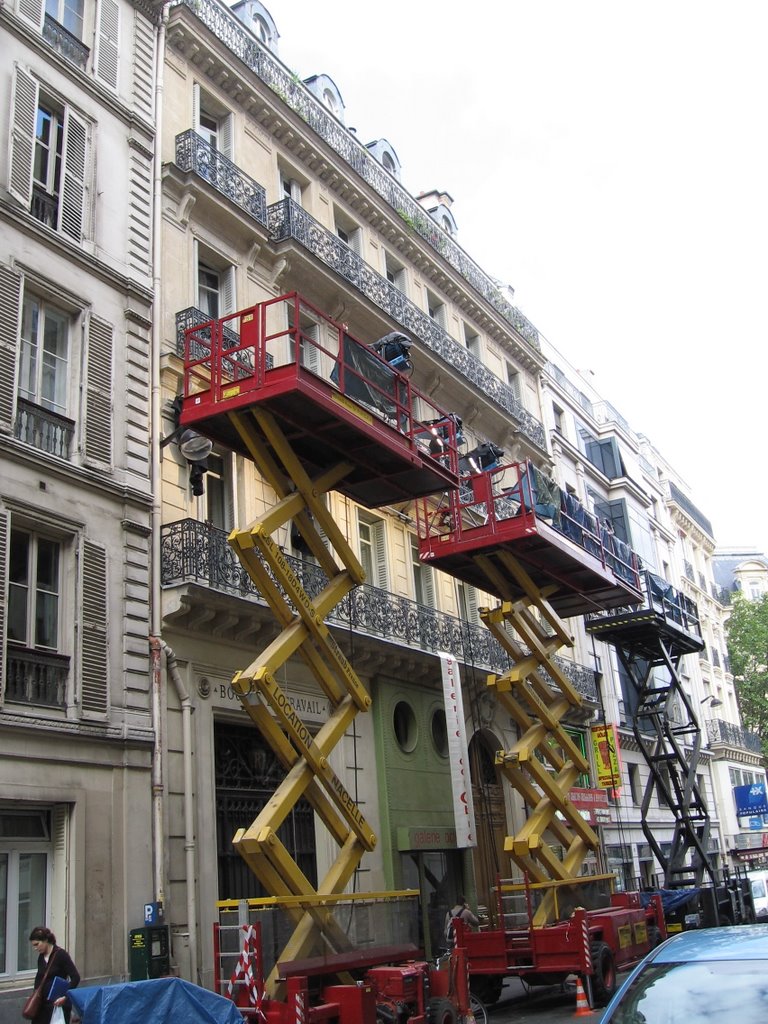
A movie set I found near Place de la Republique.

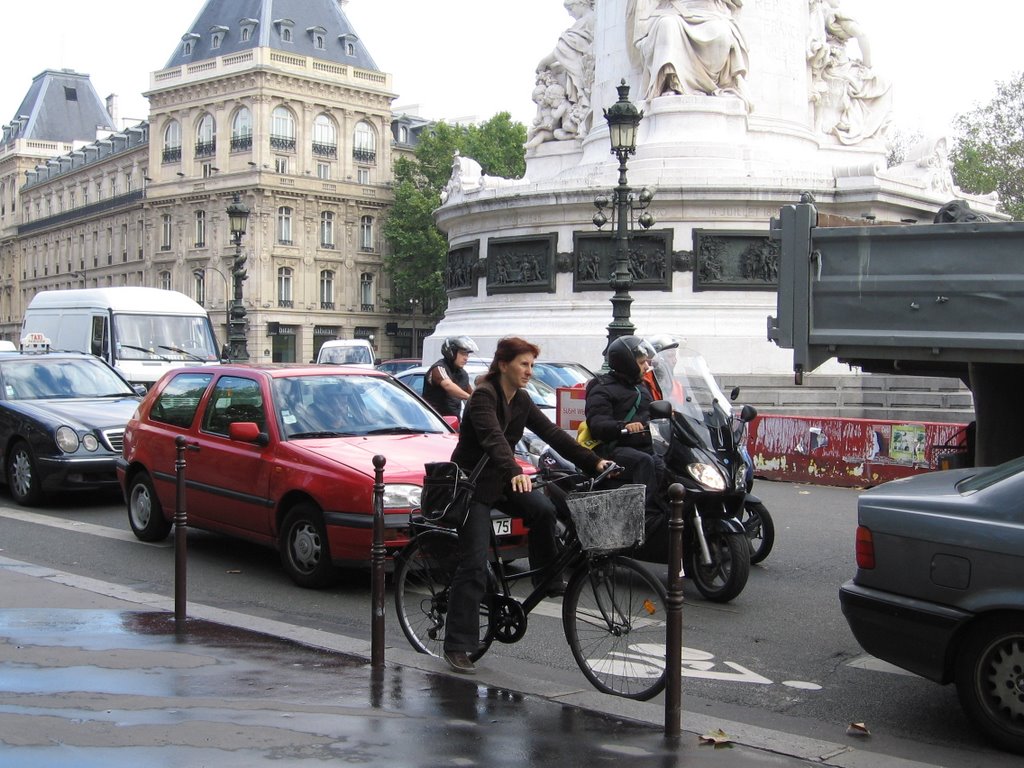
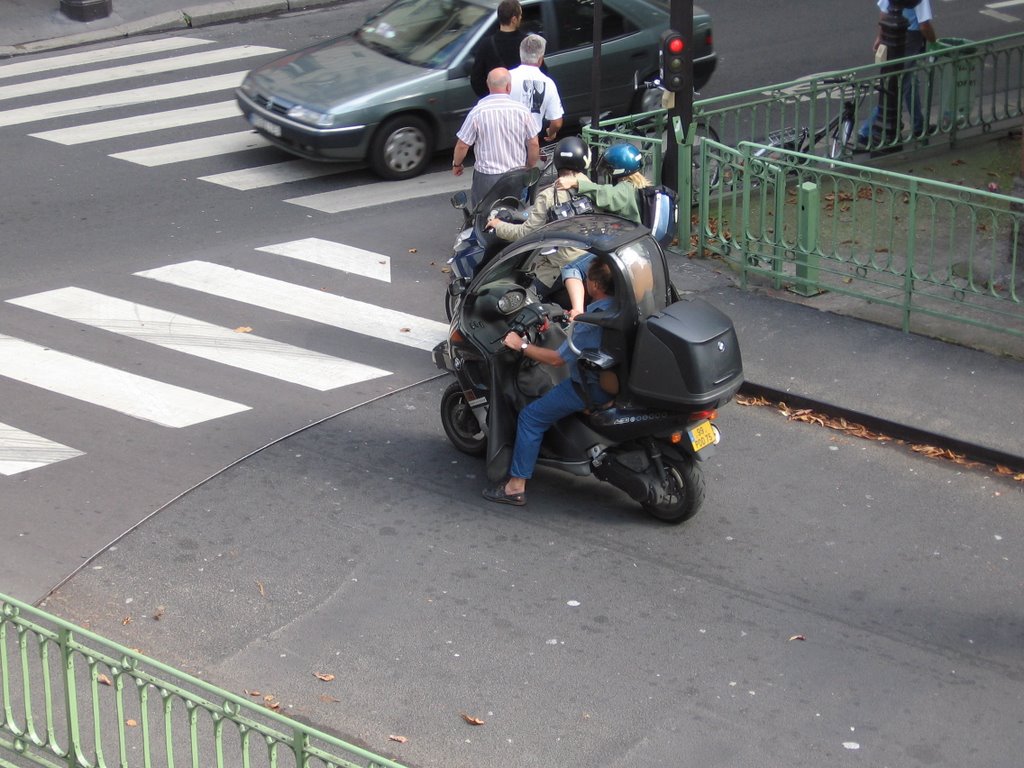
This is why driving in Paris is terrifying – bikes, scooters, trucks and cars all occupy the same space. There are no lanes – it pretty much becomes every man for himself.

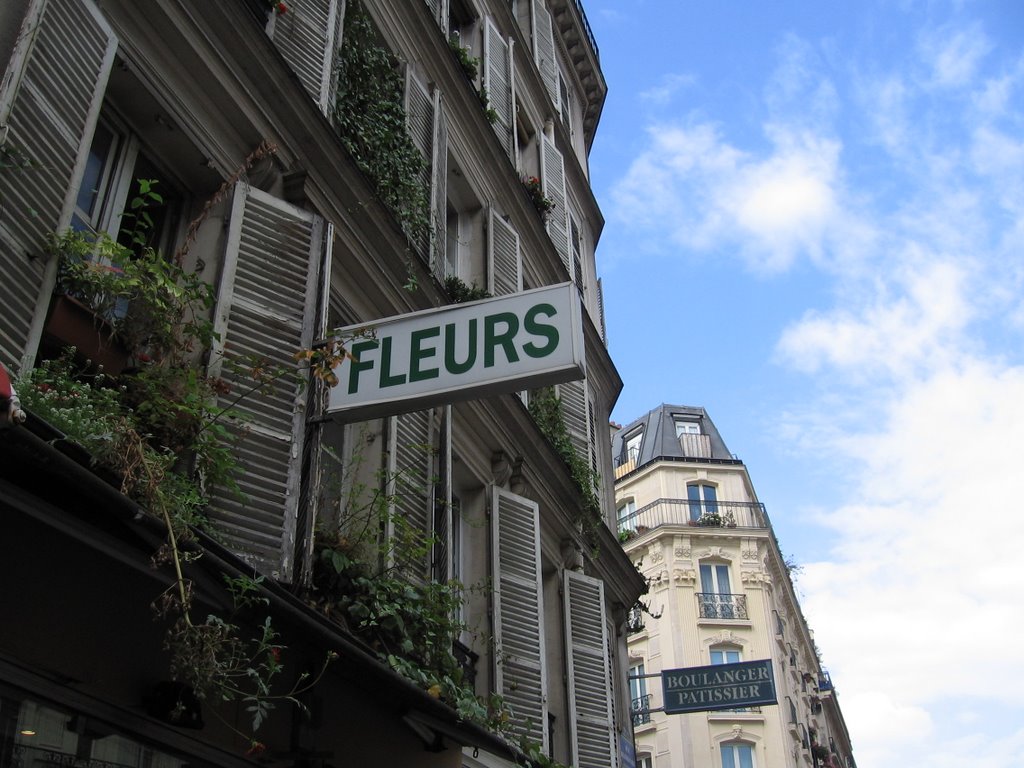
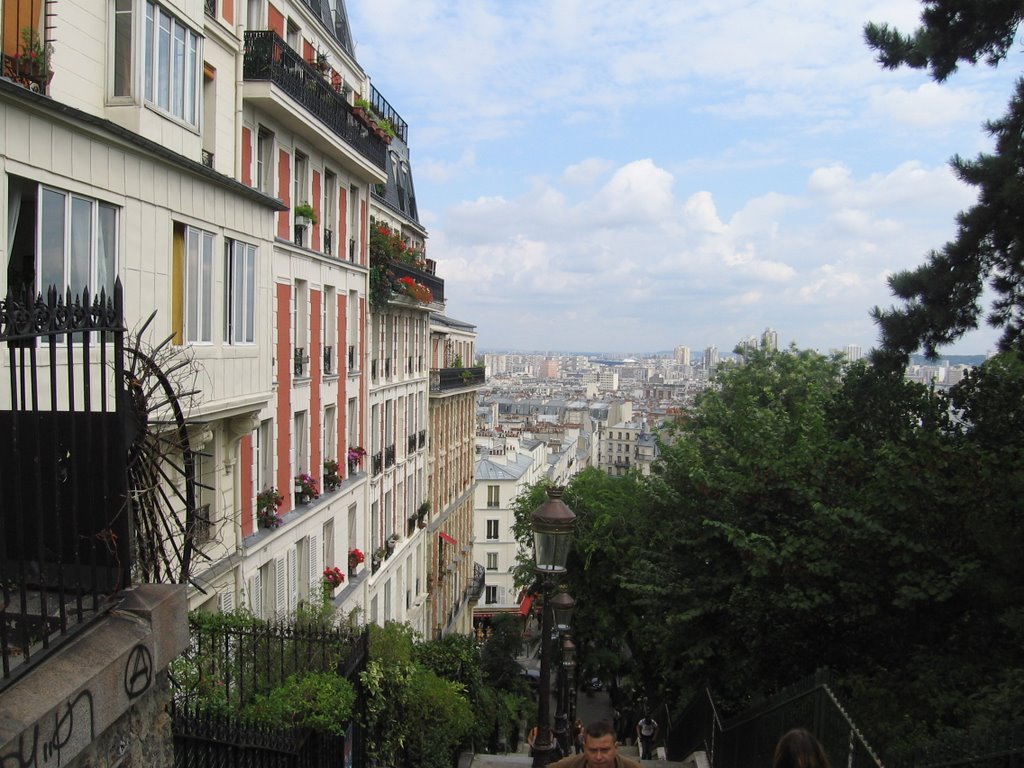
I just thought this was pretty.

Canal Saint Denis


This guy is a dork – these bubble scooters are pretty much the pansiest way to get around Paris – and yet tons of guys have them. No women though, the women all ride regular scooters.

Tent city on the Canal Saint Denis – a few blocks from our September apartment.

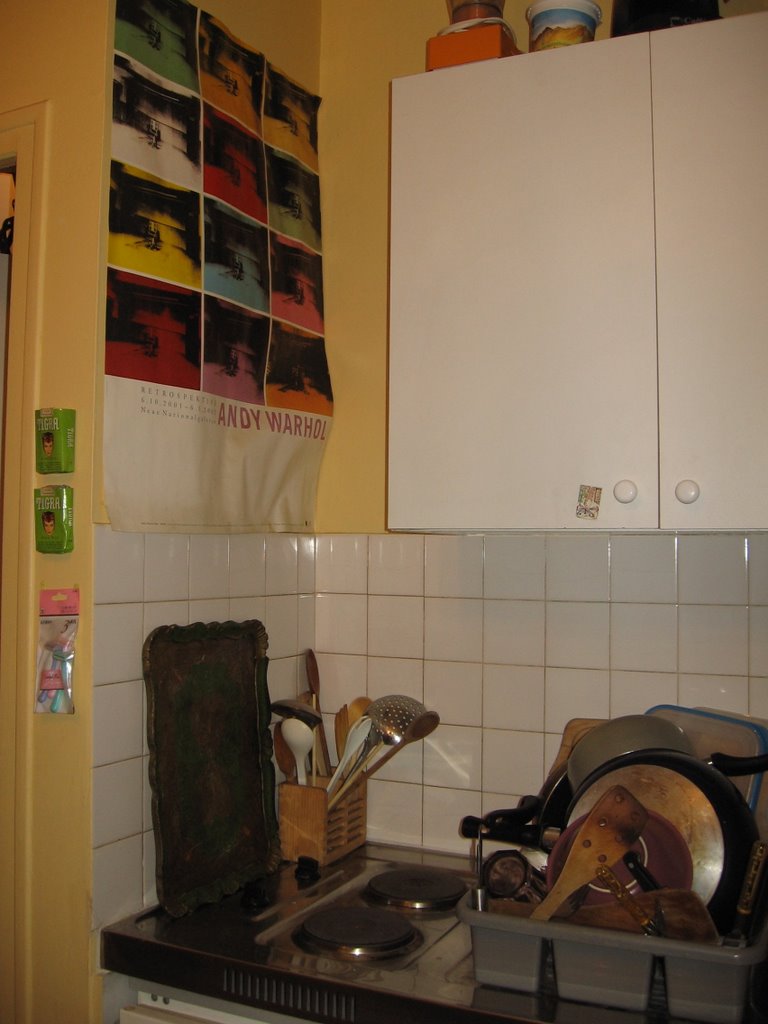
Living space of the September apartment – yes, it's a little cramped!

25 September 2006

Last Thursday the only words I knew in German were “gesundheit” and “auf wiedersehen.” I’ve become so used to being able to comfortably express myself in two languages that I didn’t give a thought to my sad lack of practical communication ability until I arrived at the Munich airport. Luckily the border policeman who stamped my passport recognized my terrified look and switched to English after a few rapid phrases in German. All of a sudden I remembered that I was in a country I’d never traveled to – and I didn’t even know how to say “I don’t speak German!”

Luckily all I had to do by myself was find my way to the airport exit – after that I was rescued by the Jorgensons, who have all picked up an impressive amount in the three months they’ve been in Bavaria. At least, they all sound really German to my ears.

One major difference from France is how orderly everything is in Germany. Quiet hours are from 20h to 8h every night and in the middle of the day from 13h to 15h. These aren’t suggested quiet hours – they’re law. So is the prohibition from opening any kind of business other than a restaurant on a Sunday. It’s not like France, where everybody takes Sundays off because they want the break – in Germany Sundays are taken off because it’s law. Probably due in large part to these restrictions, München is a very clean and nice city. There are bike paths everywhere, the neighborhoods are quiet and well-groomed, and most activities are pretty family-friendly – the beer gardens, for example.

I was pretty surprised when four-year old Jack asked his parents if we could all go to a “biergärten” Friday evening. From my observations in Tacoma, “beer garden” conjured up images of white plastic lawn furniture wrapped in plastic Coors flags and sitting under a grimy tent at the Taste of Tacoma or the Freedom Fair. In Germany and the U.S. a “beer garden” is technically the same thing, but the ideas are very different. The beer gardens we visited this weekend were all clean and grassy, with picnic tables, food and beer vendors, and always with playgrounds – in short, really nice places to go with the family. The idea of a biergärten seems like a really good one to me, but somehow I just don’t think it would work out at home.

Maybe most people already know what a German beer garden is, but I at least was pretty interested to learn.

To complete the picture of my ignorance on the subject of Germany/ München/Bavaria, I had unwittingly purchased my plane tickets for the middle weekend of Oktoberfest – celebrated all over Germany, but no manifestations can compete with that of München, where the first one was held in 1810. I’m not sure if this is because I’m a girl or just because I’m really out of it, but all I really knew about Oktoberfest was that I thought you could drink a lot of beer there. I had kind of imagined pumpkins too, but that’s probably because of the “oktober.”


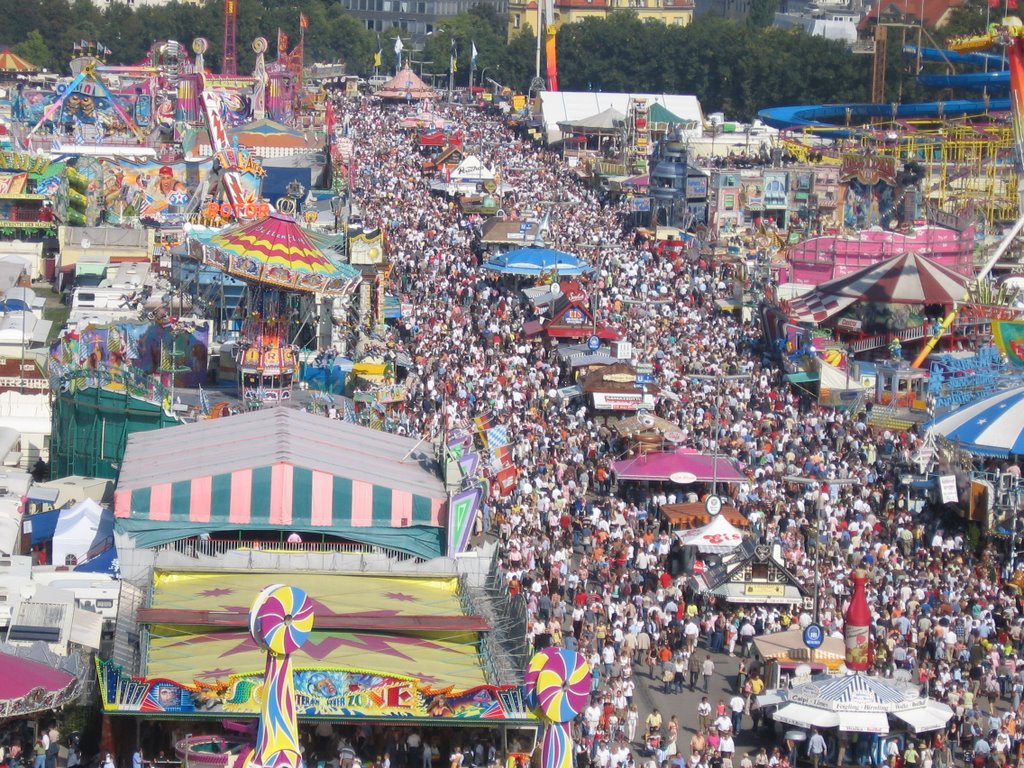
As it turns out, “you can drink a lot of beer there,” is a pretty accurate summary of the festival. Upon exiting the U-Bahn (public train system) the mass of people in lederhosen, keg hats and heart cookie necklaces sweeps you straight toward the Theresienwiese. There are rides, there are souvenirs, there is a ridiculous amount of food, and yes, there is beer. It kind of reminded me of the Puyallup Fair – except replace all the animals, the shows and the hobby halls with massive beer tents.


The beer tents open at 9am, and by 10am there are drunk Germans and tourists with their arms thrown amicably over each others’ shoulders, singing drinking songs and toasting. Lederhosen (meaning literally, “leather pants”) and dirndls are as common in the streets as jeans and tennis shoes.


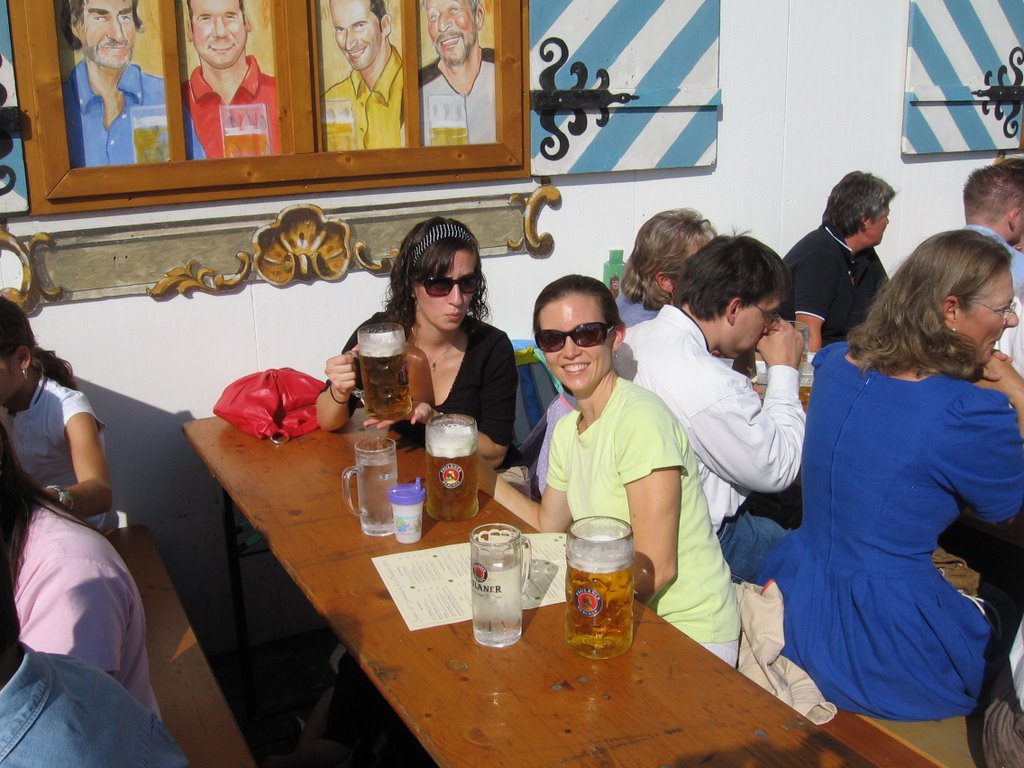
Although there are rides and attractions for the whole family (a good thing, since I went with a family of three boys 7 and under), you really can’t leave until you’ve had ein maß (a liter of beer) from one of the beer tents. That was the first time I’ve ever consumed a liter of alcohol in front of a group of kids I used to babysit. That being said, the entire d'Wiesn was filled with parents getting loud and lusty with their children next to them for the ride. It was a hearty good time for everyone – with the exception of the puking tourists.


I didn’t really add a lot to my German vocabulary, but what I did learn is all very useful. In addition to bless you and goodbye, I can now yell for help and order myself a liter-sized mug of beer.


•• There really are pretzels everywhere in Bavaria – I wish I could live in a city that was filled with both crepes and pretzels – I don’t think I could ever choose one over the other.

••• To see more pictures, click here.

21 September 2006

It's not exactly surprising but always kind of jarring to see how deeply U.S. culture has seeped into France. It's impossible to get a table at any McDonald's in the city, they're that popular. When R and I were having to go to McDo to use the free wifi, it would take us at least half an hour to get through the line and buy a coffee to justify our use of a table. R and I were hanging out with a girl named Anne from Marseilles a few days ago, and she told us when she went to New York for the first time she ate at McDonald's because it was something she recognized from home. I'm not sure how I feel about McDonald's being a universal symbol of comfort.

Because the U.S. is such a large country with massive music and movie industries it's hard to escape American pop culture here. It's funny that what I would consider distinctly American culture has infiltrated the rest of the world and fused with it – I mean that French pop culture is not only French music and movies, but a mixture of French and American. It's no problem finding a movie theater playing new releases in the version originale (V.O. as opposed to V.F.) with French subtitles.

R and I were at a club one night when "Pretty Fly for a White Guy" started playing. I turned to the French guy next to me and said (in French), "Hey this song was so popular when I was 13 years old." He gave me a strange look and said, "Yeah, me too." I should have figured, considering that a French ministry of culture was created to protect French music, arts and media. French radio stations are required to play a minimum of 60 percent French music to counteract the heavy American influence.

There are a lot of words in the English language that are French in origin – rendezvous, risqué, imbecile, for example. Likewise, there are a lot of English words that have been adopted by the French – just a bit more recently in history. Today in class, my professor asked a student to forward him an email: "Est-ce que tu peux me forwarder l'email?" In another class, my professor was trying to describe someone mugging for the camera, acting "trés star." In a pub one night I pointed to a French guy's eyebrow piercing and asked what to call it in French. His answer? "Un piercing!" And of course, there's the ever popular, "C'est cool!"

As much English as there is here, sometimes translations just don't work out as they should. In Nantes, Christina and I spotted a boy wearing a mock FBI-logo shirt that said: "FBI: First Bureau Illegal." We stared at him for a while, wondering if he knew that the words on his shirt have no meaning in French or in English...and then we stumbled upon these...stare, squint your eyes, scratch your head – no matter how long you look, they're not going to start making sense :


It's just funny to me, seeing things here that I would normally think of as "so American" taking on French personality. But anywhere you go people are going to try and imitate what is exotic to them. I guess I just need a few more months out of the U.S. under my belt before I can really appreciate the allure of McDo.

** Who else finds this ridiculous?

*** Due to the fact that I'm hopping a plane to Munich tomorrow morning (visiting the Jorgensons of Tacoma!), I'll be out until Monday or so.

An ad from the Metro (sorry for the glare)...I love French publicité, or "la pub" (pronounced like pube), as they affectionately call it:

20 September 2006

If you are ever having a funk day in Paris – or just need a formula for an automatic good one, consult the following list (in this order):

• Wear high heels to class (and prance around the city in them after school gets out) – they're much less foolish-looking in the 7ème arondissement of Paris than on the damp campus of the University of Washington. Plus, all the girls wear fancy shoes to class here. Embrace the aching feet as badges of honor.

• Buy a crépe nutella-banane from the crépe guy outside St. Germain-des-Prés (the oldest cathedral in Paris, which I walk by every day) who is nice but says disturbing things like: "Are you Indian? I know you'll want a lot of pepper on your galette." Even from the possibly racist crépe man, I'm pretty sure there is no more satisfying after school snack in the world.

• Hang out with fun girls! It's a lot harder than I predicted to go 4 weeks in a strange country without my usual girlfriends, so it is seriously healing to go sit with a group at a café and have french girl talk.


• Find a new museum to check out. Today another girl from group Odéon and I decided to explore the Eugène Delacroix museum right near school. It doesn't have a ton of art (since most of his is at the Louvre), but it's in the apartment where he died and has a lot of interesting things. Plus, it's free with the annual Louvre student pass (15 euro for unlimited Louvre entry for the entire year, what!).

• Listen to ridiculous music on your headphones in the metro. There's something oddly pleasing about secretly listening to Christina Aguilera while crushed between a bunch of sweaty French businessman and the greasy subway door. The Cure is also excellent for this purpose.

• Go buy a tradition (The best kind of baguette – it costs 30 centimes more but is so worth it!) from the nicest old lady at the corner boulangerie by your apartment. My particular favorite is the woman who is always so tired and flustered by the time I come around at 18 or 19h that she calls everyone "monsieur." Of course, this insult only flusters her more – especially the days R or I wear skirts and she's still confused.

• Continue to scheme ways of convincing the Fédération Française de la Couture that I am a member of the French press and I definitely need a free press pass for Fashion Week (the first week of October in Paris). If anyone has any bright ideas on how to facilitate this, please let me know.

So Sciences Po sent us another email – apparently registration is now Friday. Interesting, considering that I'm flying to Munich at 7h Friday morning and supposedly the only way to get the classes you want is to sit still and keep refreshing the website all day long. I'm not sure what my plan to get around this will be...right now it's wait and see if they magically change it back to Thursday!

So other than having no way to register for classes, I think I'm doing pretty well at the four-week mark. I have a place to live, people to hang out with, a job and easy access to banana-nutella crépes. Although this is probably the most romantic city on earth, it's also the best place to be to just hang out with yourself. Last night I went to see Le Vent se Lève by myself (going to movies alone is one of my most favorite things to do) and there was not a single group of two or more in the theater. It was me and maybe seven other lone people scattered through the room. It was the same way when I saw Marie Antoinette a few weeks ago, except there was one couple in the middle of the singles.

I think people are a lot more nervous about being on their own at home, but here it's totally normal to go sit and have lunch with yourself at a café, or go to the cinéma or a museum. It's an easy place to start over with no friends. I promise I am not as pitiful as that just sounded – but it's true, Paris is a forgiving place to be on your own. Of course it's always more fun to have your girl group!

** A cultural note: Shower caps are different here. In the U.S., they're voluminus plastic bubbles large enough to protect your hair and probably face, neck and shoulders from any water. In France, they're more like decorative swim caps. I was pretty thrilled to discover that the one I purchased for a euro at Monoprix is randomly trimmed with lace. I think the extra trim makes up for the fact that I can barely fit my head inside of it. Really though, who needs to be lace-trimmed in the shower?


*** This is a favorite outfit of Parisians. Apparently.

19 September 2006

It took Prof. Rouzin a few minutes to goad us into conversation today – none of us were particularly enthusiastic to confess the countries we make fun of to a room full of international students, but she wouldn’t take no for an answer.

“Les Belges, Les Belges sont les objets de toutes nos blagues!” (Belgians are the butt of all our jokes) she repeated, and pointed to Chiana from Spain.

“Les Catalans,” Chiana said sheepishly, but her answer opened the door for the rest of us. “Canadians!” was the energetic response from two University of California students (a Davis and an Irvine), while Yvonne from Singapore apparently makes fun of Malaysians. The British laugh at Scotland, Chileans scorn Peruvians, and people from the Netherlands get no respect from Germany. It sounds like everyone everywhere has the neighbors they like and the neighbors they like to feel superior to.

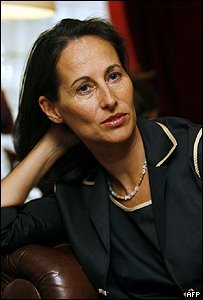
Each week we have 14 hours of French class (in effect an entire UW quarter crammed into 4 weeks) and 4 hours of “Travaux Pratiques.” My actual French language classes are more of a redundant review of grammar rules, but I really am learning new things every day. For Travaux Pratiques, we spend two hours twice a week listening to Prof. Germanangue lecture about anything he thinks we need to understand about France. He’s the one who works for Ségolène Royal, and as a Sciences Po alum, his are the most interesting four hours of my week.

Today the whole class was nearly absent for registration – luckily we’re apparently all at least semi-intelligent (though maybe not compared to our French counterparts at Sciences Po), because everyone but sick Rachael was in class on time today. Last night at 22h an announcement was added to the registration page moving our scheduled day back to Thursday. It’s a good thing I checked online this morning, because we spent all of M. Germanangue’s class discussing the French press. Needless to say, I was pretty into it.

In France (and most countries) there is the presse régionale and the presse nationale. The national papers are mostly based out of Paris (it’s the largest city and center of the government – it makes sense), and of these, there are five that are the most significant. Ranging in slant from the far left to the far right, these newspapers also happen to range in physical size – the largest paper being the most conservative and the smallest the most liberal (in the U.S. sense of the word*).

While American liberals would be closer to moderates on the French political scale, the farthest left-leaning paper is L'Humanité. Founded in 1904 by the Communist Party of France, the journal (newspaper, if you didn’t already guess) was considered the organe officiel (official mouthpiece) of the CP in France.

After L’Humanité is Libération, journal of the French “BoBo.” This is the term given to the bourgeois-bohème, sometimes known as la gauche caviar. Fairly self-explanatory, these terms are probably closest in meaning to the “limousine liberals” of the U.S. – basically people of comfortable socio-economic standing who sympathize with figures like Che Guevara. Libération apparently sells a lot of copies in the 10ème and 11ème arondissements – the funky middle-class areas.

Right in the middle of the nationales falls Le Monde. This is probably the most generally respected paper in France (though as M. Germanangue said, it depends on your personal politics). Le Monde staff consider themselves the French equivalent of the New York Times, and even M. Germanangue couldn’t assign a definite political sway to this paper. When a student asked where in Paris Le Monde is read, the answer was “Ici.” Right here at Sciences Po. Le Monde is the newspaper of professors and intellectuals, and is the safest bet for objective news writing.


Fourth is La Croix. As can be determined from the title (The Cross), La Croix is a French-Catholic news outlet. This paper’s slant is usually neither specifically politically left or right, but is obviously socially conservative. During the Dreyfus Affair (the temporary exhibit at the museum of Jewish Art and History right now), however, it took a decidedly anti-Dreyfus and anti-Semitic stance.

The largest (in size and circulation) conservative paper in France is Le Figaro. According to M. Germanangue, Le Figaro is read in clubhouses and in wealthy homes of the 16ème arrondissement. It’s funny to me that these papers can be completely shamelessly slanted – but it’s okay because they don’t pretend to be objective. Every French person chooses who to take their news from – with no apologies. Of Monday’s front pages, the centerpiece article in La Croix and Le Figaro featured the pope’s semi-apology. Libération, on the other hand, printed a full-page photo illustration of Ségolène Royal.


Most of the class was rapt for the entire two hours – we were also tickled to walk into our next class and have Prof. Rouzin ask if anyone had seen the article on Ségolène Royal in Libération yesterday. Thanks to our new comprehensive understanding of the journaux quotidiens of France, we were able to quickly deduce her (leftist) political leanings. I don’t know if I can remember the last time I was this interested in school – it’s kind of exciting.


* It’s important to distinguish that in France, “libéral” refers more to liberal economics, or those who support the free market/capitalism. These people are typically more conservative in the U.S.

** I just got an email from Sciences Po saying they understand that the courseload is extremely dense and students barely have time to complete their work, much less relax during fall semester. In light of this, the email detailed the dates of a bunch of extra vacation days for our “travaux personnels,” or days to get things done. Now we get a random week off of classes in the middle of November, and a few extra days in mid-December. Hooray!

18 September 2006

If Sciences Po really is the training ground for the government of France, I can definitely see why it is so hard to get anything done in this country. As great as the actual education is supposedly going to be, the lack of organization is sometimes a little hard for an American girl to take.

Last Monday was the first day of orientation classes for the international program. In every schedule R and I had there was a slot for “Lundi 11 septembre: Début des cours.” We could not for the life of us, however, find any indication of where or when these classes were supposed to be starting. Finally we decided that nothing would be starting before 9h, so if we got to Sciences Po by 8h30 we’d have plenty of time to figure out where we were supposed to be.

Arriving at 8h30 at Sciences Po was another story – we easily located the list that told us our language level and group (R and I are both in “Odéon”), but nowhere could we find a time or a room number. After maybe 20 minutes of confused wandering, we realized we had become part of a group of about ten confused wandering Sciences Po students. We asked at the Sciences Po information desk, but the man working had no idea what we were talking about – he sent us upstairs to find a random French professor who told us we should go to the administrative services building and see what we could find out.

As with everything else administrative in France, we ended up on a 30 minute goose chase, ending finally with a student employee printing out and photocopying our group schedules. I’m not sure what the rest of the international program did. Even after receiving our schedules and discovering that group Odéon didn’t meet for the first time until 1:30 that afternoon, we couldn’t really be annoyed – this is France, we’re used to the run-around.

Another example of the French inability to either plan or communicate a plan is the registration system. During the first week of orientation we were all told that we’d be registering for classes the 21st and 22nd of September and we’d get more information later. R and I somehow ended up not even knowing that the informational registration presentation had occurred without us being present, but we bummed the pertinent information from other Odéon students.

As R is sick with strep throat (I’m pretty sure I have built up some strong immunity to the various illnesses she’s nursed since arriving here, since we sleep in the same bed, and I’ve never shown any symptoms of illness), I set off for SciPo alone today. When I got to class I joined the group of students talking about which classes we were interested in signing up for on Friday – this is when Johanna from England stepped in and informed us that registration would now be occurring online tomorrow at 9h. Did the international program email us? Did our professors know? Were there signs of any kind? Of course not. The only notice was a change in the date on the actual registration web page. I’m not sure what we’d all have done if Johanna hadn’t been trying to get a feel for the website last night!
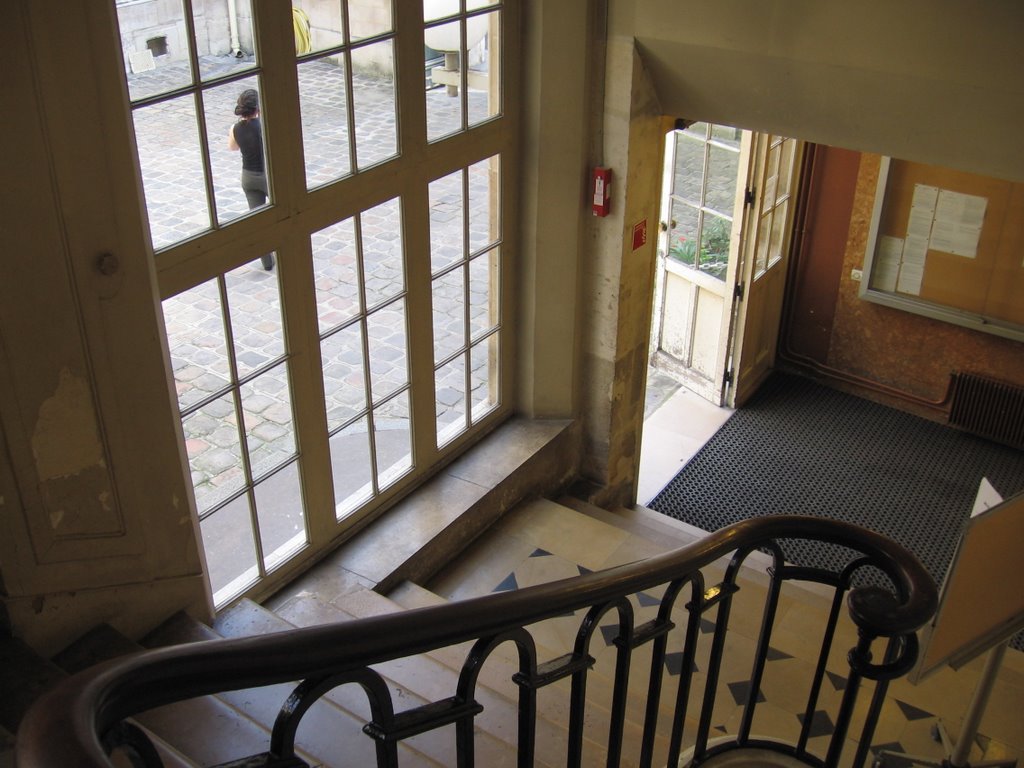
EDIT: As of an hour ago, there's a new update on the website switching our registration from tomorrow to Thursday – what the heck? I have no idea what I'm supposed to be doing. We'll see tomorrow, I guess!

As frustrating as trying to get things done can be, R and I are getting used to the pain. It helps to feel like I’m actually improving in French with 14 hours of language classes per week. One of the most useful tricks I’ve picked up is to always remember that the French do not like unattractive things. They don’t like the Eiffel Tower, they prefer svelte bodies*, and they don’t like anything that sounds bad. This helps a lot when you’re learning how to speak French – if the sentence you just put together is not particularly pleasing to the ear, it’s probably wrong.

It has also become really exciting everytime a French person asks me what my nationality is – and it’s even more exciting when they assume I’m from another European country. In Nantes with Christina the country we got most was Spain. It’s nice to know my accent doesn’t scream “I’m an American!!” I’m starting to feel like something else falls into place with every day that goes by – whether it’s dealing with French beaurocracy or learning cheater’s French speaking tips.

* The first night Rachael and I went out with Rubens and his friends, the boys were all really excited about “Ohhh two beautiful American girls! Who are not fat! Like the rest of Americans!” I think they were trying to compliment us, but I was kind of offended for my country.

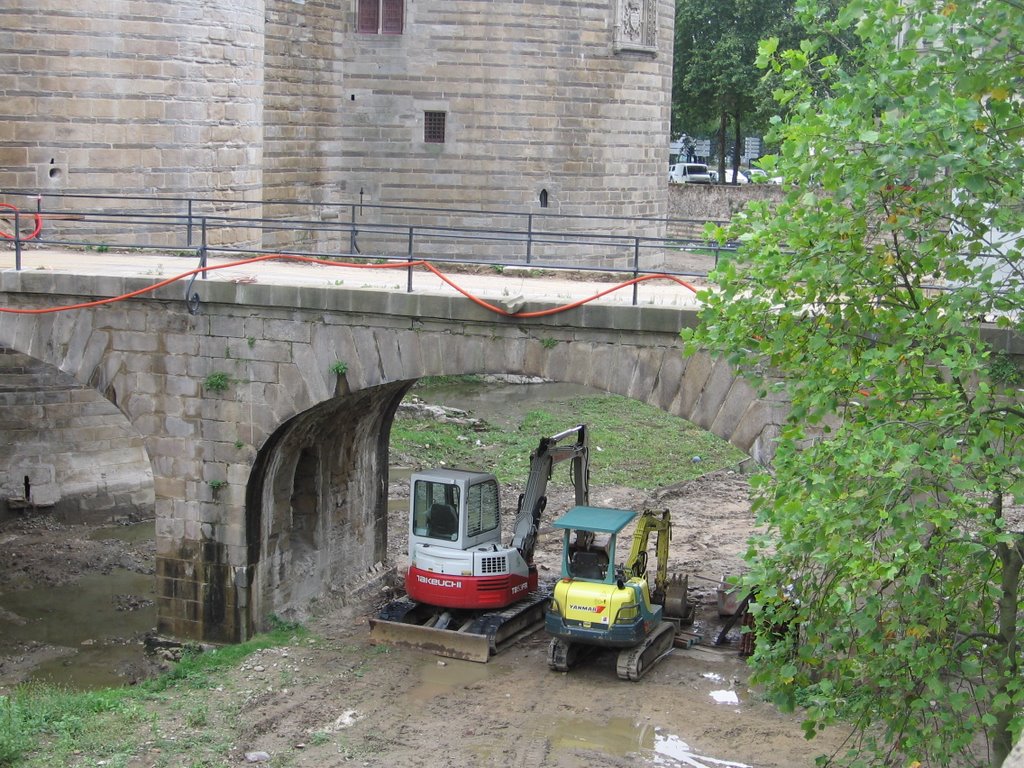
** It always tickles me to watch the fusion of things modern and ancient – living in a country whose ancient history is visible in the streets is a prime opportunity to witness this. Bulldozers clearing out the moat of a castle in Nantes, for example.

14 September 2006

Yesterday may have been my strangest day yet. I got up at 7h, got dressed, checked my email and packed my lunch for the day. Then R and I took the metro down to the 7ème for class.

On the way home we stopped at Monoprix to buy some notebooks and laundry soap, then headed home to wash three enormous loads of laundry – hey, it’s a pain to go to the laundromat! That’s why we tend to let a lot of time lapse in between trips. Over the past three weeks, both R and I have adopted more French-like hygiene habits. (Perfume, for example, is an amazing invention – you’re going to be sweaty by the end of the metro-filled day anyway, so stop trying to be clean all the time and just cover up the body dirt with some good Chanel).

We have also adopted the practice of “airing” our clothes rather than washing them. Okay yes, I realize it sounds disgusting, but we’re in France! Everywhere we go, we end up reeking of cigarette smoke, thus all of our clothes tend to smell pretty funky by the end of the day. Laundry, however, is usually around 4 euro (5 dollars) per washing machine, and 4 to 5 euro to dry clothes – we are way too cheap to wash a 10 euro load every week. Instead, we hang everything out the window for a few days…usually by the second morning our pants smell almost completely normal.

After our enormous laundry haul, R went to meet some family friends for dinner, and I stuck around the apartment to work on my list of “things to do.” After a few hours of dishes, changing bedsheets, going to La Poste, doing homework, cooking dinner and returning emails, I started to feel kind of odd. Everything just suddenly seemed so very normal. Except that I’m in Paris. The dishes:


I’ve spent so many days of my life “getting things done,” but this one was the first that ever took place in another country. This is really when it started to hit me. Up until this point, everything (even the stress and school) felt like a crazy Parisian vacation. Hanging out at the Jardin des Tuileries, stalking tourists at DaVinci Code sites, going to bars and restaurants, meeting people, buying baguettes – none of it felt like real life. But now it is. It’s just happening in a brand new location.


Even classes are bizarre. In some ways, I feel like I’m sitting in a French class at UW – but then I look around at the walls of the Grand Siècle mansion I’m learning in and remember that Mary Gates Hall doesn’t exactly look like this. Today we were discussing different French political parties in my first class, and my professor made an offhand comment about having to leave right away to meet the woman he’s working for. Who’s the woman? None other than Ségolène Royal – a Socialist who could very well end up being the first female president of France after the 2007 elections.
That’s not even a weird “I’m in France” thing – it’s a Toto, we’re at Sciences Po now thing. R and I have unwittingly entered a twisted web of political connections – a world whose inhabitants scoff at a degree from La Sorbonne, and whose administrators take their school so seriously that just 3 absences over the course of a semester will earn you an automatic failing grade.

As jarring as it is to hear casual references to Royal and other powerful political players, it’s all a part of the world I’ve entered. It’s a world with the Eiffel Tower, baguettes, politics and “France’s elite” – but the laundry and dishes are always accruing.

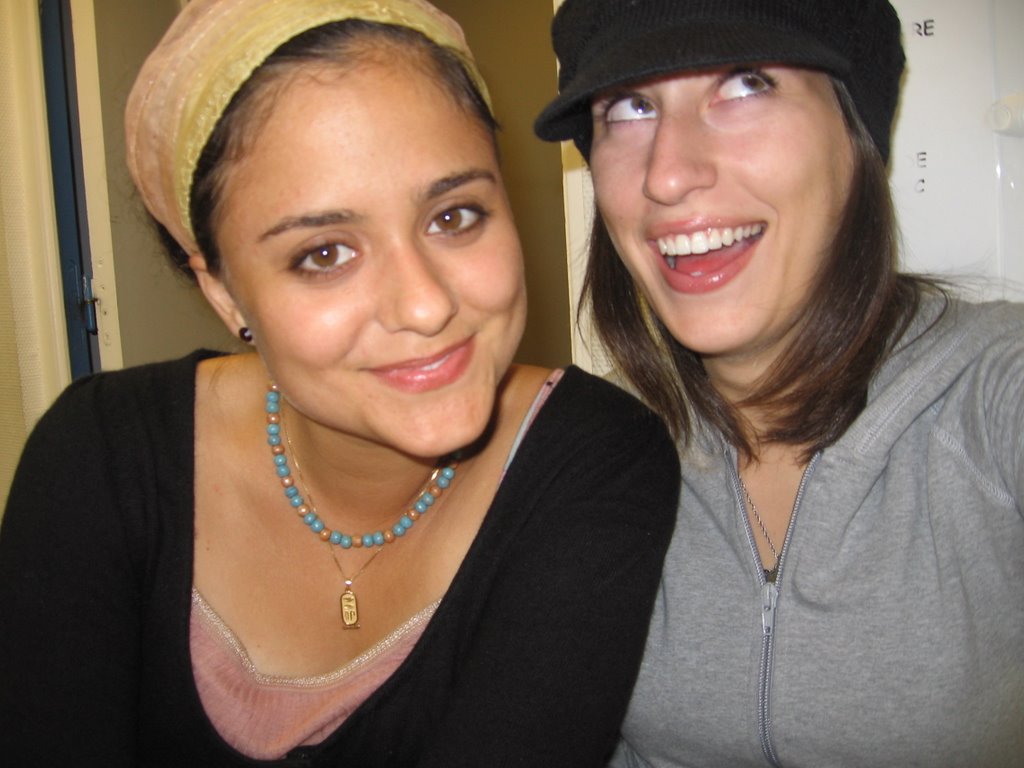
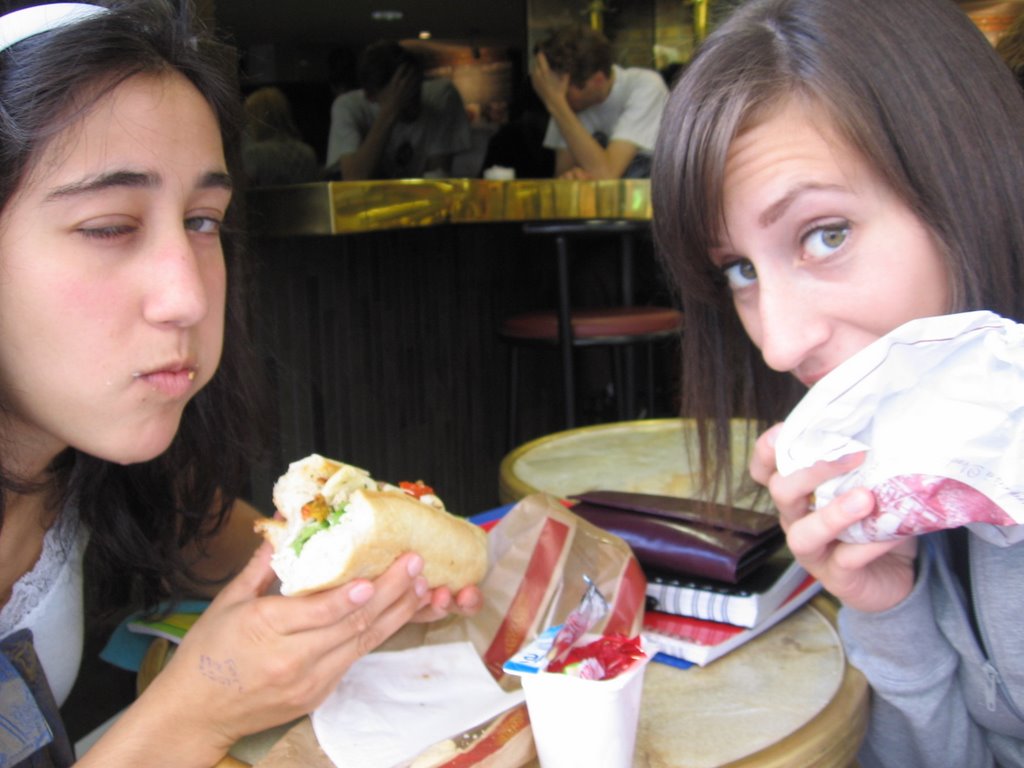
Here's a picture of Rachael and I chilling in a boulangerie on our lunch break today – just living the Parisian life.


** I’m heading down to Nantes for the weekend, so you won’t be hearing from me until at least Monday morning.

13 September 2006

Here are a few pictures of the interior of Sciences Po. I have no words today.

This is at 56 rue des Saints Pères, the building where I'll be spending most of my September. Everything is so old.


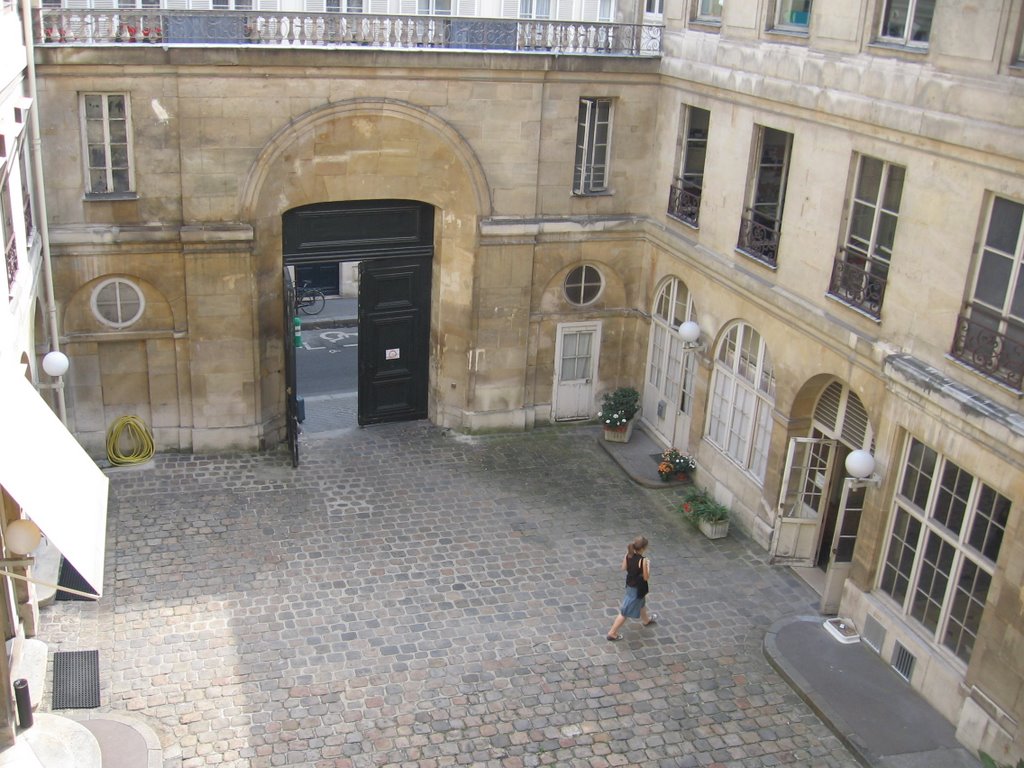
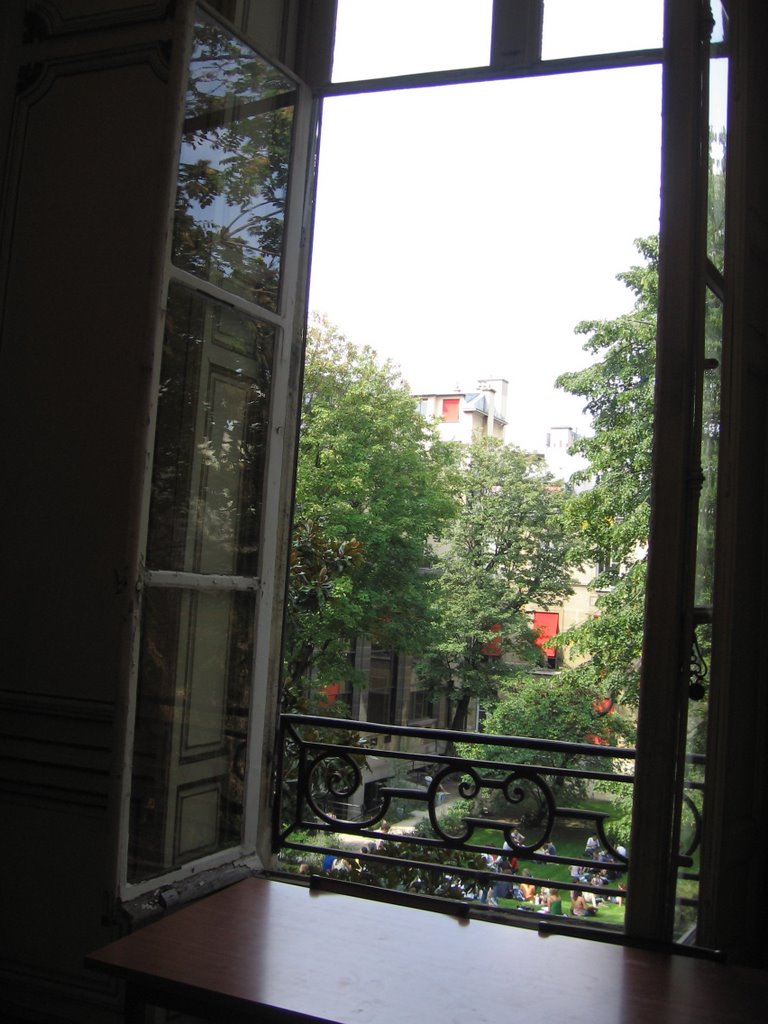
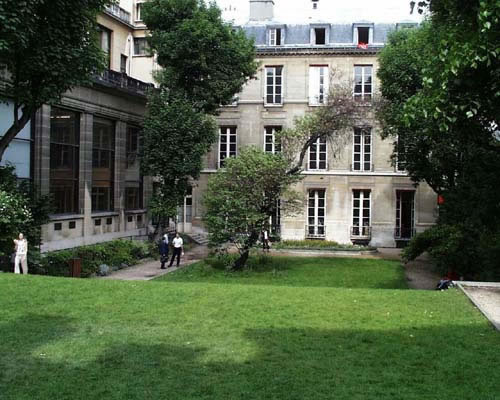
This is the courtyard at 56 rue des Saints Pères. Between this building and 27 rue Saint Germain is the grassy and tree-filled courtyard pictured two posts back.


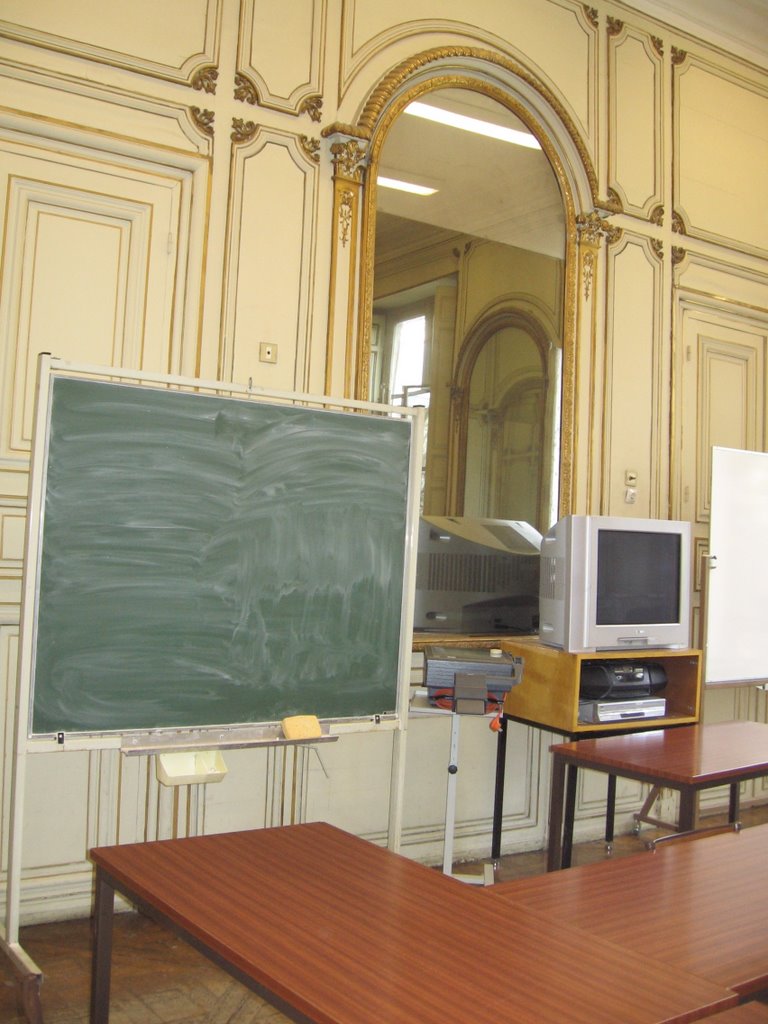
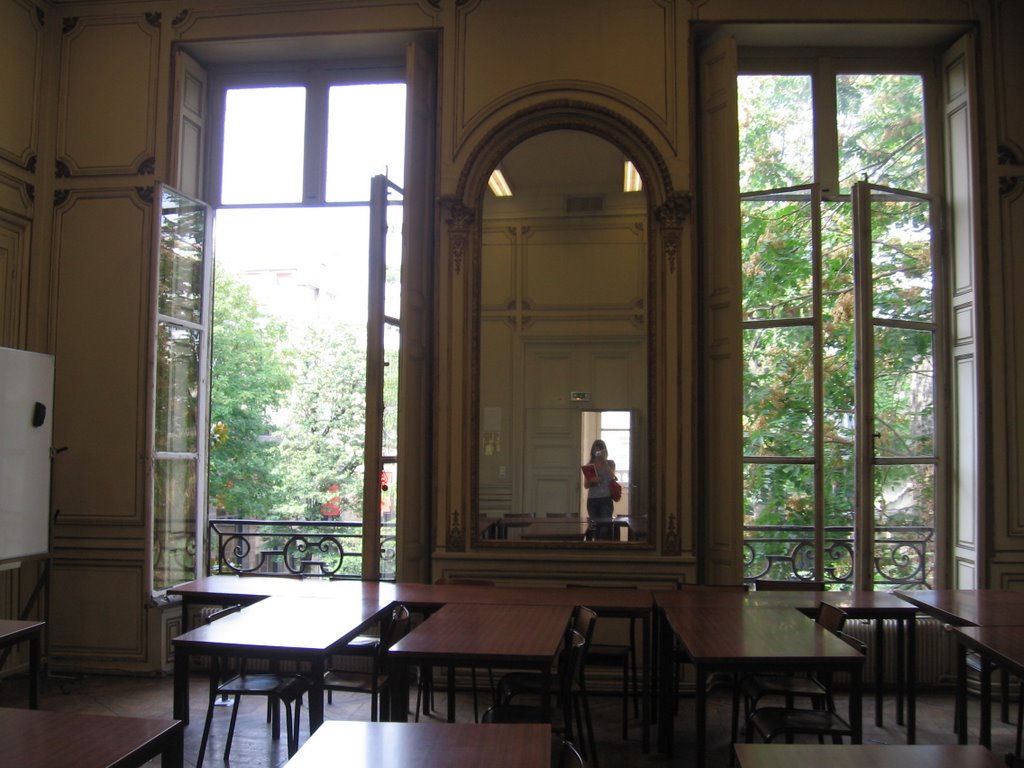
This is a typical classroom. Note the walls.


The same classroom.


You can see part of the foliage of the main courtyard here.

12 September 2006

Parisians like to tell visitors that once you’ve lived in Paris, no other city will ever satisfy you. I would chalk this sentiment up to maybe 50 percent French snobbery and 50 percent pure adoration for this city.


When someone moves to Paris from another part of France, they say that they “monte à Paris.” Even moving from Lille (in the Northern point of the semi-star that is France) to Paris, you are still “going up” to Paris. One of my professors told us today that il a monté à Paris 11 years ago from Marseilles, and now could never imagine living anywhere else.

Paris to Parisians really is the “centre du monde” (center of the world), as tee shirts proclaim from every souvenir shop in the city. To them, everything they could possibly need is right here – and if it isn’t, there’s a ready substitute. Landlocked Paris has no beaches? Not a problem. A stroll along the part of the Seine that passes through the 8ème will demonstrate that city-dwellers are perfectly content to sunbathe right on its concrete banks. Bikini tops are optional for women, while teeny black speedos are the typical male uniform.


Like that bizarre breed of Manhattanites who are rumored never to have left the island, legend has it there are certain people who have never left Paris’s Île de la Cité. On foot it takes barely 15 minutes to walk the length of this tiny island in the Seine, but these Cité-dwellers say they have everything they need. Though my sentiments are not quite as drastic of those who live on Île de la Cité, it’s hard for me to imagine a person who could resist the charms of Paris. Indeed, after three weeks here, I find myself drifting dangerously close to overattached.


Everyone who comes here falls in love – whether it’s a fleeting affair or a long-term commitment, the city is irresistible. Even the Nazi general stationed in Paris during the last fight for its liberation could not set it ablaze as ordered. When his superiors asked him if Paris was burning, some fleeting (or perhaps lasting) love stayed his hand (and arsenal).


Like anything beloved, Paris has its faults. The traffic is terrifying, whether deadlocked or roaring around curves at 100 km/h. Some of its dwellers are liable to become obnoxious or violent when you deny them your extra change. Every day spent in Paris coats the body with that unmistakable layer of city grime that feels so much more disgusting than any other kind of dirt. The metro is dirty and overcrowded – so is the entire city, come to think of it. The cost of living is outrageous. Parisians are “snobs.” The city is completely overrun with tourists and the sidewalks are covered in unscooped dog poop. I could list a hundred more, but Paris’s flaws are not the point I’m trying to make. The point is that as a Parisian, these are the things you learn to accept, because this resigned acceptance is what makes Paris yours.


In Le Petit Prince, the fox says “…si tu m'apprivoises, nous aurons besoin l'un de l'autre. Tu seras pour moi unique au monde. Je serai pour toi unique au monde...” If you tame me, then we shall need one another. To me, you will be unique in all the world. To you, I shall be unique in all the world…” This is how those who live in Paris feel about their city.


This pride, this arrogance, this sense of belonging of one to another is what it means to be Parisian. I think the city is taming me.


** And finally, a note from Paris to all of you tourists (I have an address here, I’m allowed to morph into a snooty Parisian for a minute): Wearing a souvenir tee shirt that proclaims your profound love for the city you and your guidebook are currently in is not cool. We all love Paris – give it time and you’ll learn to express your appreciation for the city with all the subtle snobbery of those of us who never want to leave.


*** This is my name, spelled phonetically in French. I don't get it either. By the way, I was only at Starbucks in Paris because Anne (who is French by way of Marseilles) loves it. As she says "It's so American!"

11 September 2006

Today I had French class in a mansion from the Grand Siècle ( the epoch of Louis XIV). Our classroom has parquet floors and an ornate fireplace with an enormous gilded mirror hanging above it. The campus of Sciences Po is based in a series of ancient mansions set around perfect courtyards for taking a café or a cigarette (if you are a part of the smoking majority here – I am not), but today for the first time I was overwhelmed by its history.

In 1872 a man named Emile Boutmy founded the great great grandfather of Sciences Po, L’école libre des Sciences Politiques, with the mission of creating a training ground for the “elite” who would one day run the country. Today, 134 years after its foundation, Sciences Po is still thought of as the training ground for France’s political elite. At least, this is what I found out through Internet research and reading the student handbook. Even learning about these lofty founding ideals meant little to me – I was much more concerned with the fact that I would soon be living the Parisian life than that I’d be carrying out a sacred French tradition.

Today, I am finally beginning to grasp what it really means to be a student of Sciences Po. For the past two weeks, everyone R and I have met has said “Ohhh Sciences Po,” with an inexplicable reverence in their voice. We were always tickled of course, but the application process for the International Programme was not a rigorous one, and we’d always brushed off the admiration.

I knew SciPo was a good school for political science when I applied, but frankly we’re pretty unaware in the U.S. I’d never even heard of this grand école of France before I read about the study abroad program on a UW website. For international students, the admissions process is fairly simple, mainly because Sciences Po requires its French students to spend their entire third year abroad. To facilitate and lessen the financial burden of the process, Sciences Po offers a direct exchange with all of its partner universities around the world. This in turn means there are quite a few slots open for des étudiants étrangères.

For French students, the process is significantly more daunting. From the age of two years old, French children are funneled into the long schooling process that will eventually determine the future of each. At the end of high school is the culmination of all previous schooling in the Bac (baccalaureate examination) to determine their eligibility for an école supérieur. With the Bac, you can not fail – a passing grade will guarantee you a spot in any université in France (the Sorbonne, etc.). In the U.S., going to a university sounds pretty darn good – but here, there is a drastic schism between the prestige of a university and a grand école.

With a university diploma, your schooling is considered a Bac + (however many years you studied after). Even a Bac + 8 (the equivalent of a doctorate) can have problems in France’s limited job market. With a diploma from a grand école (Sciences Po, for example), however, you have your choice of jobs waiting for you when you leave school. You could have a Sciences Po diploma + 3 and far more respect than a Bac + 8. The graduates of the grands écoles of France really are considered to be an elite force.

This knowledge is incredibly daunting to two U.S. students who had never heard of Sciences Po before application. We had both heard of the Sorbonne and its prestige – apparently compared to a grand école though, the Sorbonne is merely shrug-worthy. R and I are a little worried that we may have accidentally landed in a very wrong place. As relaxed as the international application process was, the international program is not separated from the rest of Sciences Po. The two of us are about to find ourselves competing for grades with students who have been preparing and working toward this for their entire lives.

Argh, is it too late to turn this year into an academic sabbatical? Learn by living, rather than be trained alongside the elite forces of France? At any rate, we’ll no longer be brushing off the “oohs” that come with any drop of the name “Sciences Po.”

** Every newspaper here had September 11th coverage today. It ranged from the incredibly tacky (Paris Soir featured huge color photographs of the towers crumbling), to some really interesting political commentaries in Le Monde and Le Figaro. Other than the media coverage though, nobody said a word about it until the beginning of French class this afternoon. One of the other Americans in my group was writing the date on his notes and said, "Oh yeah, it's September 11th." There was a collective somber nod, and that was it.

I feel like the date was more respectfully covered with silence here in France than in most gawdy "Patriot Day" tributes at home. That's probably mainly due to the difference between a country that witnessed the attack and the country that endured it. In the U.S., Sept. 11th is a day of remembrance – here, it's a reminder to always look toward the future. Use our collective history to guide today's politics for a better future.

10 September 2006

Here is some news to settle the fears of everyone who has been worried that I just came to Paris to become homeless and get attacked in the streets: I officially have a place to live. Not only a place to live, but the most perfect place I could have possibly found.

I have first date stomach (you all know the butterflies) I’m so relieved right now. After two and a half weeks in Paris with nowhere to live, and two weeks of moving from hotel to hotel and getting nowhere in the quest for an apartment in one of the three most expensive cities in the world, I am finally in a very good place.

Last weekend R and I first discussed the idea of continuing to look for an apartment together, but also beginning to search a little on our own, to broaden our options. I suggested this because although we had pretty similar apartment goals in mind, I was interested in looking in more and different areas of Paris and at different types of living situations. We both agreed to this amicably – which is lucky, since we’re still living together for all of September – and as we settled into our September sublet, we began a much more extensive search for housing in Paris.

On Wednesday morning I was checking Paris Craig’s List, when I happened to take a peek at the “childcare wanted” section. This was a complete fluke as I’d thought about working as an au pair, but had no idea how to find a family, and was under the impression that not many French people have heard of the San Francisco-based Craig’s List. As another fluke in a series of fortunate coincidences, an American woman living in the 2ème with her French husband and four (!!) bilingual children had just posted a promising looking ad: “Childcare in exchange for studio in Paris centre,” and I emailed her immediately.

After a few hours of emailing back and forth on Wednesday – details about their family and the studio from her, and long paragraphs about my experience with children (and pretty much everything about me) in return – we planned to meet on Friday morning. The whole deal sounded almost too good to be true, and I was trying to reserve any feelings in case something went wrong – as things have tended to do thus far in R and my apartment quest.

I met just with the mom on Friday morning, and returned on Saturday to join parents and kids for a family lunch. Both times I left wishing to be a part of the family. Friday morning, we’d chatted for a while about job details, and ended up spending more than an hour talking about anything and everything. Saturday was the first day I’d met the kids, and although the family is very very privileged, they are just nice nice people.

Not only did I feel like I clicked immediately with the family, but the job is perfect. The family is Franco-American, and they live in a three story apartment between the Louvre and l’Opéra. The mom stays at home with the kids, and the dad (an alum and former teacher at Sciences Po) apparently has a pretty good job, since they also own my studio. It’s in the same building, just upstairs from the family’s apartment. It’s technically a studio because it’s all one room, but it’s larger (or maybe just better designed) then any other I’ve looked at. It’s one long room with a full kitchen separated from the living area by a counter/bar for eating. Up a set of stairs/ladder thing is a loft for sleeping. All furniture is included. As I was told, “You’re only here for a year, of course we don’t expect you to want to buy furniture!”

Here's my new courtyard. My job will be helping mom for a few hours each weeknight and doing some extra babysitting as needed. I’d also possibly accompany the family on a few vacations to their other house (!!) in Provence. It’s a time commitment, but after meeting the family I’d already decided to take it if it was offered. I liked the family enough that I’d willingly give up a few extra hours of Sciences Po bonding to be a part of this family instead. Plus, no rent? That’s 500 tons of stress off of my mind. And the minds of my parents. And probably grandparents too, come to think of it.

* In other news, R and I spent the day at the museum of Jewish art and history in the Marais. It was pretty interesting, but a lot of it didn’t hold the same significance for me that it did for Rachael. I was more interested following her around and learning about how expensive it is to outfit strictly kosher kitchens. One interesting thing at the museum was the amount of security. Upon entry, everyone’s bags and coats are scanned, and after passing through metal detectors, visitors are allowed entry one at a time, by men in black suits with earphones (Men in Black style). It’s too bad that that level of security is necessary – even the Louvre is much more relaxed, but with the current sentiments in France, they’d be crazy to lower security. R says temples in Los Angeles also have metal detectors and x-ray scanners – I wonder if Seattle temples have adopted similar security after the shooting this summer at the Jewish building downtown.

* On a more fun note, here’s an observation that would have fit better into the previous post. French boys are really different from U.S. boys. They wear tight pants, carry man purses and have more artistically-styled hair than most of the girls here. They borrow my lip gloss and pretend to make out with each other in the street. They’re perfectly content to go to a club as a group of guys and dance just with each other. They think nothing of ordering Cosmos or Sex on the Beaches in bars rather than typical guy beer. In the U.S. they would be beyond “Metro.” Here it’s just Euro style – because they’re also the biggest flirts R and I have ever encountered. Last night our friend Rubens took us out to St. Michel with a group of his guy friends from school. We ended up at a pub that plays only old school American/English pop music, and R and I were thrilled to meet about 15 boys who knew all the lyrics to Shania Twain’s “Man! I Feel Like a Woman,” and were totally confident enough to sing and dance along with R and I. They were also almost (but not quite) as excited as I was to get to dance to the Spice Girls’ “If You Wanna Be My Lover.”

09 September 2006

Life in Paris is becoming surprisingly natural after two and half weeks here. There are a lot of subtle differences that R and I have had to adapt ourselves to, but most have slipped into our lives so quietly that we didn’t even notice ourselves changing.

I’ve gotten over my initial shocked outrage that Coca-Cola Light (Diet Coke) costs more at a restaurant than regular coke. If you don’t want to pay two euro for it, you have to buy your own litre at a Franprix anyway. We’ve accepted the fact that you can’t find skim milk here – it’s crème, half and half or whole milk. After a day of silent milk boycott, we caved, and we dine on incredibly rich cereal every morning. I no longer feel like such a bumbling fool on the metro, and R and I have caved to the peer pressure of cheating two to a ticket every trip (that’s just what you do here).

We’ve had our mishaps in the ongoing process of adaptation. One day (before we had our yearlong metro cards) we’d both snuck into a station on my ticket. Now most who cheat the system are used to the process and are smart enough to keep an extra stash of stamped tickets in their purses and pockets. R and I were still learning at this point, and when we could only provide one ticket to the RATP police doing spot checks at the station, we owed a sudden debt of 30 euro for our misstep. Of course, this just made us bitter and feel like we needed to make up that 30 with a lot more cheating – with used tickets in our pockets, of course.

We’ve learned that if you want a good inexpensive wine, don’t even bother trying to pick one yourself – there is so much wine in France that you could probably go 100 bottles of vinegar before finding a decent one. It’s always, always safer to ask an employee of the epicerie to recommend one they like, and once you find a tasty wine, stick with it! It’s also important to remember to request glasses with your bottle of wine. Despite the fact that everyone drinks outside in public here, it is never cool to swig wine from the bottle. If you do, you’re practically screaming out your U.S. citizenship. If you have water bottles on hand, it is possible to make do with those (as we were forced to the night we forgot glasses), but you will look like a fool.

There are so many other tiny details that R and I absorb each day – the fact that baguettes are 80 cents no matter where you are (the price is regulated by the government). The fact that everywhere, in restaurants, stores, even in the Laundromat, even with complete strangers, you greet everyone with a bonjour or bonsoir. It’s the acknowledgment that’s important.

At meals, you put your bread on the table next to your plate, never on it, and your napkin stays on the table (not in your lap) at all times. The fact that French tap water is delicious, but nobody drinks it – if you don’t want to buy water bottles everywhere you go, make sure you fill up an Evian bottle in the safety of your home, so nobody knows where your water came from. If you don’t want to gag, do not ever drink Vittel water, and make sure you specify that you want “une carafe de l’eau,” rather than just saying “l’eau,” or you’ll end up with a bottle of odd-tasting mineral water that you have to pay for.

Bathrooms are always in restaurant basements. If you want to sit down with your baguette sandwich, make sure you say so – if you pay the à emporter (take away) price, you are not allowed to sit down with the patrons who paid the extra euro to do so. It’s always safer to buy sandwiches, etc. from a boulangerie where the bread is made fresh, than from a stand that buys its baguettes from another party. If you want a good crépe, stay away from the touristy centers of the city – head instead to St. Michel or the square near Les Halles where they’ll be both fresher and cheaper. If people with pamphlets approach you asking if you speak English, say “Non!”

These are the things you get used to in any new environment – I probably don’t even realize most of the changes I’m making. Here’s one more – if you want to relieve all of your stress, find an au pair job with a great family and live in your own studio apartment in their building rent-free. More on that to come.

07 September 2006

Tonight was the Monte Cristo party for all international students. R is sick, so I ended up having to go alone. Somehow, it was fun anyway – I ended up dancing all night with 2 boys from the Sorbonne, 3 from Germany, one from Montreal and one from Boston – all at once. For some reason I ended up dancing in the middle of the club with them all kind of awkwardly dancing around me in a circle. Who knows how I ended up pimp of all the boys...but it was entertaining.

Somehow, from within the depths of Le Monte Cristo, it didn't seem to be a problem that I'd already missed the last metro and had no money (or debit/credit) card for a cab. I figured I'd just walk. I've had my pepper spray for two years now, and though I've walked with it held out before, I've never had to use it.

Tonight though, it was 2 am and all I wanted to do was call my friend Kelly from a phone booth near the Champs Elysées. I was in the phone booth, arranging my stuff when a dirty man began pounding loudly on the windows. He demanded 10 euro from me, and when I told him I didn't have it, he became even more insistant. I told him (in french) that if I had 10 euro, I'd be in a taxi, not a phone booth, that I had no cash and no bank card, but I was sorry.

Instead of leaving, he opened the door to the phone booth, grabbed me by the chest and threw me to the ground before walking away. (EDIT: When I woke up this morning, I still had a dirty handprint on my chest. Yuck.)

I picked up my pepper spray, and though I didn't know the word in French, I told him I would "put pepper sauce in his eyes," since that was the closest translation I could come up with. I ran away shouting at him and wielding the pepper spray, and being a girl, I of course started crying. I was running up a side street crying when a man started following me. He didn't seem menacing though, so I turned around and asked him the way to Gare de L'est. Talking to a friendly person at that point was too much for me, and I couldn't stop crying.

This man owns a restaurant near the Eiffel Tower, and he withdrew money from his own bank account so I could take a taxi home. He never tried to touch me, but told me about 10 times that I was very pretty, and I shouldn't cry. I tried to get his phone number or at least his name so I could pay him back his 20 euro, but he refused. All I could get was the name of his restaurant, and I promised him I'd be back with my roommate.

Now that I'm back safe in R and my September apartment, it's hard to stop crying. Part of that may be the fact that I think I have my own pepper spray in my eye.

Nevertheless, the point of this story is that not only has every French person I've met been excited to learn that I'm American, but each one has tried to take care of me in some way. After my savior tonight, I think I love the French.

I had my pepper spray out and armed while I was being dragged to the ground – though I kept threatening, I was still too scared to spray it, even as I was being thrown into the dirt. Make sure you have the balls to wield the pepper spray you possess, or it will do you no good.

As soon as I stop leaking from the eyes, I'm going to bed – first thing tomorrow, I'm going to locate this guy's restaurant and drop a lot of money there.

06 September 2006

I'm in a great mood today – it was R and my first morning waking up in our sublet apartment, having our own cereal for breakfast and not having to buy street pastries and shut ourselves into a phone booth to call possible apartments. R is sick, so she chilled at the apartment while I went off on my own to shop! First of all, although R might be one of the most laid-back people I know, the two of us have not left eachother's sights in 2 weeks. That is a lot of time. So going off on an adventure by myself felt amazing.

It's amazing to realize that though I've only been here half a month, I'm starting to know my way around, both the city and the system. I love not having to worry about communication issues. There are areas of my French that need to be improved, but it's nice to know that I can go out into the world and speak French without having to worry about getting lost, or confused or misunderstood. Having been here a little while now, I'm also at the point where I can figure out what I need to do to get things done.

Today I needed to fill out an application for the Imagine R card, a year-long discounted metro pass for students of Paris under 26 years of age. Since I don't have a permanent addresss, and hence no French bank account, I had no idea how I was going to mail the money – Imagine R doesn't accept cash. I left our (well it's kind of ours) apartment and decided to head to La Poste (post office) to see if anyone there could give me a suggestion. After 20 minutes in line, I showed my application to the woman helping me and asked if she knew of any way for me to buy a check to mail. She smiled and pulled a form out of her desk – I could do it right there and then for a fee of only 4 extra euro.

Feeling pretty good about having accomplished one thing today, I set off to do some fun shopping in Paris. Let me warn you now that the following will probably only be interesting to me, with the possible exception of my Tacoma friend Annette, partner in hair-product aholics anonymous. If you're not into hair, skip this paragraph. One of the woes of my life is big frizzy hair! Trying to pack for a year in France was difficult, and I ended up leaving out anything that I could easily buy here, so one of my orders of shopping business was locating a good hair straightener. (If you're still reading, you're feeling bored, and you're not Annette, too bad, you were warned!) In Tacoma, if you want a good hair straightener, you go to a beauty supply store (the kind that supplies salons with their equipment), not a drugstore or electronics store, and I had no idea where I needed to look in Paris. I tried to think of who might know, and decided that a Sephora girl would probably know. She directed me to an appliance store, where you can apparently buy the best brand of hair appliances in Europe. The company, called Babyliss, is based out of Paris, and has a thrilling selection of hot tools!

After my exciting adventure to the land of Parisian hair tools, I stopped back at the apartment to drop off my appliances and check my email. One of the emails I'd recieved was from a woman I emailed from Craig's List early this morning and forgotten about. It's an au pair position right near the Louvre. The lucky watcher of her children will get a free studio apartment, plus an extra salary to assist her with flexible (about 25/week) hours playing with her four kids. The au pair they find will also be paid to accompany them on family vacations to their other house in Provence on school breaks. So far every housing lead I've been excited about here has turned into a big fat nothing, so I'm calling other landlords still, knocking wood every five minutes and trying not to get my hopes up.

Now R is staying here still and I'm about to head out on another good mood adventure. Maybe this is my good karma finally catching up to me from when I left my old sleeping bag in a metro station for a homeless woman. I hope. Knock wood. Updates to come.

** The orientation events for Sciences Po international are somewhat similar to Dawg Daze at UW – treasure hunts, tours of the city, etc – but with the addition of lots and lots of parties and alcohol! R and I are really not used to this. Tonight at 11 pm, we'll be heading to the Champs Elysées for a private SciPo party at the club Le Monte Cristo. Tomorrow, SciPo offers a pub-hopping event with free shots for students with ID cards. Bizarre, eh? I know, I know, the Parisian life is tough.

05 September 2006

In predominantly Catholic France, it’s interesting for a Jewish girl and a nothing-in-particular girl to observe the differences between here and at home. For example, schools (including Sciences Po) observe Christmas break, with the Christmas clearly specified, and nobody would ever think of protesting.

Paris has, of course, nearly a cathedral for every corner creperie, but it’s easy enough to visit for the architecture rather than the religious significance. Still, the Christian presence is everywhere. Walking up to Sciences Po from Montparnasse the other day, R and I decided to do a bit of DaVinci Code tourist hunting at Saint Sulpice on the way. I remember visiting European cathedrals on past trips to France and England, and made sure our shoulders were covered and our camera flashes were off before entering. To me, that sort of thing is more of a matter of respect for those who do worship there, than an observance of any religious deference.

Everyone in Paris knows that if you want a good falafel, you have to go to L’as in the Jewish quarter (it’s Lenny Kravitz’s favorite falafel place, apparently). Fitting neatly between the Marais and the Parisian equivalent of Castro St., San Francisco, the Jewish community of Paris has historical roots. Outside of the 3ème, however, you learn to keep kosher as discreetly as possible.

Tonight, R and I had dinner with a boy named Rubens we met near Montparnasse. He ran into us searching apartment ads last Saturday and immediately wanted to help. He gave us the phone number of his influential uncle and promised to contact some other potentially helpful people, so R and I decided to take Rubens out for a “thank you for being nice to us dinner.” (I apologize for the long tangent, but I had to find a place to fit Uncle Volario).

At dinner, we asked Rubens to pick out our meals. When Rachael said “je ne mange pas de jambon,” (I don’t eat pork), he whipped out his cell phone to show her the star of David icon on his screen. R and I both kind of chuckled at the secret handshake-style cell phone thing, but he shook his head at us and said “you don’t say it here.”

According to Rubens, while there may not be a ton of outright hostility, people “are meaner” if they know you are Jewish. Before leaving the U.S. I did hear a few stories about anti-Semitic France, but I was really surprised to learn that French Jews have to keep their faith on the “down low” so to speak, relegated to small displays of cell phone screen icons or tiny necklaces worn under shirts.

Before parting ways, Rubens assured us that we would be glad we’d met him, and invited us both to celebrate the Shabbat with his mother. Well technically, he invited R, but quickly turned to me and said, “of course you are welcome too, but maybe you say to my mother you are Jewish as well.”

As a practicer of nothing-in-particular, I’ll keep my eyes open for more observances.

** By the way, I am writing this from the kitchen of the apartment R and I are subletting for the rest of September. The owner of the apartment is the cutest, nicest, tiniest professional French comedienne I’ve ever met. The downside is that R and I have to share a bed for a month, but we have a kitchen and a shower, so we feel that the scales are tipped happily in our favor.

*** One more note: Rubens ordered tartare de boeuf (raw beef) at dinner, which he insisted that I try. To my horrified surprise, it was delicious. So delicious that I might just muster up the courage and order it for myself one day.

04 September 2006

“I wonder what they’d say if we told them that just isn’t cool in the U.S.”

This is a question R and I have often found ourselves asking. Sometimes it’s in reference to fanny packs, sometimes to boys in decorative head bands, sometimes to Razer scooters, and sometimes, it refers to rollerblading.

It’s not that R and I consider ourselves to be some kind of connoisseurs of cool – it’s more that we find it highly amusing to compare what’s “in” in France, with what’s “in” at home. A lot of the time, the two are in pretty serious conflict.

For example, the French are in love with inline skating – in fact, it seems to be something of a national pastime. When we stopped at a sporting goods store last week to replace my nearly downless old sleeping bag, we were possibly two of five people in the entire store not there to buy rollerblades.

This is funny to us, because in the U.S., rollerblading is so not cool. Here? It’s all the fashion. Consider for a moment the skateboarding scene of the U.S. Skateboarders are coolly subversive, because the skateboard scene is still a throwback to the old “rage against the man,” counterculture groups. while I don’t know anyone who still owns a pair of rollerblades. Now take the skateboarders of the U.S. and outfit each one in a set of inlines. Same kids, different wheel arrangement.

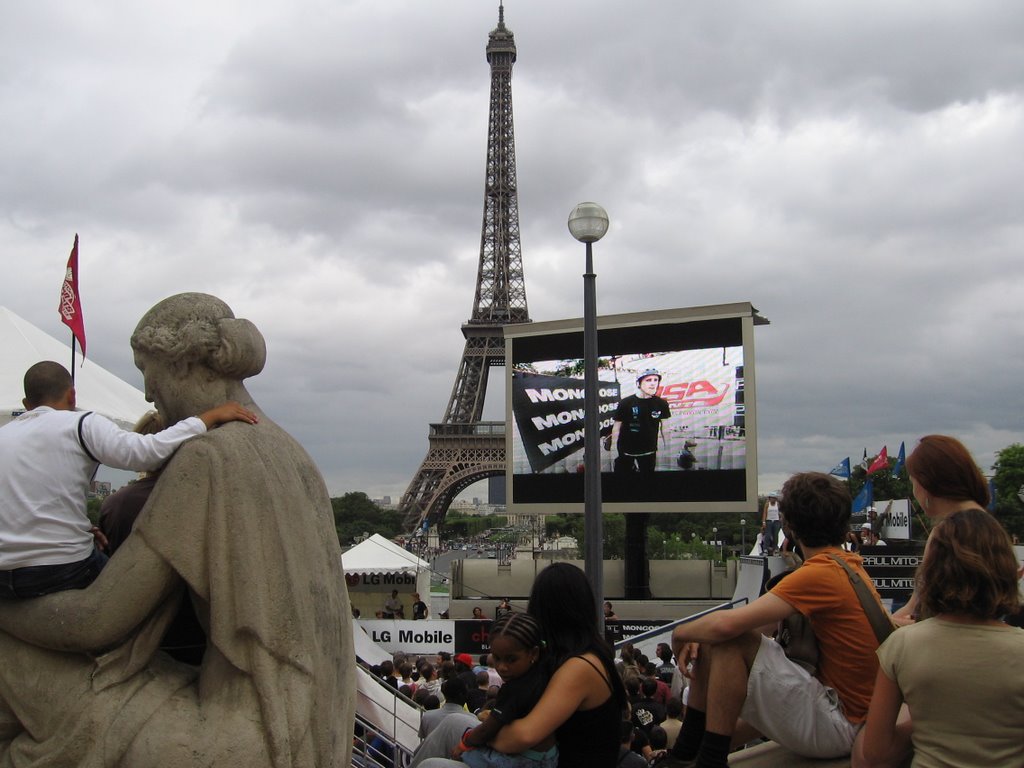
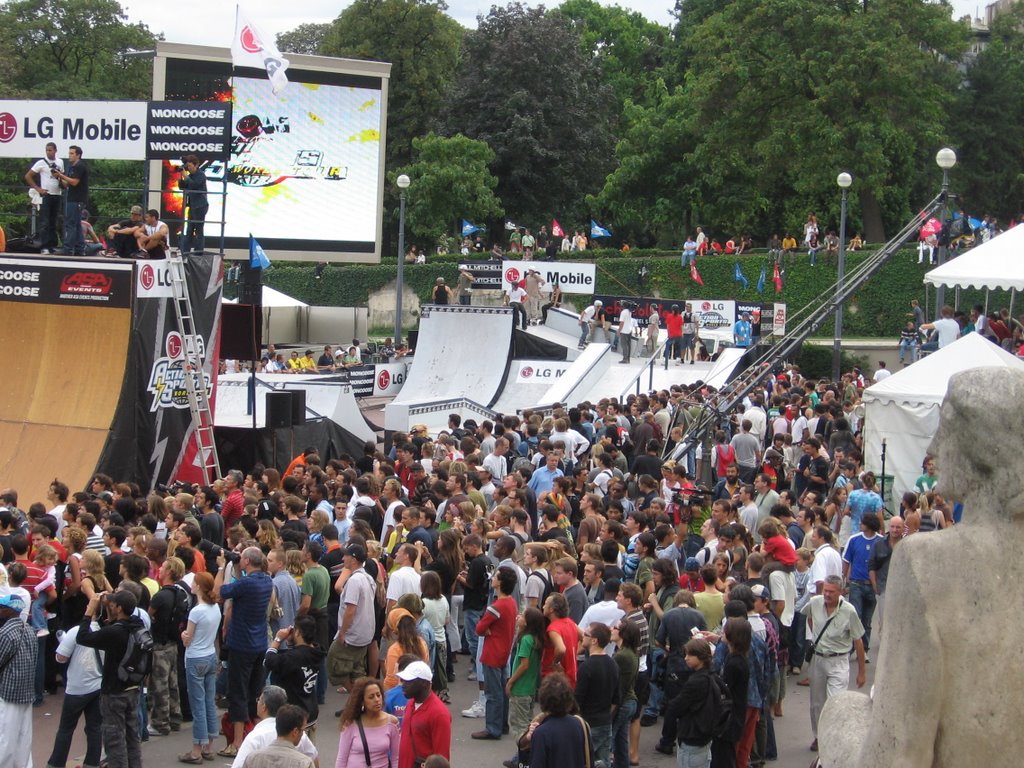
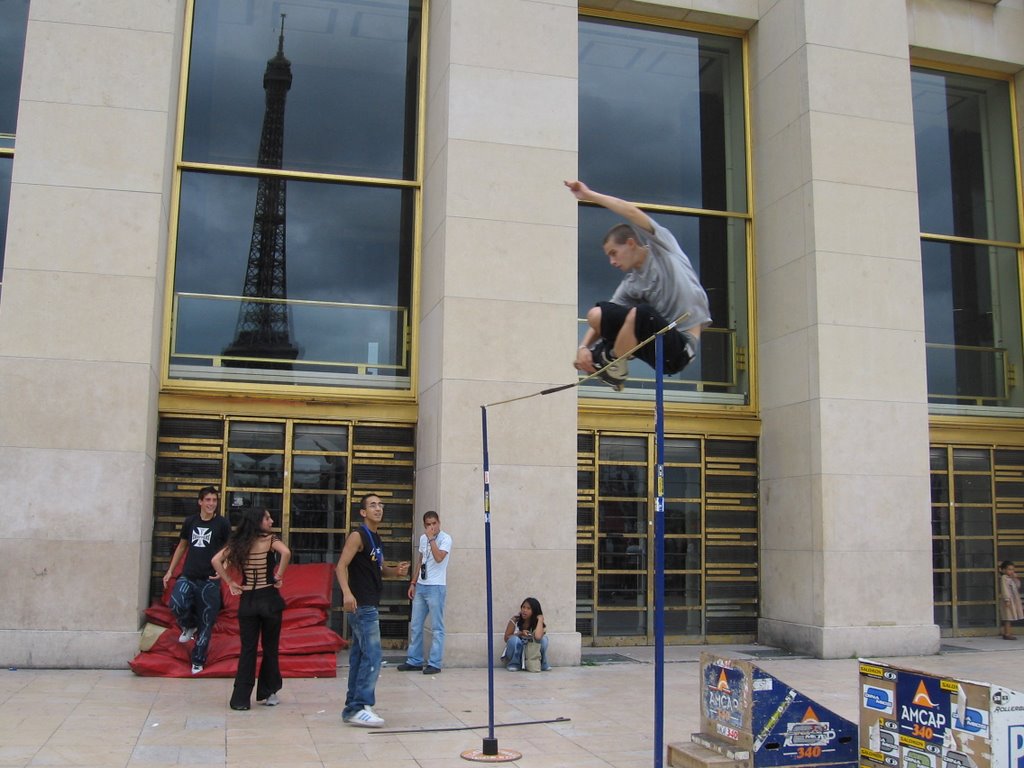
R and I found some pretty definitive evidence of this yesterday, when we stumbled upon an extreme sports competition/exhibition across the Seine from the Tour Eiffel. The three sports featured were dmx biking, rollerblading and rollerskating. The bikes weren’t even being ridden, relegated instead to a showcase tent. The skateboarders were at least stunting, but didn’t even get an announcer. The rollerblading? A massive t.v. screen projecting slow motion recaps of certain stunts, loudspeakers blaring American rock music, and an announcer commentating in not only French, but English and Spanish as well. You can guess where all the crowds were.


Behind the main stunt course, some "street skaters" had set up a pole vaulting pole and a ramp, and would speed down a marble terrasse to leap over it – no helmets, no pads – it was intense.


At our Sciences Po orientation today, one of the events advertised for the coming weeks was “balard en rollers,” or, a rollerblading excursion around the left bank of the Seine. Forget renting skates – maybe to truly immerse myself in the Parisian lifestyle, I need to own my own.

Unlike this guy, though, I will be wearing knee pads.

03 September 2006

Despite what everyone told me before leaving, R and I have experienced nothing that could be considered anti-American sentiment. In fact, it's just the opposite. Most people we meet are at first excited to practice their English on two girls from the U.S. and next excited that we are willing to practice our French on them.

With the exception of our chilly rejection from the community of people who actually have places to live, I feel like we've been welcomed into the country with open arms.

Thursday night R and I and another friend from UW (Christina) returned to the student-heavy Mouffetard area in the 5ème for dinner. We couldn't resist the delicious smells wafting from Colbeh, an Iranian/Armenian food restaurant. Midway through some delicious Armenian wine and what was so far the best meal we've had in Paris, one of the cooks was dragged from the kitchen to play a keyboard and sing Armenian songs.

It soon became clear that our seranader was the father of someone in the restaurant, and we began to realize that, apart from our table of three and a British couple in the other corner, all of the patrons in the restaurant were part of a boisterous Armenian family. It only took a few minutes for them to start dancing.

Now, the restaurant was tiny. It was one narrow room, completely filled with tables exept for a small passage down the middle of the dining room. Within minutes, the passage was filled with semi-tipsy people doing authentic Armenian dances. The three of us were pulled from our chairs by a gray-haired man with hips to rival Michael Jackson or Mick Jagger and dragged into a shimmying conga line. Like a scene from a movie, R, C, the British couple and I were immediately part of the family, and we shimmied and danced through the restaurant for a good half hour.

Sadly, the three of us were pressed to catch the last metro train of the night, and as we left the restaurant, we were bid "bonsoir" with a collective wave à la Sound of Music. After a week of R and I desperate, homeless and lonely in Paris, this was like a bandage for our battered minds.

R and I plan to become regulars. On our next visit to Colbeh, we might even be brave enough to take a turn at the mic – though that depends on how much Armenian wine we're first plied with.

01 September 2006

This morning, R and I woke up early to pack our belongings and check out of La Manufacture. We dressed nicely, organized all our documents, withdrew 400 euro cash between us and hopped a metro to Oberkampf to make our apartment appointment (the nice one above the fruit stand).

When we arrived, there was a line of maybe 10 professionally-dressed young people, and the line only grew as we waited in it.

We were ushered up a set of windy stairs to a perfect apartment – spacious, well-lit, hardwood floors everywhere...and still for only 1045 euro/month. The agent giving the tours stopped R and I before we made it past the entry hall.

Apparently, the landlord will not rent to students. It would have been nice if the agency had told us this on the phone.

Now we are combing the Internet for more options. We just called 10 from a phone booth – none had anything for us. We paid our hotel bill this morning, thinking we'd either be moving in or finding a cheap hostel to live in. I don't know what else we can do. Our only option is to stay in a hostel and just keep looking.

Updates to come.