30 March 2007

Nowhere is the French reverence for all things culinary more apparent than in the canteen of the Sciences Po blood drive. Rather than the typical Tacoma blood bank fare of saltines, prepackaged oatmeal raisin cookies and array of juices, French donors are offered a selection of sandwiches, yogurts and fresh pastries.

The food isn’t the only thing that’s different about donating blood in Paris – for one thing, the required abstention post-tatouage is a mere 4 months, compared to the year-long wait in the U.S., and there’s no minimum required iron level – in fact, they don’t even check.


I tried rather half-heartedly and unsuccessfully to figure out if I was allowed to donate here at the beginning of the school year, but gave up or forgot or was just to lazy to follow through. I’d completely forgotten about it until I checked my Sciences Po email yesterday and discovered that SciPo was hosting a blood drive today.

Still not sure whether I was even eligible to donate in France, I showed up anyway. Since I had an 8am class and was already at school, I was one of the first in the door at 10:30, ready to completely befuddle all of the technicians.

As easily as I can generally communicate in France, there are some things that I just don’t know. My weight in kilograms, for example, or my height in meters. During my interview, I had several technicians gathered around me trying to estimate my height and weight – as they shouted out their guesses, they’d look at me for confirmation, as though hearing the correct numbers would trigger some dormant part of my brain that conforms to the metric system.

It took me a lot of arguing in my American French to convince the médecin that yes, it was possible that I had donated blood maybe 15 times in my life. He kept asking if I was sure, and after thinking about it I realized that it’s probably more like 25 – I’ve been a pretty regular donor since I hit 16 and this new number just completely floored him. À 21 ans? Vingt-cinq fois à 21 ans? he kept exclaiming. Just as I couldn’t figure out why he was so amazed, he couldn’t figure out why I was so nonchalant – until he asked me what the minimum age for donation is stateside. Until a few years ago, French donors weren’t allowed to donate until they were 21 years old. This age limit was lowered to 18 with parental consent, and then finally to 18 without parental consent, so a minimum age of 16 years and 110 pounds was pretty surprising to my poor interviewer.

I had another adventure trying to explain to the médecin that the only surgery I’d ever had was to have my tonsils removed more than a decade ago. I’d been wrongly assuming that the word for tonsil was the same in French – enlèvement des tonsils, enlèvement des tonsils! I kept pointlessly repeating while patting my throat with one hand and miming some kind of tonsil removal with the other. Turns out, “tonsil” is not a word in French, not even close. The correct vocabulary would have been les amygdales, which was probably one of the words the médecin kept saying, but had sounded so far off that I’d disregarded it. The confusion ended with him writing “tonsil” on a piece of paper and telling me that I need to figure out the word for next time.

Once we had the medical history sorted out, it was time for the interview. For the most part, this was exactly the same history I give at Cascade Regional in Tacoma – but even more inclusive, if you can imagine. For example, if you say no, you have not had unprotected sex even one time since 1980 with a man who has had unprotected sex even one time since 1980 with another man, you get another list of questions. Do you have a significant other? Male or female? How long have you been dating? Are you monogamous? Are you sexually active? If so, when is the last time you had sex, and was it with a significant other, or somebody else. I was kind of taken aback by this series – I’m used to the no, no, no to all of the high-risk for HIV diagnostic questions, but not so much to the relationship/sexual profiling ones. They also ask if you’ve ever smoked hash or cannabis – if so, when and in what quantities. I’m not sure what pot has to do with blood quality, but I guess my médecin was satisfied that I probably didn’t have any traces of marijuana in my system today, and I was sent out to be bled.

There were two technicians drawing blood, a man and a woman, and they both seemed very tickled to have an American girl incapacitated on a cot. The man was excited to practice his English, and told me, “Your snow, I mean rain? Snow? Ah yes, boots for rain, are so nice, mademoiselle,” while the woman fussed over me, speaking as slowly as she could, patting my arm, and unzipping and rezipping my sweater whenever she deemed that I might be in need of a temperature adjustment.

I was hoping for some French “I donated” merchandise, but hélas, all I got was a chausson aux pommes, a Mont Blanc yogurt and a compliment on my footwear.

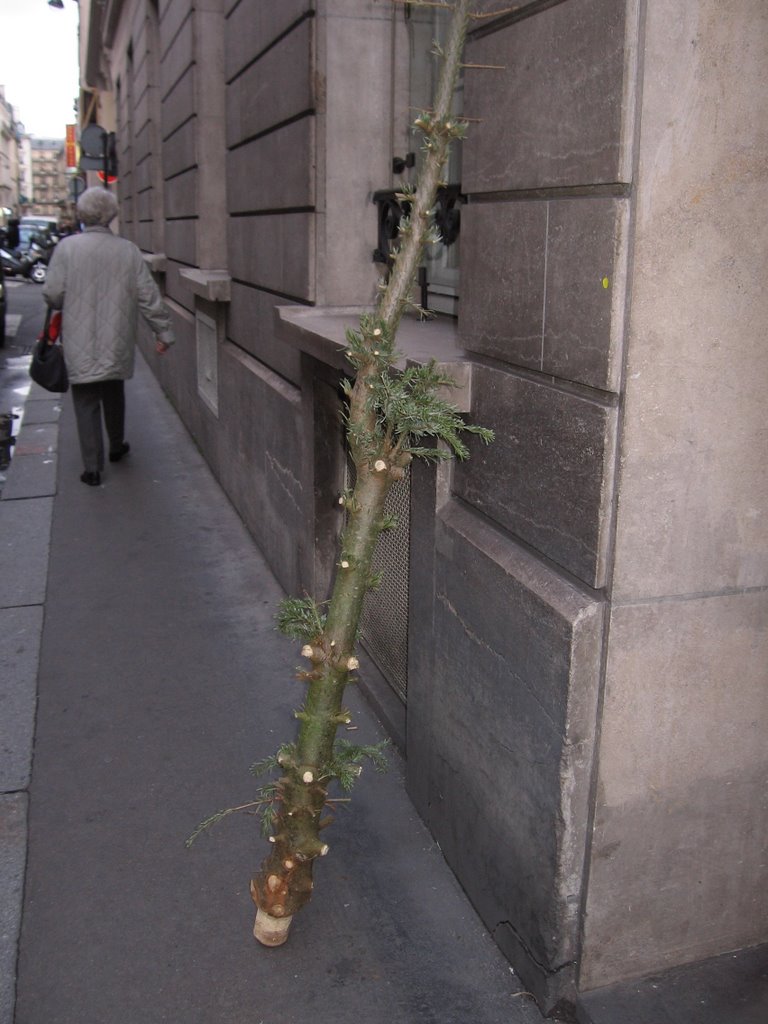
I know parking is an issue in this city, but this guy definitely should have kept looking:

26 March 2007

I think it’s safe to say that it’s spring in Paris. The sun is shining, it’s warm enough to walk to class without a jacket, and every spare patch of grass in the city is filled with smoking sunbathers – no really. They lay on their backs with their pants and shirt hems rolled up, one arm across the eyes to block out the sun while the other hand brings a cigarette up for a drag every few minutes. Only in Paris, right?

With the onset off a new season and the beginning of a long run of the warmer months, it’s definitely time to reassess French fashion. Get ready with a pen and paper because here are my notes for must-have clothing for anyone currently living in the city of light, or wishing they were.

First and most important is the mini trench. We already knew that the trench was French, but as the months get warmer and dryer, the hems get higher, the colors brighter and the fabrics lighter. Styled exactly like a full-length Carmen Sandiego, but cut to fall at the hip, the shoulder and wrist straps, big buttons and tie-waists of the mini-trench are exactly the same as those of it’s cold-weather big sister, just styled for spring. Khaki is the most popular color, but you’ll also see black cotton, darker browns, grays, and an array of bright springy colors like greens and oranges. It’s important to note that chicness is still a way of life in the sweaty grime of summer in the city, so if you want to look Parisian, go with a neutral – khaki, brown, black, gray or navy blue. If you’ve got the cash, buy yours at Comptoir des Cotonniers for around 200 euro. If you’re on a budget, try any of the cookie cutter “Paris Chic” boutiques lining any side street in the city and style yourself for a much more affordable price of 20-30 euro. The middle of the roaders shop at Gap, Esprit, Promod or Zara. My own happens to be blue and gray plaid and was not quite as cheap as 20, but was well under 100 euro.

As predicted by Vogue back in December or January, the chic nail polish for spring is dark brown – just as chic as the Chanel Black Satin rage of the fall and winter, but a bit less harsh for spring. Buy it Chanel if you’re blessed with a disposable income, but the rest of us stock up at Sephora or Monoprix.

As the Laguna Beach style of beachwear for any occasion – cut-off denim miniskirts with or without leggings, flip flops and wife beater-style tank tops – has not, and probably will never catch on here, you’re a lot safer going with a knee-length cotton skirt or dress. Stock up at Zadig & Voltaire, H&M or Antik Batik and pair with tights, leather boots and cardigans for the spring and flat sandals or espadrilles in the summer and you’re sure to capture that easy breezy French girl chic. These pieces are particularly effective if shown off from the back of a moped driven by a frighteningly stylish French boy.

As for shirts, French fashion doesn’t seem to change tremendously. Tee shirts are cut low to show off a nice décolletage and skim the body. I think the idea is to never look like you’re working for your chicness – tight tee shirts or too-complicated tops just look like too much effort and destroy any idea of chic you might have had. Loose and light, but always sexy.

In a repeat of last summer, the cut-off trousers are back – or maybe they just never left. Worn either below the knee in madras style, or cut high like hot pants that you might happen to wear to work (with some thick opaque tights underneath and a seriously conservative shirt, of course!) Buy them anywhere that clothes are sold and wear them with the same attitude as the floaty skirts and dresses. The perfect carelessly chic French outfit? Short trousers, a horizontally striped cotton shirt (think John Paul Gaultier) and ballet flats or sandals.

There are two types of shoes preferred by French feet from March through August. The first being a pair of chic flat sandals. Styled in the exact same shape as the ballet flats that are still roaringly popular among the chic and skinny-panted young women of Paris, but cut as sandals (cut out toes, for example, or with thin ankle straps). Wear these with your skinny pants – it’s still just morphing from winter to spring after all, cropped trouser pants or floaty cotton skirts. As with every style, you can become an haute couture fashion victim just as easily as a boho budgeted one. Starting at 19 euro in the generic boutiques, going up to a thousand euro if that’s how much you’re willing to pay for your footwear.

Espadrilles are the other foot fashion must-have. From what I hear, they’re back every year as a summer sandal you buy once each spring and spend the summer wearing to the ground as you vacation in Italy or Provence. These you really can buy anywhere – for 100 euro in the boutiques on rue Saint Honoré (which may not sound like a lot until you consider what this shoe is – woven hay and a piece of canvas) or for 20 euro in the women’s clothing department of Monoprix. Go for crazy stripes, polka dots, whatever strikes your fancy at the moment, because you’ll just be stocking up again in Spring 2008.

The French are obsessed with Levi’s denim. There are Levi’s boutiques all over the city, where you can clad yourself in 90 euro pants that you might have paid $50 for at Sears in the U.S. (I should know, I spent a summer working there). Whoever you are, whatever your income, at least one pair of Levi’s is going to be a staple of your wardrobe. You either save up and guard them zealously as your special pair of jeans, or you wear them for day-to-day bumming around, paired with a simple button shirt from Prada. Sound ridiculous? Not for the moms who live in the 2ème arondissement.


Women carrying Longchamp purses should be featured on the postcards of Paris, alongside the beret-wearing, baguette holding men that so often grace the racks of souvenir stands. Though it doesn’t seem to have reached international fame, the brand is as much a staple of life in Paris as is owning a scarf for every day of the week. They make regular leather purses as well, but live here for a while and you’ll probably be more familiar with the brightly-colored canvas bags with leather handles. They come in all colors and sizes and if you are a female who lives in the city, no matter your age, you probably have one of these bags. If you’re a mom, you carry a smaller one as an everyday purse. If you’re a student you probably carry both a luggage-sized bag filled with books and graph paper and a smaller one over your shoulder with normal purse contents.

In Paris, there’s no such thing as putting away your scarves for the winter. Maybe the wool varieties are sealed and stored, but pashminas are as common as ever. More popular for warm weather are little wispy scarves, brightly colored and sometimes sparkly, tied in jaunty knots at the neck. Even though it’s a little sunny and bright to sport black and skulls, it seems like every young person in the city (male or female) has one of the sparkly skull scarves that have been popular since I arrived last August.

Really, the most important thing to remember is to stay chic. Take a leaf from Coco Chanel, and stop in front of the mirror on your way out the door each morning to remove one item from your outfit. Clutter isn’t chic, anymore than looking like you stepped out of a Hollister catalogue is – at least not here. Be chic, be effortlessly stylish, never look like you feel the heat, never ever put your scarves into summer hibernation – and please, please, don’t forget the deodorant. The metro is horrible enough when the weather gets warm without being pressed against other sweaty people of already questionable hygiene.

21 March 2007

I love coming home at night to the smell of burned out candles. It’s a smell I’ve always loved – it used to remind me of birthdays, but now it reminds me of my apartment in Paris. The candle smell comes from my neighbors on the first floor (reminder, in France, the first floor is the first floor above ground level) who are a male pair of interior decorators who do quite a bit of entertaining. Every time they have a dinner or party or festivity of any kind, we enter and exit the building by candlelight.


Tonight I got home after the candles had been blown out, and the only reminders of the evening were the still-smoking white candles lining the courtyard and first floor staircase. I was coming home from a movie, trying to make the most of the Printemps du Cinéma promotion that ended today. For whatever reason, the Fédération Nationale des Cinémas Français organizes this three-day period each spring (possibly beginning just last year), during which all movies at all theatres all over France cost only 3.50 per person. Determined to maximize my benefit, I saw a movie all three nights.

Tonight it was Les Témoins, a movie about a group of people in Paris in 1984 who are affected by the “new virus,” or AIDS. It’s been receiving great reviews in the French press, and it really was a good movie. Even better than the movie, was the fact that I realized that I really have no trouble understanding French. For whatever reason, comprehension has always come naturally to me – I’m nowhere near the same level with my writing and speaking, but I feel like I understand fluently. Sciences Po lectures are no problem, and I often find myself translating or repeating for other exchange students. Realizing that I was following the complicated story of how the disease was passed and dealt with by this group of people (not to mention, the complicated ways in which everybody was involved with one another) was just the confirmation I needed.

At one point the girl next to me leaned over to ask “Wait, what excited her?” And I found myself quickly explaining that these two people are married with a baby but maintain an open relationship, which until now, only the wife had taken advantage of. The scene dealt with the husband asking about her sex life and how she’d feel about hearing that he’d gotten some of his own. Turns out, it excited her. The response of my neighbor? “Wow, I did not get that at all.”

Even when I was here on a month-long exchange in high school, I was always introduced by my host family as “Our little American – who will understand everything you say.” It’s frustrating though, being able to understand everything that’s going on around me and feel so limited in expressing myself. I get along fine in day-to-day life, but put me in a discussion about politics and I can nod along without ever being able to express my views as eloquently as I’d like to be able to. I constantly feel like I have to justify myself when speaking to French students – I’m smarter in English, I swear.

In a way, it’s fitting that I am a nanny to an almost three-year old boy learning two languages. I feel like we’re in the same boat, trying to figure out how to express ourselves in the right way that we’ll be understood. We both confuse French and English words sometimes, and both get frustrated when we can’t get our points across. Though Georges tends to start laughing when I say “What? What? I have no idea what you are saying to me Georges,” while I get more flustered and less able to communicate clearly.

Other times though, I communicate too well in French. Today leaving a brutal breakdancing class, I was walking out with another girl, both of us complaining in French about how sore we’d be tomorrow. (If you want an idea of just how sore my wrists and shoulders are going to be tomorrow, check out the following video – we were working on air flares).


After a full hour of supporting our full body weights on our hands, we were walking to the metro together moaning things like, Alors, mes poignets! and Je ne pourrai pas lever les bras demain! (Ah, my wrists! And, I won’t be able to lift my arms tomorrow!) when she apparently caught a glimpse of the label on my REI rain coat and switched to English – “Oh, you’re from America?” I confirmed, and we laughed at ourselves for a minute before continuing to bemoan our worn out bodies. Just before parting ways at the metro, I asked what part of the U.S. she comes from.

As happens in strange countries a good deal more than you’d expect it to, the answer was “Oh, Seattle.” It turns out she’s actually from Vashon Island, a ten-minute ferry ride from my hometown of Tacoma and is in Paris working on her Master (more like general grad school in France). How funny is the world that a Tacoma girl can go to a hip-hop class in the 12ème arrondissement of Paris and learn after three sessions of toprock and six-steps that she’s practicing her freezes next to girl from Vashon? This is why I love this city.

14 March 2007

Usually I spend my days collecting stories and ideas to write about as I walk, run and metro through the city. These are a few little life in Paris anecdotes that I couldn’t quite stretch into full stories on their own.

Autobus, ligne 39
Last Monday, Ella and I had been waiting at the Richelieu-Quatre Septembre bus stop for about 20 minutes before we saw the notice taped to the glass wall of the stop. Thanks to yet another protest, the bus line we take to the Académie for her dance class each Monday would once again be interrupted. From 18h to 20h that evening, there would be no busses running between Richelieu and Gare du Nord.

As it was only 17h20, we were a little confused about why there was no bus. After mulling it over for a few minutes, we decided our best bet was to hike down the few blocks to Palais Royal, where we could catch the bus at an uninterrupted stop, just in case the line had already been disrupted.

After about a block and a half, I looked back to see none other than autobus 39 heading down the street behind us. We stopped and stared – the driver stared back at us for a moment, and then we broke into a run, sprinting toward Palais Royal as fast as we could run with school and dance bags bouncing at our sides. Thanks to the narrow trafficky streets of the Paris centre and an aptly-timed red light, we made it to the bus stop sweaty and panting, but with a few moments to spare.

When the bus pulled up, the driver – young, male, and oh-so-cute – could barely sit up straight he was laughing so hard. Embarrassed, we boarded the bus and I gave him a sheepish and wheezy grin. “Eh,” he said, “ça va?” (Hey, are you okay?). I nodded, and started to follow Ella toward the back of the bus. “J’aurais vous attendu,” (I would have waited for you) he called after me, and when I looked back, he winked.

I think I have a crush. Is it horribly girly and teenyboppy that I hoped we’d have the same driver today? Sadly, “I would have waited” was nowhere to be seen, but I have five more months of rides on autobus 39 before I head home to Washington.

Greasy picnics in the park
When the sun comes out in Paris, so does the smog, the tourists and the picnickers. As there is a severely limited amount of grass that you’re actually allowed to set foot on in this city, there are a few locations that become nearly impassable on nice days like today. One of these is Pont des Arts, a pedestrian bridge connecting the cour carré of the Louvre to the rive gauche, and a favorite wine and cheese picnic spot in any weather. When it’s really sunny, it’s best to go here with a picnic in mind or not at all, as picking your way around lunchers, musicians and amateur artists is definitely not the most efficient way to cross the river.

Another popular picnic spot is a little patch of courtyard smack between the jardin des Tuileries and the courtyard of the Louvre. Since this is technically not a part of Tuileries, its grass is fair game, and the two medium-sized squares of it fill up early on nice days, with dogs and their owners, sunbathers and picnickers. It’s quite a nice lunching option if you’d like to park yourself on a rare bit of grass and don’t mind the bold peddlers of sunglasses, hats and knock-off Dolce & Gabbana belts.

Being next to the musée du Louvre and a block from the tourism office of Paris, this is one of those weird parts of the city that is frequented by tourists and natives alike. Usually the city is quite segregated, and while tourists might spend a great deal of energy searching for “real Parisians,” real Parisians spend even more energy avoiding them. To pick out the tourists from the authentic Frenchies, you have to know where you are and what you’re looking for.

If you hit up this particular spot during lunch, look for groups of people sitting on the grass with wine, cheese and baguettes – these are 100 percent tourists. The “real Parisians” are the ones crowded around overstuffed greasy bags of MacDonalds takeaway. It’s disturbing, but true. Sure Parisians eat baguette sandwiches and paninis too, but not here. Americans and the like think they’re being chic and French by eating French bread near the Louvre, but what they don’t realize is that the McDo on rue de Rivoli has designated their picnic spot as the unofficial outdoor dining area for the McDonalds that is so beloved to seemingly everyone in France.

Counterfeit euros
Last night after nannying, I made a quick stop at Monoprix for a few groceries. All I needed was milk and olive oil, but as I was shopping before dinner, I also ended up with several varieties of cookies and some disgustingly delicious Chokella cereal.

Monoprix is always filled with people around 21h because it’s the only grocery store around that is open until 22h on weeknights. Waiting in a line that wound through the store, I felt awkward enough with my basket of unhealthiness. The cashier rang up my groceries and as I bagged them I handed her a 50-euro bill (rather than pay with a credit card) to speed up the process so I could get out of the store and home to eat dinner.

The woman manning the register took my bill and started hmmm-ing and muttering to herself. She held it up to the light to inspect the watermarks, and scratched at the center of it with a fingernail. “C’est bizarre, ça,” (that’s weird) she kept saying, and eventually passed it to another checker, who gave it to a manager to inspect in a special machine. Meanwhile, I was standing at the end of the register with my bags of groceries and line that just kept growing behind me, while everyone in the store was craning their necks to see the criminal who was trying to pay with counterfeit money.

All I could think was, how the heck was I going to get my 50 euro back? It’s not my fault if I got fake money out of the ATM! Could I find my receipt and go back to Crédit Lyonnais and complain? Would they believe me? I spent about 10 minutes like this, while everybody waiting in line, glad to have a distraction from boredom, focused their attention on me.

Eventually somebody pronounced my money legitimate, and as the checker handed me my change she grabbed my hand and looked into my eyes – “You understand that we weren’t accusing you – it could happen to anyone,” she assured me in French. I thanked her, grabbed my cookies and ran before they could change their minds.

And lastly...
Did I ever mention that I finally got my carte de séjour?

12 March 2007

It’s been so sunny in Paris lately that I’ve been waking up early. When I got up this morning, a perceptible haze had set in. The sky was bright and there wasn’t a cloud in sight, but to the North and East, the sky was thick and brown.

It’s actually been remarkably warm here the past few weeks – I’d been warned all autumn what a terrible time February would be in the city, but the month passed in blue skies and sunny days. Today it was so warm that I didn’t need a jacket walking to class – a tee shirt and thin cotton cardigan were more than sufficient.

With beautiful days that stretch longer and longer by the week, comes the annual revelation that yes, Paris is a beautiful, but dirty and polluted city. Indeed, the view from the top of the basilisque de Sacre Coeur is a breathtaking panorama of the city, but more often than not shows a rather hazy view, with the outer arondissements fading into nothing.

This is about as good as it gets:

The most polluted street in the city is rue des Saints-Pères – an address for one of the buildings of Sciences Po that I spend a good deal of time in. It’s something actually scientific to do with the height of the buildings and narrowness of the street, the amount of traffic each day and the wind direction, but I can’t imagine that there’s any section of this crowded city that is significantly better or worse in terms of air quality than any other.

According to my French politics teacher, there was an informal study done one summer by a journalist or professor or something, where the man spent an entire day breathing through a snow white handkerchief. He didn’t do anything special, just went through his daily activities – metro, work, lunch, grocery shopping, etc – all with this handkerchief clasped to his face. By the end of the day, the handkerchief was black.

This was a disturbing bit of information, but not at all surprising. My asthma has been worse here than ever before, and where I only ever used to need an inhaler for working out, I’ve taken to carrying mine everywhere.

Maybe I’m just spoiled by the clean air and mountains and forests of the Pacific Northwest, but I find myself walking around thinking, “I’ll be okay, I’m only here for a year. How much damage can just one year of secondhand smoke, smog and uncooked meats really do to my health?” Then I pause and think about the fact that there are people who live their whole lives in this city and don’t seem to be worse off for it. The French are generally a pretty healthy people – at least diet-wise. As of yet, there haven’t been any proven health benefits of the country’s love affair with cigarettes.

All health concerns aside, this city just gets gross when it’s hot. The air is humid and oppressive and you end every day sticky with dirt and sweat. The metros are the worst, but even on foot there’s no way to avoid the feeling that your body is somehow covered with little particles of dirt and carbon.

This perception is not contradicted by the fact that there’s garbage everywhere – even floating in the Seine along with the swans and fish that have gone belly-up. I’m not even going to go into the fact that there’s dog poop everywhere – in the streets, on the sidewalks, in the metro, on your shoes…the fact of the matter is that this city is dirty, and the only way to not let it bother you is look up, which isn’t hard to do. I don’t think anybody would prefer looking down at the ripped papers in the gutters to looking up at the beautiful buildings, pilfered Egyptian art, ridiculously spiky churches or the pretty pretty bridges crossing the polluted river.


Pretty as Paris is in the bright beautiful sun, the fact that it’s been so warm already is slightly concerning. If spring arrives midway through February, when and how intensely is summer going to come? If the smoggy warm afternoon of March 12th had me longing for the start of Paris Plage, I have a feeling I’m going to be longing for Antarctica in a few months.

I once saw a list, "You know you're Parisian if..." The first point was "You love Paris," the second, "You hate Paris." I think that's me. You can't possibly live in this city for any significant period of time without simultaneously adoring and despising it. It's dirty, yes. It's polluted, yes. But it's oh-so-pretty.


* France follows the same general daylight savings patterns as the U.S. – “Fall back, Spring forward,” just on a slightly different calendar. While Americans set their clocks ahead last Sunday, we did nothing. In France, we don’t lose our hour until the last Sunday of March, so for two weeks, I’m only 8 hours ahead of Tacoma (instead of the usual 9).

** The highlight of my February was getting to watch the Nina Ricci show through the back opening of the tent in the jardin des Tuileries. Ohhh the magic of fashion week!

02 March 2007

Oh how I love fashion week in Paris. Sunday kicked off the week of prêt-à-porter shows, and as usual, the city has gone even a little nuttier than usual. From the long white tents set up in the jardin des Tuileries, to tourists visiting the Louvre catching an eyeful as the Valentino and Vivianne Westwood shows empty out, to portions of the Centre Pompidou being completely shut down to set up runways for YSL, to celebrity-sightings all over the city.

Today, after dragging myself out of bed for an 8 a.m. class, I arrived at Sciences Po to discover (with the rest of the class) that our professor had cancelled it for the day. At first I was quite bitter about all the sleep I'd needlessly missed, but then I realized that I could now go watch the arrivals at the Chanel show at Grand Palais.


I arrived at about 9:30 a.m. and stationed myself directly across the street from the entrance, to watch international fashionistas flash their coveted black and white passes at the bouncers and slip inside the massive doors of the Palais. As I stood there, chatting with the driver of a fashion journalist with the fortune to have her own pass, and just observing the flow of people, I began to realize that I am definitely not the only chronic stalker of fashion shows.


There are apparently quite a few of us with this habit – we're all in our early twenties, have the show schedules memorized, and spend our free hours during fashion week lurking outside, trying to catch glimpses of models and designers. While happily watching the arrivals, I swapped stories with a girl from Mexico – she'd been around at the backstage entrance and had seen Karl Lagerfield, while I'd seen Anna Wintour arrive.


Yes, probably the highlight of my as yet brief career in fashion week stalking was the moment this morning when I watched the current editor-in-chief of Vogue step out of her hired car, pose for the photographers and strut past the guards. Unfortunately, I seem to have the slowest camera reflexes of all time, and although she was about five feet away from me (facing me, and the photographers) for quite a long moment, I didn't manage to get my camera out of my pocket and turned on until she was a little bobbed blur in the distance. Still though, I saw Anna Wintour!

Here's a much better picture of her from Saturday's Hermès show at Théatre du Chatêlet:


Though Anna Wintour was definitely my biggest thrill, there were a number of other celebrities lurking about. Also on my sighting list were, Lou Doillon, French actress and daughter of Jane Birkin (inspiration for the Hermès Birkin bag), Cécile Cassel, an 18-year old French comedienne, Clemence Poesy, another French actress and Virginie Ledoyen. At the Valentino show on Wednesday in the Carrousel du Louvre I saw Molly Sims.

Molly Sims posing with some thrilled adolescent boys:


Ohhhh I love fashion week in Paris.

01 March 2007

How to spot tourists in Paris (a few simple tips and guidelines):

10) Look for couples – it is my estimation (and I have absolutely no evidence or any way to back this up) that 60-70 percent of the lovey-dovey couples wandering through this city are from out of town. Paris is pretty high on the list of romantic vacation spots for couples and frankly, most Parisians are just too cranky to be seen showing any sort of public affection. If 60 percent of the couples in Paris are not from Paris, 90 percent of the couples kissing on, walking hand-in-hand over or gazing over the railing of a bridge are foreigners too.

These people, for example – there is no chance that they are natives:


9) Look for anyone carrying a Starbucks cup (or any sort of food for that matter) – this is not a country where people eat on the go. In fact, even going into a Starbucks you’re likely to be pegged as a tourist – the one time I bought coffee at the avenue de l’Opéra Starbucks, the barista started speaking English to me before I’d even opened my mouth.

8) While quite a number of authentic French people frequent the Louvre, from families to art students to groups of école maternelle children on field trips, there is a certain route through the museum that anyone who actually lives in this city is going to avoid like the plague. You may know it as the “Louvre lite,” the quick stroll-through that steers the museum-goer around to view certain famous works of art. If you can make it through the onslaught of camera flashes and awkwardly posed photo ops, you’ll be able to tell everyone back at home that you saw not only the Winged Victory, but the Venus de Milo and the Mona Lisa.


7) Keep an eye out for anyone snapping pictures of the inverted pyramide at the Louvre or Saint Sulpice cathedral – these folks are in the city of light to follow in the footsteps of Robert Langdon, and if you’re lucky you may hear them muttering “the priory…Jacques Saunière…Silas…the rose line…” to themselves as they crawl around in the corner of the church or pose cheesily with the pyramide. These are also the few who are willing to pay the 5 euro to take the Da Vinci Code audio tour of the Louvre.

Girls gearing up for the Davinci Code tour:


Tourist posing at Saint Sulpice cathedral, in front of the "Rose Line"


6) Parisians don’t wear backpacks, so this is a dead giveaway. For school, a chic leather or darkly colored canvas bag is the usual choice. French people also don’t wear anything North Face. Columbia sportswear is imported here (I was pretty surprised the first time I spotted it in Go! Sport), but I’ve never encountered an article of North Face anything for sale in Paris. It does seem to be quite a coup though, to come back from a study abroad with a North Face backpack, so it’s easy to be fooled if all you have to base your assumptions on is a bag.

5) Anyone on the Champs Elysées, be it in a restaurant, a shop or walking down the street, is most likely not from around here. It’s a different story at night, when Frenchies and tourists alike don their swankest outfits and line up to try and get past the bouncers at Le Queen or VIP Room, but for the most part, Parisians avoid the hordes of foreigners strolling between place de la Concorde and l’Arc de Triomphe like their lives depend on it.

4.5) Also, of course, anyone participating in a Segway Scooter tour of the city:


4) True Parisians have the metro system down pat – they store their Navigo passes in outside pockets of their purses or jackets and swipe themselves briskly through the metro turnstiles without ever actually pulling out the card. Some who take the metro less often use individual tickets instead of the rechargeable passes or cartes oranges, monthly passes formatted as reusable paper tickets, but even these publicly transported persons are nothing but business as they breeze through the gates with no hesitation. Those too cheap or lazy to buy passes or tickets simply hop the turnstiles. Usually adolescent guys, these freeloaders saunter up to the barriers and, without batting an eye, hoist themselves up and over the structure with nothing but their arms. Any one of these types is probably French, or has at least lived in Paris for a while. Any one else, though – the families nervously studying the giant maps on the walls, people nervously poking their tickets through the machines and stumbling uncertainly through the gates, or the few who are too befuddled by the weight-sensing mats to figure out how to trigger the doors to open and allow them out of the stations – anyone holding up the metro commute for any amount of time is probably an out-of-towner.

3) Although there is a growing number of runners who frequent the quais de Seine and the few large jardins scattered throughout Paris, most of the people seen exercising in the city are either just visiting or are foreign imports. There are gyms and there are those who try to keep in shape, but in the words of a French friend, “the French hate exercise.” Any kind of exercise (except for rollerblading, oddly enough) is pretty detested, but none more than the street run. I never receive stranger looks than when I’m out for a jog. Usually I’m someone who gets stopped a lot to ask for directions by Frenchies and foreigners alike (something I’m perhaps a little too tickled by), I guess a combination of the fact that I don’t look stereotypically American, and that I don’t walk around with a scowl on my face. When I’m running though, I either get “hey sexy” in English, or “Arrrriba!” A jog through the city in stretchy yoga pants and a hooded sweatshirt practically screams “America!”

2) Anybody spotted actually giving money to the hundreds of beggars slumped around the city, on corners, in metro stops or in parks is probably not Parisian. After living here a while, you become so jaded at the number of homeless in the city that the easiest thing to do is ignore the cups they shake at you. It’s so hard to tell who is really in need and what they’re actually going to use the money for – and there are so many of them, that ignorance is the typical choice. After a while you begin to recognize the regulars – the man who kneels on a pillow on St-Germain with a dirty sign that reads “j’ai faim” (I’m hungry), or the woman with the deformed foot who sets up shop underground in the Châtelet metro stop every day. Even glancing at one of these people will set you apart from the hordes of city-dwellers, much less giving one of them a few coins.

How many tourists can you spot in this picture? My guess is that everyone in the street is from somewhere outside of Paris, and most likely outside of France as well.


1) There’s a certain quality possessed by true Parisians, that outsiders, no matter how hard they try, can not emulate. Those endowed with the elusive je ne sais quoi, stand out in a city of camera-clutching tourists by this intangible but very noticeable carriage. You know someone is from the city if they can manage to lean casually against the door of the metro while it careens around corners, expressing only boredom through facial expression. An authentic Parisian strides from place to place “with a purpose,” with the goal to get from point A to point B without being distracted or side-tracked by any of the beautiful sights or interesting people that fill this city. It’s a quality near impossible to describe – hence it’s ambiguous name, the je ne sais quoi (I don’t know), but spend even a few days in this city and you’ll know without a doubt who belongs here and who is merely passing through.

12 February 2007

I remember the first time I saw the movie Amélie. It was New Year’s eve before any of us had our driver’s licenses, and my friend Rachel’s dad drove us to the Grand Cinema to see a movie.


I’m not sure why we picked Amélie, but aside from a few moments of discomfort – the kind that stems naturally from being 16 and hearing the word “orgasm” while sitting next to a friend’s father who also happens to be a pastor, we loved it.

I’m not sure I know anyone who has seen the movie and didn’t enjoy it, actually. We loved it because we were 15 and it painted such a magical picture of Paris. Freshman year living in the dorms at UW we had an “Amélie Night” in the third floor lounge to share the movie with those hapless Honors students who had somehow escaped falling in love with Amélie thus far.

It’ll always be one of my favorite movies, but these days the name Amélie Poulain carries a bit more weight for me. Tacomans and Seattlites watched it for Paris and its mystery and romanticism. Parisians watched it because it was their movie. Audrey Tatou is their sweetheart, and being set in the heart of Montmartre – filmed in cafés and markets that really exist, Amélie was born in the heart of Paris.

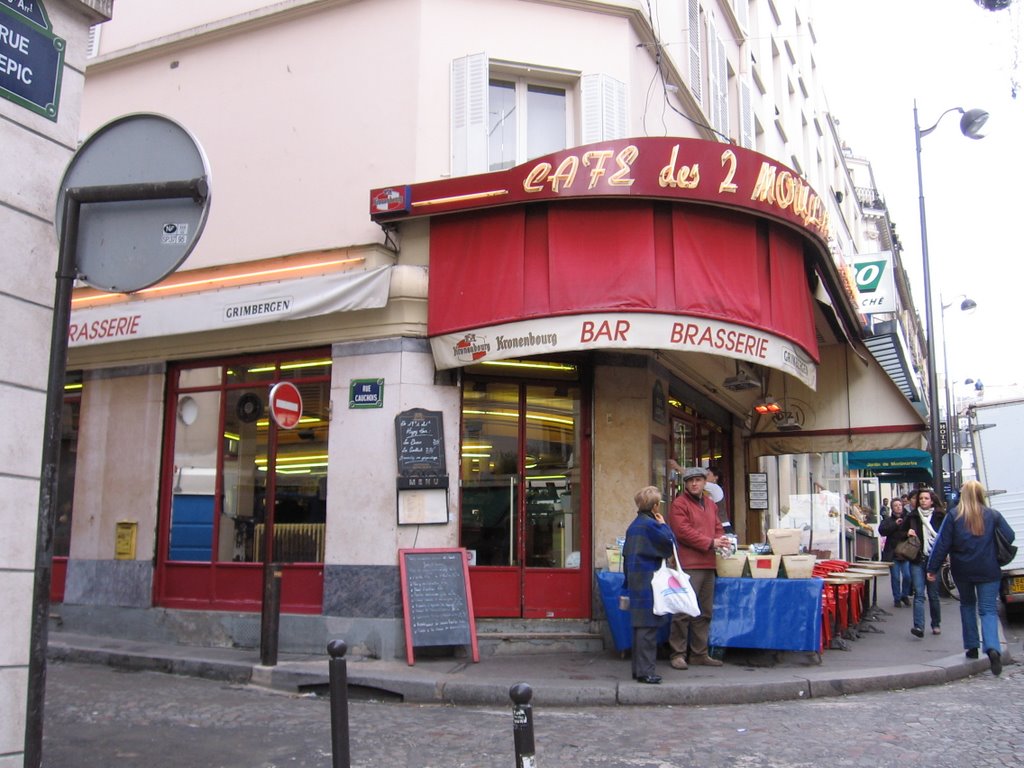
Café les deux moulins:


In the six years since the world became privy to the Fabuleux destin d’Amélie Poulain, Audrey Tatou’s Amélie has become something of a Parisian symbol. C’est la Paris d’Amélie, it’s Amélie’s Paris, has become something of a catch phrase, inducted into life by students, professors, journalists and all other denizens of Paris. The funny thing about this categorization, is its connotation – which depends completely on the context and the person saying it.

Montmartre is rather idyllic:


If you hear someone refer to Amélie’s Paris, it’s just about as likely to be pejorative as it is affectionate. If you’ve seen the movie Amélie, it’s going to be easy to conjure up an imaginative mental picture of Paris – a bright and lively world, where the streets are clean, Parisians know the names of their grocers and waitresses. It's a place where you’re not going to catch a crippling disease sleeping in a metro station, where a goldfish “liberated” into a river is going to survive the pollutants for longer than a few days, where love is waiting to sweep you off on the back of his scooter.

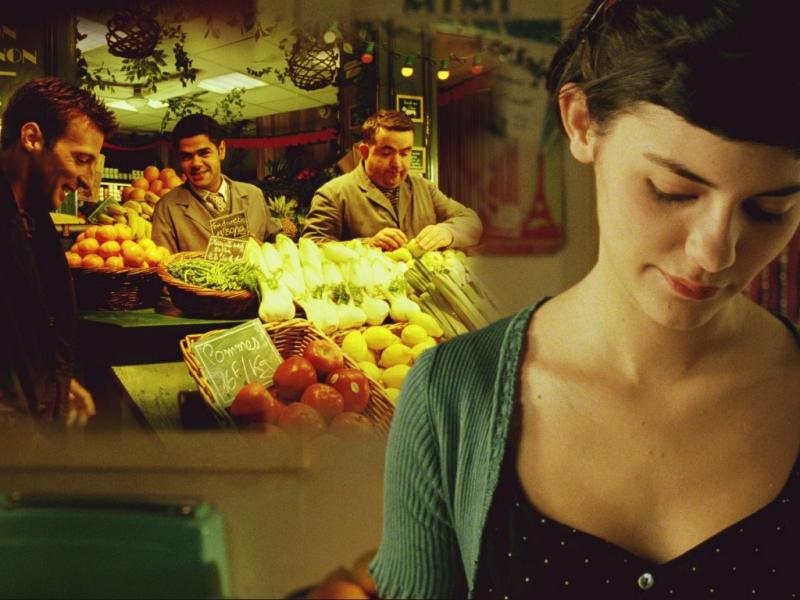
Amélie's Paris:


It’s a nice place to imagine – it really is, and in some ways it does exist. In a way, Amélie’s Paris is the heart of this city – a chic, colorful, comfortable, fascinating, magical endroit. A place where there’s possibility in every day – and, as trite as this expression has become, you never know where the day will lead you. In that sense, the Paris of Amélie Poulain is quintessential Paris, a fabulous girl that holds a special place in the heart of the most cynical of Parisians.

What can’t be forgotten is that while Amélie’s Paris really is that endearing magical place for some people (i.e. bobo (yuppies who don't want to believe they are yuppies) to affluent exchange students here on a ticket from an elite institution of political science), it is the absolute contrary for so many who live here. An article we read about immigration and discrimination in France for one of my classes during the stage d’integration defined Amélie’s Paris as a Paris with ni noir, ni arabe (basically a white Paris without blacks and Arabs). The sole Arab in the film, Lucien is a handicapped employee of the grocer, played by a Moroccan beur actor (a beur is a second-generation North African – the term used to be derogatory, but it’s lost its original meaning in becoming part of mainstream speech) who was born in Paris.

Lucien was an intentional placement by the director as a symbol of the Arab in France, but his solitary presence still adds weight to the implications of Amélie’s Paris. For those who have a lesser affection for the Paris of Amélie Poulain, it is more a symbol of everything that is wrong with the country than everything that is essential to Paris.

Real Paris:


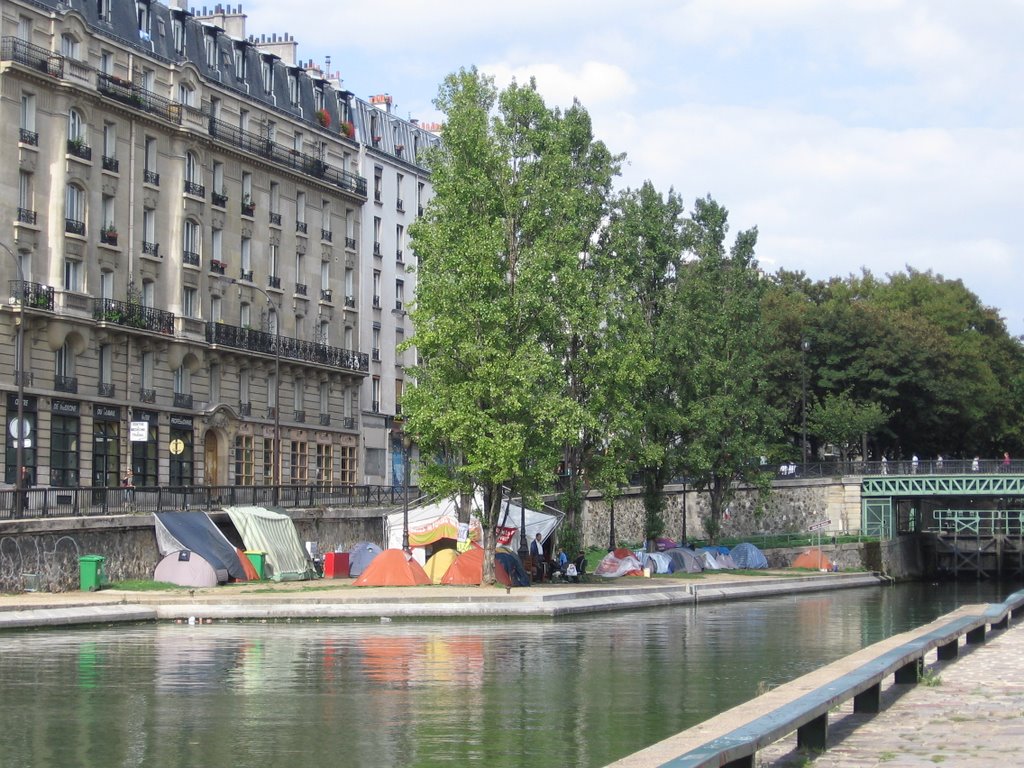
The film shows nothing of the banlieues, the tent cities that line the Canal Saint-Denis, the street protests and the problems facing the countries immigrants and minorities. There are many who feel that the country is run by a stuffy elite, all formed from the same mold who often fall into the trap of thinking that Paris is a true representation of France. There’s a pretty widespread sentiment that that very quintessential Paris inhabited by Amélie represents this stale situation and everything that desperately needs to be changed. To this end, to live in Amélie’s Paris is to be idealistic and naïve, to sweep the country’s problems under the rug – no matter how attractive and whimsical that rug may be.

For me, an outsider just listening and observing, I love living in the marvelous Paris of Amélie Poulain. I love walking through Montmartre in a skirt, buying baguettes at my local boulangerie, going to the open-air Saturday market, making eyes at cute boys on Vespas – all to the soundtrack of old-school Parisian street-corner accordian music that plays in my head.

This is fun and lovely while it lasts, this strolling and thinking how much I love living in this most magical of cities. But then I take a turn up Quai de Valmy, and spend 20 minutes walking by tent after tent after tarp after tent, spray-painted with messages like, Je vis sans toi (I live without any help from you) and a sloppily-scrawled survivant (survivor) across a small red tent close to collapsing under the wind. This is all it takes to jerk me back to that other Parisian reality – the one that exists in a combination of Amélie’s magic and all of the problems that are unceasingly present.

Real Paris:

07 February 2007

I’ve been terrified of my European Union final since the first lecture of the semester. After sitting through one Cours Magistral, I realized that it was completely pointless for me to be in the lecture – not only was the class held for two hours at 8 in the morning, I could not, for the life of me, understand the French of Professor DeWost. Going to my conférence only confirmed my assessment – none of the other international students got anything out of the lectures either. The man just mumbles, and there’s nothing to be done about it, aside from filling out less than favorable course evaluations.


Fortunately, the teacher of my conférence was very knowledgeable and a clear speaker, so I figured I’d get more out of paying good attention during her section classes on Monday afternoons. All was well until we found out that at Sciences Po, completely unlike the system at UW, you receive two separate grades for each course – one full, five-credit note for the conférence and one full, five-credit note for the lecture.

This is when I began to get even more apprehensive – I’d been going on the assumption that even if I blew the final, I’d have my exposés, débats, fiches and participation credits to balance out my lack of familiarity with the French system of oral examination. Apparently not. Instead, the final that I took for L’union européenne et droit communautaire would yield a full grade – and since that grade was based on a mere 20 minutes of assessment, I could very easily fail a five-credit course.

Fears grew even sharper among the international students when we learned the full format of the exam. Apparently we were each to receive an appointment time for an individual exam. Upon arriving at the site, we’d be called into a room to receive our topic and 20 minutes of tense preparation. After that, we’d go into another room to present a 10 minute exposé – yes those oral presentations that I’ve been preparing and giving all semester (but with days and days of prep time).

Everyone in my conférence emailed each other their notes for the entire semester, but still I had no idea what to study. The only advice I’d received was the not very reassuring (and kind of insulting), “Make sure to tell them your American (or from the programme international) so they know to expect less from you.” I read through the European Union’s website to remind myself of the functioning of the Parliament, the Council and the Commission; the ratification dates and objectives of each treaty and the demographics of the EU. I read the BBC’s European news coverage from the past week, but other than that, I didn’t know what to do. So instead of studying efficiently, I sat around and worked on giving myself a hernia.

To add to everyone’s stress about this test, the fact that individual exams had to be scheduled for each of the 300-some students in the lecture meant that for weeks after Sciences Po had posted the final exam schedule online, we were still waiting to find out when our appointments would be. We finally received an email from the sécretariat, with an attachment that would supposedly give us our assigned times. Instead it was an Excel chart with the names and email addresses of all the international students in the course. After many frantic mass emails were sent out, someone from the class finally emailed the sécretariat back, and on Monday we finally received our appointments. Mine was today, February 7th at 14h40.
When I arrived at the ENA building, I found out from the line of classmates waiting in chairs outside of the preparation room that exams were running late. Like everyone else, I pulled out my class notes, but instead of reading them I stared blankly at the opposite wall, feeling my legs and hands twitch rhythmically.

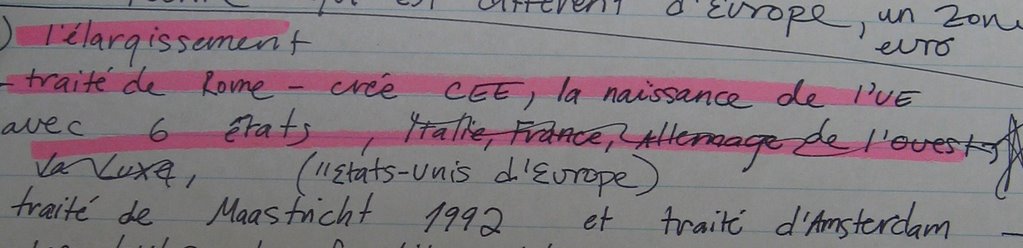
I was finally called into the salle de préparation at about 15h10. I presented my student card to the woman overseeing the preparation time, signed my name on a contract stating that it was really me taking my exam, and she offered me two manila envelopes. From each envelope I was to select a strip of paper with an exposé topic on it, choose the one that interested me and return the other. My two options were l’élargissement et approfondissement de l’union européenne (the enlargement and deepening of the European Union) and le processus juridique entre l’union européenne et les états-membres (the legal processes between the European Union and its members).

I grabbed the slip about l’élargissement and ran to a desk as I was already down three minutes of prep time. Since this was supposed to be a formal presentation, not an interactive examination, I needed some kind of coherent structure, not to mention a problématique and a thesis, so I sketched out a sloppy outline and begin writing down everything I could remember from the week we’d discussed the EU’s enlargement and any other useful information I could come up with.


After twenty minutes of frantic scribbling, I was escorted into the actual examination chamber. I shook hands with the examiner, signed another contract and began to argue my thesis, that enlargement, rather than being a detriment and complication to the EU was a necessary project to not only unify Europe, but inspire a greater confidence in the power of the EU by not only its citizens, but outside countries as well.

While I’m not sure my actual presentation made any sort of sense organizationally, I had a thesis that, if not always being completely logically supported, was strong and I finished with a solid conclusion. I also pulled out some of my old International Studies written exam techniques and threw as many hard facts into the presentation as I possibly could – so that even if my on-the-spot French and exposé were at times shaky, the examiner would at least know that I’d attended class and knew what I was talking about. I hit a rough spot when I stumbled before remembering that the newest additions were Romania and Bulgaria, but hopefully made up for it by discussing the Bolkestein Directive and quoting Jacques Delors and Winston Churchill (when he called for a “United States of Europe”). I even found a way to work in the article I’d read just before my final, about the busting of a child pornography ring in Austria.

My examiner followed up with a few questions about the relationships between the Commission, Council and Parliament, and whether the judicial system of the EU could be compared to that of the U.S., which I answered adequately, if not brilliantly. My final question was something along the lines of “what do I want to be when I grow up,” so we spoke for a few minutes about journalism and whether or not there would be any demand for an American foreign correspondent whose specialty was French politics. We came to the conclusion that, as horrid and convoluted as it is for us non-Europeans to learn, my best bet is to stick with my studies of the European Union.

As I left the exam, my legs were shaking so badly I could barely walk up the stairs, but I managed to tell a German friend from my class that he’d be fine. When my muscles finally began to relax, I treated myself to a pastry from my boulangerie (whichever neighborhood boulangerie you shop at the most automatically becomes “yours” when you’re describing it to anyone else) and couldn’t think anything but “I survived!” Now all I have to do is make it through one more marathon night of studying for my three-hour essay test on contemporary French politics tomorrow morning.

04 February 2007

Something I’ve noticed a lot, living in Europe, is the fact that as a people, we Americans are really quite conservative. After five months in France, I’d like to think that I’m mostly used to the freedom of sexual expression that is so different from the taboos and behavioral expectations back in the United States – but every once in a while I’m still caught off guard.

The first thing you notice in France is the pub, or advertising that is often blatantly sexual and is pretty much everywhere. From naked women on billboards, to a TV spot for instant coffee that borders on soft core pornography to the infamous egg billboard, sex is everywhere you look, with a hand in nearly everything you buy. You can turn on the TV at 16h and see naked people (which you definitely can not in the U.S.), sex in movies is more frequent and less of a deal, and posters advertising porn websites or hotlines fill the windows of most tabacs and presses.


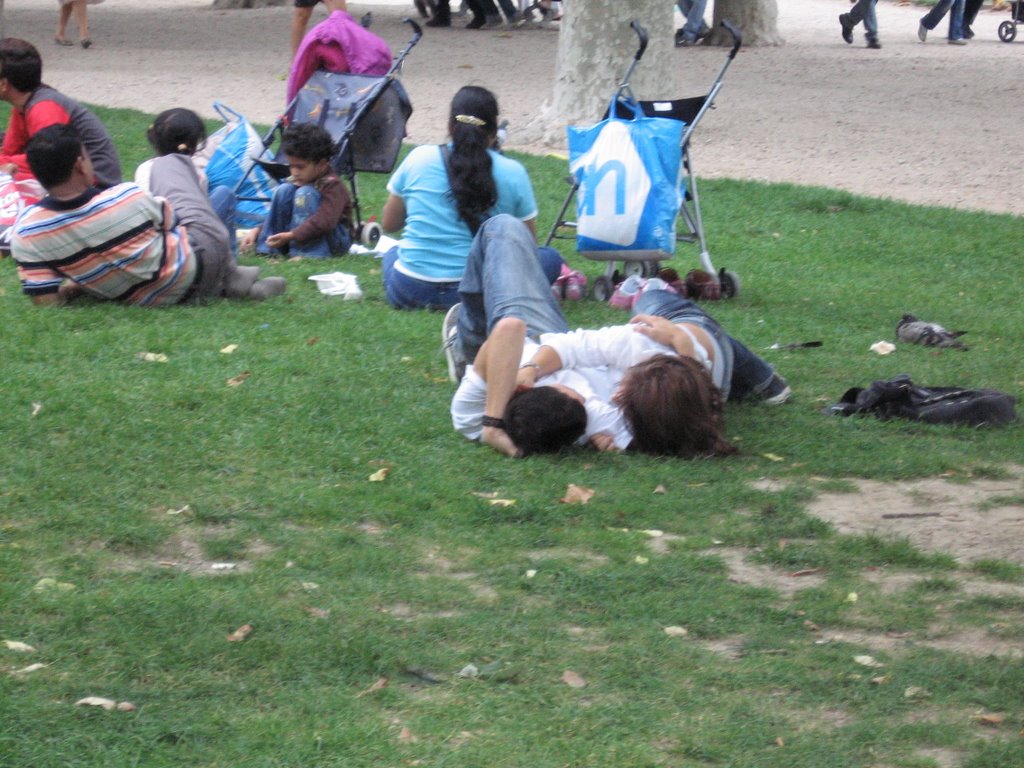
Sex in France isn’t limited to the media – stroll across any bridge crossing the Seine, or wander through any park in the city and you’ll probably see enough action that you can save your money on those adult websites. It isn’t uncommon to see a couple making out horizontally in the grass, or feeling each other up as they lean against the wall of the Pont Neuf or Pont des Arts.

(Like this couple, who seemed close to undressing each other, surrounded by families having picnics in the Champs de mars below the Eiffel Tower).


It’s surprising for me, a girl from a pretty liberal area of the United States, to witness all these public displays of affection, sexy billboards and intense TV ads, but for the French who see them day in and day out, the presence of sex in mainstream society is old hat. Sexuality is so integrated into everyday life here that Printemps, a major department store like Galaries Lafayette, Nordstrom, Sak’s or Macy’s features a plaisir section.

Even for someone who may not be versed in the French vocabulary for lovemaking, plaisir is pretty easy to figure out. Last Wednesday I was wandering through the sous-sol (basement) level of Printemps, checking out the soldes, when my attention was caught by a long counter with a sign reading simply Plaisir. I couldn’t see any of the items on the counter, as it was surrounded by a low wall to keep anything from falling off, so I walked over to check it out.

Apparently, the pleasure section is exactly what you’d imagine. There, sandwiched between the Christian Dior and Christian Lacroix lingerie departments was the sex toy section of Printemps. In addition to dildos, lubes, vibrators and furry handcuffs, the display also contained a book section. The Kama Sutra (in French) a “position playbook” (in English) and a French book about achieving female orgasms were among those featured.

Being an American and completely surprised to find such a section in the middle of a department store in the 9ème arondissement of Paris, my cheeks were burning as I examined the contents of the table. The French women hitting the sales however, were completely unsurprised, and either walked by without a second look, or walked over to the table to unashamedly handle the toys. While I feel like I’ve gotten quite used to the sexed-up culture over here, I was really not expecting to find plaisir during my casual browsing, and couldn’t help but imagine the reaction if Macy’s or JC Penney’s was ever to begin stocking vibrators alongside their make-up, shoes and towels.


The progressive attitude here isn’t limited to the explicitly sexual. For every erotic TV ad, there’ll be another billboard that features nude people but is completely un-erotic. For the French, it’s okay to be a sexual person – but it’s also okay to appreciate the human body for what it is, without a display of nudity having to be overtly sexual. Kids learn about their bodies at an early age, and there is no shame associated with nudity or sexuality – which seems to be the complete opposite of trends in the United States.

Check out this book on the human body for young children, for example. The nanny family owns two copies, one in French and one in English (so the kids learn the appropriate vocabulary in both languages). Notice anything bizarre? In the French version, you actually see the entire body, and learn the real word for each body part – including la sexe. In the version published for U.S. consumers, however, every single child wears a pair of white underpants – even the babies are covered up, and while there are arrows pointing to the stomach, the belly button, and the waist, there’s a big gap in the middle of the body before jumping down to the legs and the knees. Disturbing the difference, isn’t it?


The result of the openness here is that everybody is incredibly comfortable with themselves and sex in general. While everybody may have an inkling about Jacques Chirac’s sexual indiscretions, nobody cares – it’s his decision and his business and his sexuality has nothing to do with his ability (or perhaps lack thereof, based on more recent public opinion) to govern the country. If the U.S. adopted an attitude that was anything similar to that of France, Bill Clinton and Monica Lewinsky would have been the last thing on anyone’s mind – and nobody would even know who Kenneth Starr was. The infamous Janet Jackson boob slip at the Superbowl would have been so insignificant that it would have been forgotten the next day. Looking back at the States with my new French goggles, we seem pretty ridiculous. Who protests a breast? It seems like a joke, but I guess we are the joke.

It’s rather invigorating to be living in a country that is so open about its sexuality. The whole atmosphere just seems so healthy – nobody’s growing up with shame or confusion about their bodies or feelings. It’s so much easier for people (particularly teenagers) to make decisions about their bodies and their sexuality when they have a plethora of information that nobody’s trying to stifle. Twenty years of growing up in a country with institutions like the FCC has apparently rendered me a bit more conservative than I’d like to admit. While I really admire the freedom of sexuality here, I still tend to blush when I find things that surprise me, which embarrasses me to no end. I don’t want to be the American who blushes at sexy commercials! Maybe after a full year of expatriotism, I’ll have trained a slightly cooler response – or at least have figured out how to keep the blushing to a minimum.


•••• This has nothing to do with sex, sexuality, nudity or conservatism, but the idea of a Che Guevara bellybutton ring really cracked me up. What better way to honor a symbol of revolution than to put him on a charm and stick him through your bellybutton?

29 January 2007

As I often lament, for all my obsessive printing out of entire fashion week schedules, “casual” walk-bys of the Ritz, the Georges V hotel, and strolls up and down the rue Saint Honoré (a celebrity-sighting hotspot for all the high-end shopping), I am really not very good at celebrity stalking.

Every fashion week, I study and print out the fashion week schedules, and wander around the outside of the École des beaux arts near Sciences Po or the Grand Hôtel near place de la Madeleine, hoping to spot, if not celebrities, than some really tall chic models. R and I compulsively check Pink is the New Blog to find out which celebrities might currently be wandering around Paris, and lurk around the nicest hotels and most expensive designer boutiques.

Last weekend it was Beyoncé, Jennifer Hudson and Eddie Murphy, here for the French premiere of the movie Dreamgirls. Last week it was Victoria Beckham, Katie Holmes and Anna Wintour, here for the haute couture shows.

For an International Studies major and admitted nerd, I am hyper-aware of Fashion Week. Errr, make that fashion. I refuse to buy Diet Coke in Paris because it’s too expensive (1 euro 30 for a bottle!), but I’ll gladly shell out eight euro for an imported last month’s American Vogue – and then buy the British and French issues as well.

My favorite thing to do on a Sunday evening is walk along the rue Saint Honoré, from the avenue de l’Opéra to the beginning of the embassies, not exactly window shopping (when am I ever going to be able to afford a John Galliano slip dress?), but window gazing. I hit up Chanel, Miu Miu, John Galliano, Dior and everything in between to soak up the window displays. During Fashion Week, I make the same rounds, but instead of checking out the mannequins, I’m peering beyond them to see if there’s anyone famous in the store.

During Fashion Week, instead of walking straight down avenue de l’Opéra and through the courtyard of the Louvre, I walk down rue de la Paix and through place Vendôme, home of the Ritz hotel – to absolutely fruitless results. So far, my celebrity log includes one moderately well-known French tv actress I’d never heard of, a random footballer from FC Barcelona, who I’d never heard of, and a mad paparazzi rush to stalk some American actress (I couldn’t see who) in Le Voltaire, a restaurant across the Seine from the Louvre.

Yesterday I finally began to understand where I was going wrong. Apparently my stalking efforts were entirely misplaced, because the first thing Zoé said when she got home last night was “I saw that guy with the big nose again.”

I was doing the kids’ dinner dishes and kind of laughed and asked what she was talking about, thinking something along the lines of “Haha, 12-year olds…”

“You know, that actor with the big nose – he’s French, he’s in a lot of movies?” This is where I finally paused in my dishes to look at her. “You mean Gérard Depardieu?”

Yes, she meant Gérard Depardieu – one of the few French actors who has mostly made the crossover to mainstream American pop culture. His one disadvantage is not being a gorgeous woman – if he happened to resemble Audrey Tatou or Juliette Binoche, he might be even more familiar.

Apparently, Gérard owns the restaurant right around the corner from my building, Le Petit Gaillon. Apparently he’s always wandering around right in my neighborhood, checking on his restaurant – the restaurant that is directly across from the boulangerie where I buy my bread every few days. Apparently, I am a terribly inobservant person. How many times might I have passed by him already, too focused on the taste of my still-warm baguette to look around me?

This is kind of ridiculously embarrassing. I really am the world’s most inefficient stalker, wasting my time patrolling rue Saint Honoré, place Vendôme and rue Georges V. Not to mention the fact that a Gérard Depardieu sighting would be a much grander coup than a sighting of Posh Spice or the like.


••• Pictures of Le Petit Gaillon to come, check back!

27 January 2007

Getting dressed this morning, I chose my outfit carefully. I don’t have huge plans for the day – just babysitting, doing a little apartment cleaning and then meeting some people at a bar in the 11ème for drinks and couscous. While the bar is chill and nobody really dresses up to go there (well any more than French people usually dress up just to live their lives), it is still a Parisian bar – which means you’re likely to be sitting in a cloud of stale smoke for upwards of an hour or two, which in turn means choosing your clothing wisely.

Even when the temperatures are measuring below freezing, I won’t put on a sweater – sweaters are a pain to wash and the wool sucks up the smoke like a vacuum. Some places aren’t so bad – clubs, for example, are still smoky but most have fairly high ceilings so it’s not a big problem. Chez Georges is one of the worst places for smoke – you won’t stop reeking until you’ve showered at least twice and you probably won’t stop coughing for at least 24 hours. It’s also one of the most happening bars for students, so sometimes you just have to suck it up, make sure your inhaler’s in your purse and be prepared to wash all your clothing the next day.

Tonight though, we’re going to Tais. Tais isn’t so bad – I’ll need to hang up everything I’m wearing and let it air out for about a day, but it’s pretty inoffensive as far as smoky bars go.

That’s just Paris though. Everywhere you go you expect to be surrounded in a cloud of smoke – or at least you did five years ago. As difficult as it is for a girl from the clean air of Seattle and its notorious but appreciated smoking ban, even I have to admit that the second-hand smoke problem is far better than it was either of the two previous times I’d been to France.

Smoking kills. Also a common warning label is the Smokers die prematurely.


Just in the past few years a small number of non-smoking restaurants have begun to crop up around the city – this is a huge deal for Paris. Some restaurants have been offering non-smoking sections for longer, but a French non-smoking section is usually just a few tables without ashtrays.

I still inhale quite a number of exhaled carcinogens, but the Paris of today is a far cry from the old thought that “all French people smoke.” When I was staying near Bordeaux in 2002, 16-year old friends of my host sister would stroll into Isabelle’s house, roll up a quick cigarette from their bags of tobacco, grab one of the parents’ ashtrays and start puffing away.

A few weeks ago though, I went out with a boy to celebrate the fact that after being a smoker since he was 16 (he’s 20), he hadn’t had a cigarette in a month, and was really excited about quitting.

Some of the other tenants in my building are pretty obnoxious smokers – sitting on the steps in the courtyard so everyone else is forced to walk through their clouds of smoke to get in and out of the building, or even smoking in the elevator. Given the size of the average elevator in Paris, this is just disgusting, but it’s a long ways from walking down the street and feeling like I need to keep my inhaler out and at the ready.

One particularly interesting development in the smoking culture of the French came in the form of a weekly Sciences Po e-newsletter. Beginning February 1st, all buildings and courtyards of the campus will become completely smoke-free. This is kind of a huge deal – most of the lycées (high schools) have student smoking areas, and of Sciences Po’s two cafeterias on the main campus, one is the “smoking cafeteria.” On any given day, even the sub-zero temperature ones the courtyard between the two main buildings is filled with students grabbing a smoke.

At the beginning of the year, there were actually a few times I thought it might be easier to meet people if I started smoking – it’s very social at Sciences Po. The thoughts only lasted for a few moments – then my asthma brought me back to reality.

I feel like the climate of France is in the process of changing – one of the oldest and truest stereotypes about the French is that “everybody smokes.” But not for long – the times are changing. Maybe in a few years I could even wear a sweater to go out for drinks…errrr, or a few years after that.

20 January 2007

Today I watched a girl climb out of the metro at Étienne Marcel to the soundtrack of the Clash (album: London Calling). She was in my subway car, and I noticed her first for her extremely chic and Parisian coat before I ended up following her out through the turnstile and out of the station.

I was listening to music on my headphones, and thinking only of what I’d make for dinner later as I exited the metro, not paying a great deal of attention to my surroundings. But as this girl reached the top of the staircase, she broke into a huge grin as she spied what she’d been looking for and flew into the arms of her waiting boyfriend.

Surprisingly (to me, anyway), their reunion did not erupt into that infamous spontaneous Parisian make-out session. Instead my girl from the metro recieved an enormous hug that engulfed her, lifted her chic French feet right off the ground and said “I am so glad to see you. The sweetness of the scene put me into quite a good mood. It was kind of like the beginning of the movie Love Actually, with the arrivals gate at Heathrow airport – though this analogy apparently makes me Hugh Grant, which I’m not completely sure I’m comfortable with.

In the city of love and the extreme public display of affection I find it rather funny that instead of the joyful embrace on rue de Turbigo near les Halles, I get the awkward encounters with the boys I really don’t want to be encountering as I make my way through the 7ème arondissement.

I mean honestly. I really feel that Paris is a large enough city, and I am still enough of a foreigner that I really shouldn’t be running into anyone I know, much less three boys I’d either dated or had some sort of history with in the five short months I've been living here. I’ve only been back from the U.S. for two weeks, and while the first was pretty uneventful, I’ve managed to encounter all three of these rather awkward boys in various parts of the city since last Sunday.

First there was the run-in at the Centre Pompidou. Sunday afternoon Rachael and I, thinking we’d accomplish more in a library than in either of our apartments, packed our school bags and waited in a two hour line just to enter the library. (Yes, I know this is ridiculous – but not only is the Pompidou’s library catalogue the most comprehensive in the city, it is also really the only place to do work on a Sunday.) Approximately 10 minutes after finally making into the library, I felt a hand on my shoulder and turned to behold the boy I’d been off and on dating since October – and still hadn’t had the French version of the “I can’t date you anymore” talk with (partly due to my laziness, but mostly because I've been too busy with school to see him, and can't bring myself to do the deed through a French text message).

The second boy I’d only been on one date with before deciding I’d rather just not return his phone calls. Luckily, I spotted him coming from down the street and was able to behave like an immature fool and run in the opposite direction down a little side street. A little disturbing to me, being that I'm 21 and living on my own in France – shouldn't I be beyond the eighth-grade reactions by now?

The third, though, was Thomas. Yes, the one who upon hearing the “I don’t want to date you anymore” speech lectured me for being a “heartbreaker” and told me that he doesn’t just kiss any random girl. This was the first time I’d even seen him since the most awkward evening of my 21-year life, and it was just as uncomfortable as the last time I’d seen him. Luckily I was standing with a group of French friends in the St-Germain Monoprix, so I just blushed and grimaced at him (I promise I tried to smile – it just didn’t work out).

It’s true that everyone has the awkward encounter with an ex stories, but I really feel that three of them in less than a week (in Paris, of all places), is quite excessive. The Thomas encounter unfortunately happened right after the reunion at Étienne Marcel, so as determinedly as I tried to think of the smiles of the metro girl and her boyfriend while climbing the stairs of my building, it was impossible. Instead, I just blushed and cringed, enjoyed the smell of burned out candles from my neighbors’ dinner party, and felt that three awkward moments were surely a fair trade for at least another month of French boy drama-free days.

19 January 2007

Yes, it's been rather windy in Paris the past few days. Though I just thought I was hearing particularly loud gusts because I live at the very top of my building.

16 January 2007

So it’s two weeks before finals start at Sciences Po – and nobody has any idea what’s going on. For the past several weeks we’ve been asking our conférence teachers to explain our finals to us, but after half an hour of explanation today by one of them, none of us (in the programme international) is any closer to understanding.

This is what we’ve got: each Sciences Po class is apparently worth 10 credits rather than the five any U.S. university would assign to a course that consisted of a lecture and a conférence (similar to a quiz section). The scary part is that rather than have a grade that’s an average of the work each student has done over the semester and their grade on the final exam, each grade sheet will reflect two separate grades – one for the conférence, where notes are cushioned by exposés, dissertations and class participation done throughout the past five months. One grade, however is based entirely on the final exam. That’s right, five entire credits are dolled out or withheld based on each student’s performance on a 10-minute exposé during finals week.

That’s the other scary part – the actual format of the finals. A group of us from the programme international were talking in class today (the conférence for La vie politique française d’aujourd’hui) about how in the U.S., you know on day one of the semester when your final will be, what it will cover (be it comprehensive or midterm to final) and what the format will be. At Sciences Po the information is just beginning to trickle down to us, the foreigners.

This has nothing to do with finals, but I rather liked this truck (found in the 19ème arondissement):


Though we’d speculated before on the degree of difficulty of finals at France’s elite school of political science, we hadn’t given a lot of thought to the format – how different could a final on the continent be from what we’re all used to? The answer is quite. We do have a “finals week” at Sciences Po, but at the moment the only finals scheduled are for the masters students. The rest of us are waiting to find out when and where our exams will take place. How will we find out? We have no idea. All we got out of our maître de conférence was that we would, at some point before we’re supposed to show up for it, be assigned an individual exam time for each of our classes.

When we receive our exam assignment, there’s nothing to do but prepare as much as we can – which for my European Union class means that we will all be doing everything we possible can to finally understand this freak political entity, but will most likely not succeed at this. I think the main thing I’ve gleaned from this course is the fact that the EU really is an objet politique non-identifiée, a play on the acronym OVNI, the French version of UFO. Think “Unidentified Political Object.”

When exam day arrives, each of us will arrive at our appointed examination room at our appointed hour, and receive two questions or theses. We then have an hour to prepare a 10-minute exposé on one of those topics, using no resources but the knowledge we’ve acquired over the semester. When the hour is up, we must argue our thesis for 10 coherent minutes in front of anywhere from one to several examiners. After 10 more minutes of exposé-related questions from the examiners, the final is over – and we are left to chew our fingernails to their quicks until grades come out and we find out just how terrible a grade for five credits of lecture can possibly be.

At the moment though, everything is still completely up in the air. We don’t know when our finals are, we don’t know what they’ll cover, we don’t know how to prepare and we have no idea what kind of grades to expect (er well, aside from the fact that we’re expecting low ones). All I have to go on is the fact that my maître de conférence of my EU class doesn’t think that any of us are likely to completely fail the five credits. That assurance really does nothing for my mental state right now.

10 January 2007

On my way to the 11ème this morning, I had the wild idea in my head that I might just walk away from my visite médicale with my carte de séjour in hand. Had I not spent the past two weeks in the United States, I might have remembered that France isn’t exactly a country in which it’s easy to get things done. Assertiveness, sharp negotiation skills and even outright pushiness will get you nowhere here. Efficiency is not a trait I would attribute to any institution in France – be it Sciences Po, the government or the RATP (the organization of the metro, buses and trains within Île de France).

The carte de séjour is a residency permit you are obligated to apply for if you will be living in France for longer than three months. You can be eligible for residency for a number of reasons – marrying a citizen, being recruited for work by a French country, going to work as an au pair for a pre-arranged family, or studying at a school in France. You can’t just up and move to France to find a job or whatnot – you have to have a plan and designated entry and exit dates.

The difficulty in getting a carte de séjour is that you have to apply for it once you’re actually in France. You can apply for a long-term visa (three months, maximum) from the U.S., but it’s supposedly only good for one entry into the country (although I never had a problem returning from trips), and you have to apply for your carte de séjour immediately upon arrival.

The problem with France is that to get anything important done, you usually need to deal with about three different people in three different locations – and they don’t usually have any idea what their counterparts are doing or saying. For example, the Préfecture de police provided Sciences Po with a list of required documents for the carte de séjour, which they then mailed out to us. An officially translated birth certificate, for example, which was not only expensive, but also turned out to be quite an adventure to obtain.

When R and I went to the Préfecture de Police, they informed us that the site had moved and sent us to an address in the 15ème arondissement. When we arrived there, however, we found that we could not apply until we had permanent addresses and bill receipts – our letters and receipts from our hotel were not valid (although we had been told that they would be). When we returned a second time, we found out that Sciences Po has a special office for processing the cartes de séjour, and we were supposed to turn everything in there.

The woman at Sciences Po was incredibly helpful and got everything sent off for us – at which point there was nothing to deal with until we received our dates for our visites médicales.

January 10th at 10h30 was both Rachael and my appointed time, so we arrived early at the Délégation with shot records, medical histories, our birth certificates and stamps (yes, like postage stamps) that served as proof that we’d paid our 55 euro residency taxes.

After checking in, we were ushered to a full waiting room, where we were called one at a time to go wait in another waiting room. From there, we were called one by one into a third room, where we were weighed, measured and had to read eye charts. We were then asked if we were pregnant, and if not, formed a line into a hallway with four doors. One led back out to the waiting room and the remaining three were dressing rooms. We entered the dressing rooms individually, stripped to the waist and were called into an x-ray room that connected to the other end of the changing rooms.

We were then x-rayed (chests only) by a male and female doctor and sent back out to the waiting room. There we waited again, this time to be called on by individual doctors. Mine was more interested in my iPod and practicing his English on me than in doing any kind of actual exam – he ended up just taking my blood pressure, asking about any medications I’m on, giving me my lung x-ray (“It’s a present, for Christmas!”) and sending me on my way.

R and I were then sent to an office of the Préfecture de Police housed in the same building, where we found out that we should be able to get our cartes, but surprise surprise, the machine is broken. We have to return on February 16th to finally obtain our residency permits (just six months after arriving in France), which is a good thing because my visa expired in mid-November – I guess I’m an illegal resident.

I’m not going to get my hopes up though – if you expect to be able to accomplish things, you’ll only be disappointed.
It’s the second Tuesday of 2007, and I’m back in my little apartment in Paris from a two week vacation. Christmas is officially over.


Rather than vacationing in the South with the nanny family, which was alluded to several times, and blatantly lied about several other times, I flew home to Tacoma for a surprise visit. Well, it wasn’t a complete surprise – my family obviously knew that I was coming home – it was my parents who paid for the round-trip ticket (to Paris in August, back to SeaTac in December) after all.

I managed to pack quite a few friends into the short two weeks I got to spend at home, but there were still quite a few people I’d intended to call and just didn’t have a chance to. I only had 15 days – I had to budget my time very carefully, to eat the maximum amount of pho and Mexican food, bake as many chocolate chip cookies as I could fit into the family supply of Tupperware, drive a car for the first time in four months, and hang out with the family as much as possible.

Though I’d expected to feel weird about being back in Tacoma for such a short time, it felt completely natural – especially since the vacation was packed full of the things I always do in Seattle. I went to PNB’s The Nutcracker with my grandparents, cheered at a Stadium swim meet, helped out in the Seabury School library, got dinner on the Ave and hung out with both Tacoma and Seattle friends.

Like I said, it was totally natural to be home. The weird thing is being back in Paris. I think part of the strangeness is the fact that this Christmas was particularly eventful. Wilbur (the family dog) was hit by a car and killed two days before Christmas, which definitely shook things up. Ben is waiting to hear back from a few schools he’s already applied to and is in the midst of the rest of his college applications. My dad is trying to write and publish a book. We threw a party (we’re not generally a party-throwing family). I decided to forsake all of my overly-amorous French boys and try a (really really) long-distance thing for the rest of the year (though I still need to have a talk with one of the boys I’d been kind of casually dating since October – I’m getting really good at giving the “I don’t want to date you” speech in French by now). It was a busy vacation.


Sunday though, I packed up my bags again (this time laden with peanut butter, contact solution and American candy for the nanny kids), and after two planes, a six-hour layover in Amsterdam, two pieces of lost luggage, a train and metro ride, I was back home. This is the really weird part – I feel like I just stopped in to visit Seattle life for a while, but now that I’m back in Paris, I’m back in my real life – everything else that happened in the past few weeks seems like it belongs to someone else’s memory.

Unpacking, yet again:


The truth is that I don’t live in Tacoma or in Seattle – I live in the 2ème arondissement of Paris, France, and I feel completely at home here. I’m back in my apartment, on my street (although I was disturbed to see that a new restaurant has appeared across the street from me – Paris wasn’t supposed to have changed in only two weeks!), and after sleeping for 14 straight hours in my bed, I went shopping at my local Franprix, to restock my kitchen.

I’m back to the life where I walk through the courtyard of the Louvre everyday to get to school, where I have a year-long membership to the Pompidou Center, where we go out for a drink at 23h on a Tuesday night. I’m back to the life where I buy my bread, produce and groceries in three separate locations, and have to dress up before I leave my apartment to go shopping for them.

I feel like I don’t know where I live anymore – do I live in Tacoma, Paris or Seattle? It feels so weird to “visit” my house in Tacoma – but at the same time it’s so normal that it’s weird to feel as settled as I do, living alone in Europe at the age of 21. I don’t know if that’s something I’ll ever figure out though. I guess the plan is just to enjoy where I am while I’m there and not worry so much about everywhere else. It’s 2007, after all – and I’m in Paris!